Where Does AI Get Its Info: How AI Uses Data
Introduction
For people in the United States, the short answer is this: AI gets information from data used to train its model, information supplied during a chat, and—when enabled—outside tools such as web search or company databases.
An AI system does not “know” facts in the same way a person does. It learns patterns from large collections of text, images, audio, code, and other data. It then uses those patterns to predict a useful response.
The exact sources depend on the AI product, its model, its settings, and the task you give it. Some answers come from training data. Others come from live sources. Some may be wrong because the system fills gaps with a likely-sounding answer.

The Three Main Sources of AI Information
Most modern AI systems draw information from three broad sources:
- Training data
- Your current conversation or uploaded files
- External tools and connected data sources
These sources work in different ways. Knowing the difference helps you judge whether an AI answer is likely to be current, private, or reliable.
1. Training data
Training data is the large collection of examples used to build an AI model. Depending on the model, it may include:
- Books and other published works
- News and magazine articles
- Public websites
- Government documents
- Academic papers
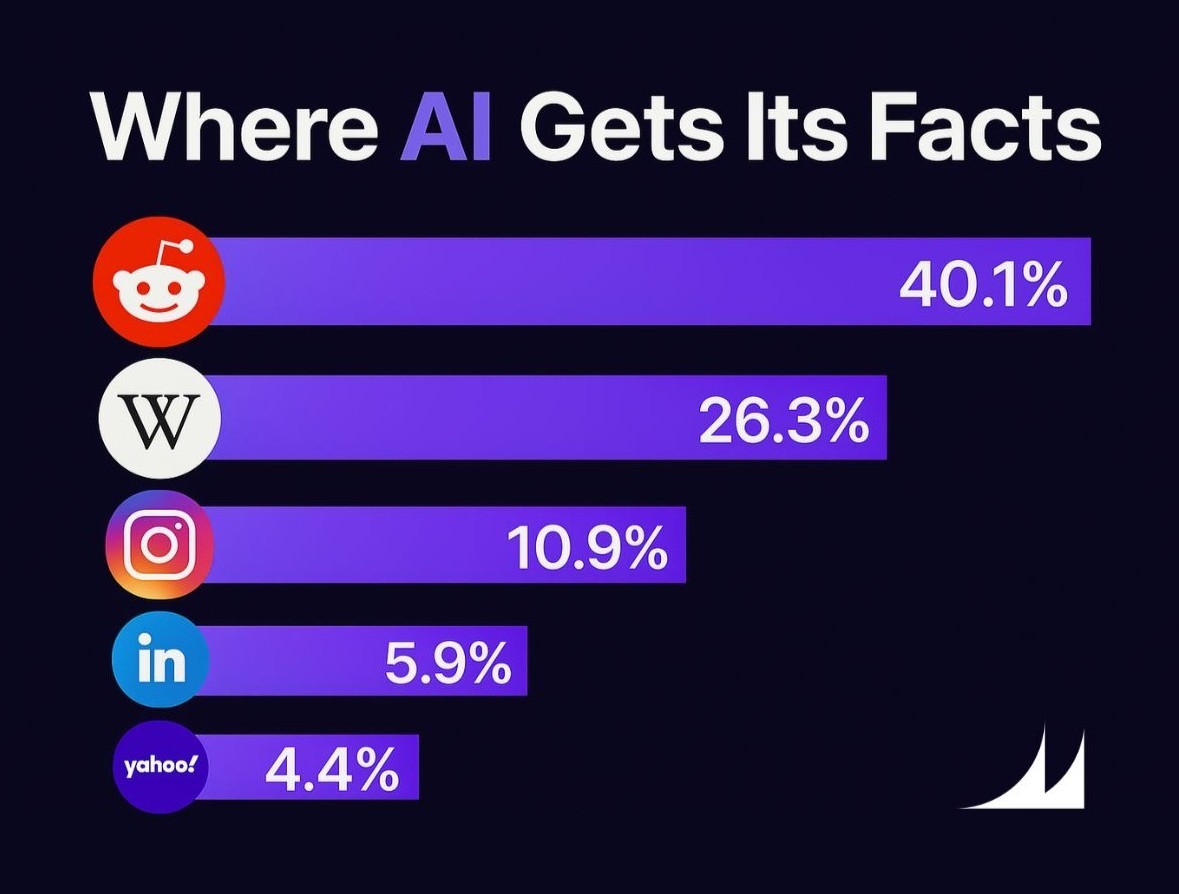
- Public discussions and forums
- Software code
- Images, audio, and video
- Licensed or purchased data
- Data created by human reviewers
The exact mix is often not fully public. AI companies may describe broad data categories without listing every website, book, or file used.
For example, the Common Crawl project collects public web pages and makes datasets available for research. Such web archives can be used as one source in AI research, but the presence of a page in a web archive does not prove that a particular AI model used it.
2. Your current conversation
An AI system also uses the information you provide during a session. This may include:
- Your questions
- Earlier messages in the same chat
- Text you paste
- Documents you upload
- Images you submit
- Instructions about tone, format, or goals
This information gives the model context. If you ask, “What does this contract mean?” the AI can examine the contract you provide. It is not necessarily retrieving that contract from its training data.
Whether a company stores or uses your conversations for later model improvement depends on its product and privacy settings. Policies differ between consumer, business, education, and developer accounts. Always check the specific service’s current privacy policy.
3. External tools and live data
Some AI tools can connect to outside sources. These may include:
- Search engines
- News databases
- Weather services
- Maps
- Stock or market data
- Company knowledge bases
- Customer support systems
- File storage services
- Scientific databases
- Software tools and calculators
When an AI system uses one of these tools, it may answer with newer information than its original training data contains. However, the tool may still return incomplete, incorrect, or poorly understood information.
A chatbot with web access is not the same as a model that automatically knows everything on the internet. The system must search, receive results, interpret them, and use them correctly.
How AI Learns From Training Data
AI usually learns through a process called machine learning. For language models, the system studies many examples of written language and learns statistical relationships between words, phrases, ideas, and formats.
A simple example looks like this:
“The capital of the United States is…”
A language model learns that “Washington, D.C.” often follows this phrase. It does not store the sentence in the same way a database stores a record. Instead, training changes the model’s internal settings so that some patterns become more likely than others.
Pretraining
During pretraining, the model processes a very large dataset. It may be asked to predict:
- The next word in a sentence
- Missing words in a passage
- A description of an image
- The next part of a piece of code
- A suitable response to an instruction
The model makes a prediction, compares it with the training example, and adjusts its internal parameters. This process happens many times across a large number of examples.
Fine-tuning
After pretraining, developers may further train the model to follow instructions. This stage can help the system:
- Answer questions in a clearer way
- Follow requested formats
- Refuse some unsafe requests
- Stay on topic
- Use a more helpful tone
- Work with specific types of data
Human reviewers may help rate or compare sample answers. This feedback can guide the model toward responses that people find more useful. It does not guarantee that every answer is accurate.
The model does not work like a search index
A search engine usually looks for documents that match a query and then ranks them. A language model usually generates text from learned patterns.
This difference matters:
- A search engine can point to a source.
- A language model may produce an answer without showing its source.
- A search result can be checked against the original page.
- A generated answer may sound certain even when it is wrong.
Some AI systems combine both methods. They retrieve documents first, then ask a language model to summarize or explain them. This approach is often called retrieval-augmented generation, or RAG.

Does AI Get Its Information From the Internet?
Sometimes, but not always. The answer depends on the product and the mode you are using.
An AI model may have been trained on some public internet data. That does not mean it can browse the internet during every conversation. Many AI systems answer from their existing model unless a search or retrieval feature is active.
Offline or model-only answers
A model-only answer comes from the model’s learned parameters and the information in your prompt. It may not know:
- Today’s news
- Current prices
- Recent court decisions
- New product versions
- Local weather
- A website published after its training period
The model may still answer such questions. Its answer could be outdated or invented.
Search-assisted answers
A search-assisted system sends a query to a search tool or database. It then uses the returned material to form an answer.
This can improve freshness, but it creates new risks. The system may:
- Search for the wrong terms
- Select a weak source
- Misread a page
- Mix old and new information
- Treat an opinion as a fact
- Omit key details
- Cite a page that does not support its claim
For current or high-stakes information, open the source yourself. Check its date, publisher, evidence, and relevance to your situation.
Why an AI may know obscure facts but miss recent ones
Training data can contain older, specialized material. A model may explain a historical topic well but fail to answer a question about a law passed last week.
That is not a contradiction. The model’s strength depends on the data it received, the way it was trained, and whether it has access to current sources.

What Types of Data Do AI Companies Use?
The data used by AI companies can come from several categories. The boundaries may overlap, and companies do not always disclose every source.
| Data category | What it can include | Main limitation |
|---|---|---|
| Public data | Public websites, government pages, open papers, public code | Public access does not always settle copyright or quality issues |
| Licensed data | Material used under a contract or permission | License terms may restrict how the data is used |
| Human-created data | Examples, ratings, edits, demonstrations, and evaluations | Review quality can vary |
| User-provided data | Prompts, files, feedback, or account content | Use depends on product terms and privacy settings |
| Synthetic data | Data generated by another AI or a rules-based system | It can repeat errors or reduce variety |
| Private organizational data | Internal files, manuals, databases, or support records | Access controls and data quality matter |
A model may use a mixture of these categories. One model may rely heavily on licensed content, while another may use mostly public and human-created data.
Public does not mean accurate
A public website can contain excellent research, personal opinions, outdated claims, advertising, or false information. If an AI model learns from a broad web dataset, it may absorb patterns from all of those sources.
Training does not act as a perfect fact-checking system. The model learns what language patterns appear in the data. It does not automatically determine which claims are true.
Public does not always mean free to reuse
In the United States, copyright law and AI training remain active areas of legal debate. The U.S. Copyright Office’s reports on copyright and artificial intelligence discuss issues such as training, copyrighted works, and generated content.
A document being available online does not by itself answer every legal question about copying, training, or reuse. Legal outcomes may depend on the facts, the license, the use, and current court decisions.

Can AI See Your Personal Information?
AI can process personal information that you provide or that an authorized connected service makes available. It should not be assumed that an AI system knows private facts about you simply because it is powerful.
Personal information may enter an AI system through:
- A prompt
- An uploaded file
- A connected email or storage account
- A business database
- A support ticket
- A browser or application integration
- Account details collected by the service
The system may also infer sensitive details from information you provide. For example, a set of messages could reveal a person’s location, health concern, employer, or financial situation.
Check the privacy settings
Before entering sensitive data, review:
- Whether chats are saved
- Whether chats may be used to improve the service
- Whether temporary chat or equivalent controls exist
- Who can access business or school account data
- How long files are retained
- Whether third-party tools receive your information
- Whether the service operates under a business agreement
Policies change. Use the current policy for the product and account type you use. For example, consumer and enterprise versions of the same AI service may have different data practices.
Avoid sharing information that is not needed
Do not paste a Social Security number, full medical record, private password, bank login, or confidential company file into an AI tool unless you have verified the service, its settings, and your organization’s rules.
A safer approach is to remove names, account numbers, addresses, and other details that the AI does not need to complete the task.

Why Does AI Sometimes Give Wrong Information?
AI can give wrong information because it generates likely responses rather than checking every statement against a trusted source.
This problem is often called a hallucination. A hallucination may be:
- A made-up citation
- A false date
- An incorrect calculation
- A fictional case or study
- A wrong quotation
- A blended version of several real events
- A confident answer to an unclear question
The word “hallucination” should not hide the real issue: the output is unsupported or false.
Common causes of incorrect answers
Outdated training data
The model may not include recent events or changes.
Weak or conflicting source material
Training data may contain errors, rumors, duplicate content, or competing claims.
Ambiguous prompts
A vague question can lead the model to choose the wrong meaning.
Missing context
The model may lack location, date, audience, technical details, or relevant documents.
Poor tool use
A search-enabled system may retrieve a page that does not support the answer.
Pressure to answer
Some systems try to provide an answer even when the evidence is weak. A fluent tone does not prove confidence is justified.
How to check an AI answer
Use this short process:
- Identify the claim. Separate facts from opinions, guesses, and recommendations.
- Check the date. Ask whether the information could have changed.
- Open the source. Do not rely only on a citation title or link.
- Compare sources. For important claims, use an official or primary source.
- Check numbers yourself. Recalculate prices, percentages, dates, and totals.
- Ask for uncertainty. Request the assumptions, limits, and evidence.
- Get qualified help when needed. This applies to medical, legal, financial, safety, and other high-risk decisions.

How to Ask Where an AI Answer Came From
You can ask an AI system to explain its sources, but its response is not always proof of the answer’s origin.
Try questions such as:
- “Did you use web search for this answer?”
- “What sources support this claim?”
- “Which parts may be outdated?”
- “Separate known facts from your assumptions.”
- “Give me primary sources for each important claim.”
- “Quote the exact passage that supports this statement.”
- “What information is missing from the prompt?”
If the system provides sources, inspect them. A model may produce a plausible but incorrect citation, especially when asked about obscure papers, legal cases, books, or statistics.
A reliable source trail should connect each important claim to material that actually supports it. A general source about a topic does not automatically prove every sentence in an AI-generated summary.

How AI Information Differs by Use Case
The best way to judge an AI answer depends on what you are asking it to do.
| Use case | Likely information source | Main concern | Best check |
|---|---|---|---|
| Brainstorming | Model patterns and your prompt | Ideas may sound better than they are | Judge usefulness yourself |
| Summarizing a file | Your uploaded file and instructions | The summary may omit or distort details | Compare it with the original |
| Current news | Search or news tools, if enabled | Speed, source quality, and changing facts | Read the original reporting |
| Coding help | Training data, prompt, and sometimes documentation tools | Code may be insecure or outdated | Test it and read official documentation |
| Medical questions | Model knowledge and any supplied sources | Personal risk and missing context | Consult a licensed health professional |
| Legal questions | General legal text and supplied facts | Laws vary by jurisdiction and date | Check official law and consult an attorney |
| Financial decisions | General financial information and user details | Loss, fraud, and changing rules | Use official records and qualified advice |
The more serious the outcome, the more you should treat AI as an assistant rather than the final authority.
Common Misunderstandings About AI Information
“AI knows everything on the internet”
It does not. A model may have learned from some internet data, but it may not have access to current pages or private information.
“AI stores every document it reads”
Not necessarily. A model’s learned parameters are not a normal document archive. A separate service may store prompts, files, logs, or account data under its own policies.
“AI is always copying and pasting”
Usually, a language model generates new text from learned patterns. However, models can sometimes reproduce memorized phrases, especially when training examples were repeated or distinctive.
“If an answer sounds confident, it must be verified”
Confidence in wording is not evidence. A smooth answer can still contain a false claim.
“Adding ‘please be accurate’ solves the problem”
Clear instructions can improve an answer, but they cannot replace current sources, careful review, or professional judgment.

A Practical Rule for Using AI Information
Use AI according to the risk of the task:
- Low risk: Use it for ideas, outlines, plain-language explanations, and draft text.
- Medium risk: Verify facts, dates, calculations, technical steps, and citations.
- High risk: Treat it as a starting point only. Check authoritative sources and consult a qualified professional.
For current information, ask the system to search and cite sources if that feature is available. For private information, minimize what you share. For important decisions, keep a record of the sources you checked.
AI is most useful when it acts like a fast research assistant—not when it replaces the source material or your judgment.

Frequently Asked Questions
Does ChatGPT get its information from Google?
Not by default in every mode. A ChatGPT product may use its trained model, your prompt, uploaded material, or a browsing feature, depending on the version and settings. If browsing is active, it may use search results or linked web pages.
Does AI learn from my conversations?
It depends on the product, account type, settings, and current privacy policy. Some services may use consumer conversations for service improvement under certain controls. Business and enterprise products may apply different terms. Check the specific provider’s policy before sharing confidential data.
Can AI access private websites?
Only if the system has authorized access through a connected tool, account, file, or database. A standard chatbot cannot automatically enter private websites or read your email.
Does AI use real-time information?
Only when it has access to a live search, database, application, or other current-data tool. Without that access, its answer may rely on older training data and the information in your prompt.
How can I tell whether an AI answer is true?
Check important claims against reliable primary sources. Look at the date, open the cited page, confirm that it supports the claim, and verify numbers yourself. Use qualified professional advice for medical, legal, financial, and safety decisions.
Conclusion
AI gets information from training data, current prompts, uploaded files, and sometimes live tools. The exact mix varies by model and product.
The key point is simple: AI can produce useful information without guaranteeing that every statement is current, sourced, or correct. Ask where an answer came from, verify important claims, protect private data, and treat high-stakes output as a starting point rather than a final decision.

Everett Ashford is a tech reviewer at mytechgrid.com specializing in SSDs, cameras, TVs, earbuds, headphones, and other consumer electronics. He provides honest, data-driven reviews based on hands-on testing and real-world performance analysis. Everett simplifies complex tech details to help readers make smart, confident buying decisions.