Generative AI can help people and organizations in the United States create content, review information, solve problems, write code, and complete routine work faster. It can draft an email for a small business in Texas, help a teacher in Ohio build a lesson plan, or summarize a long report for a nonprofit in California.
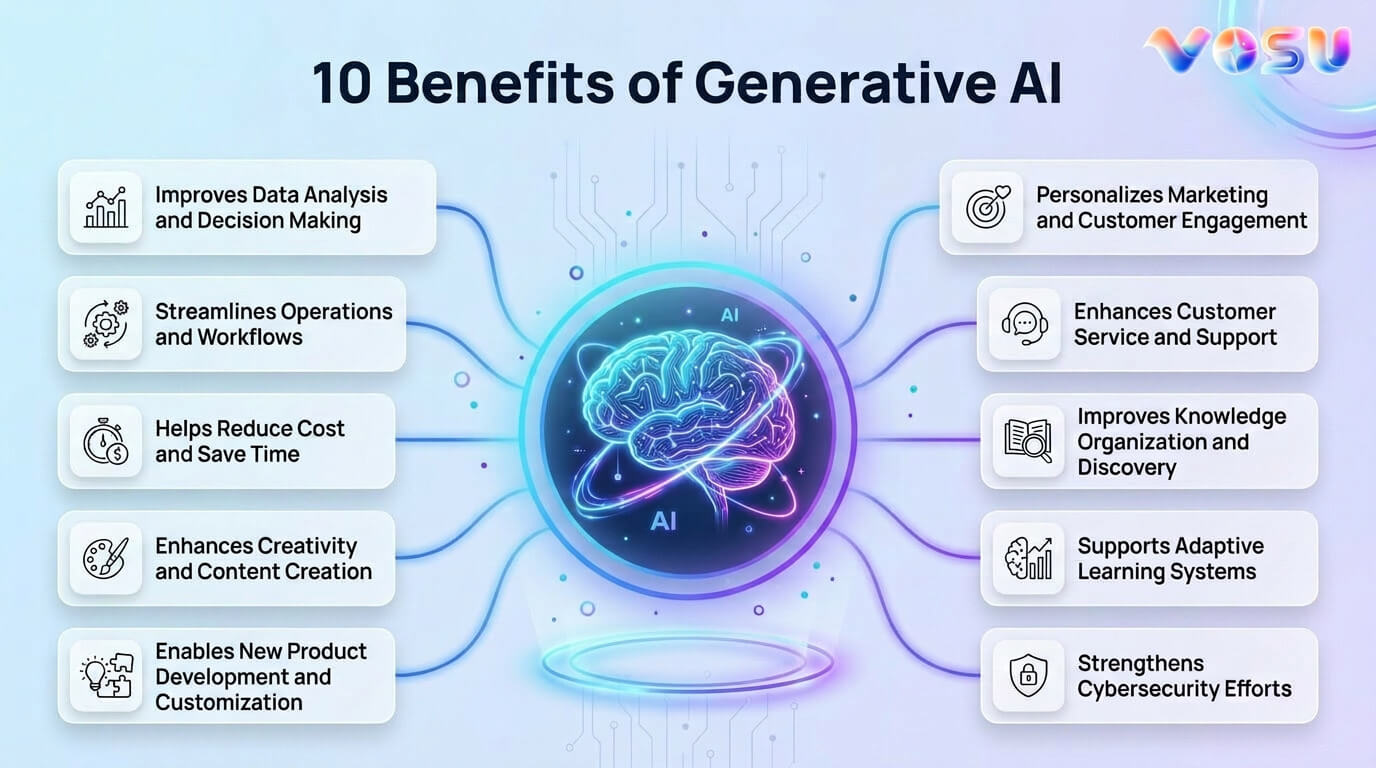
The main benefits are time savings, lower routine workload, faster content creation, better access to information, and support for creative and technical work. These benefits are strongest when people use AI as a helper and check its work before making important decisions.
Generative AI does not replace good judgment. It can make errors, reflect bias, or produce made-up facts. The best results come from clear prompts, trusted data, human review, and rules for safe use.

What Is Generative AI?
Generative AI is a type of artificial intelligence that creates new content from a user’s request. It can produce text, images, audio, video, computer code, and other forms of digital content.
A generative AI tool learns patterns from large amounts of data. When a user enters a prompt, the tool uses those patterns to create a response. It does not think like a person, and it does not always understand whether its answer is true.
Common examples include tools that can:
- Write or rewrite text
- Summarize documents
- Create images from descriptions
- Generate computer code
- Translate languages
- Answer questions
- Make study guides
- Analyze data
- Draft marketing material
- Produce voice or video content
Generative AI differs from older software because it can create flexible responses instead of following only fixed commands. For example, a spreadsheet can calculate a value when given the right formula. A generative AI tool may explain the formula, suggest one, and show how to use it.
What Are the Main Benefits of Generative AI?
The most useful benefits of generative AI come from reducing routine work and helping people move from an idea to a usable first draft.
1. Generative AI saves time
Generative AI can complete many first-step tasks in seconds. It can draft a memo, summarize meeting notes, organize research, or create a list of ideas.
This does not mean every task is finished in seconds. A person still needs to check the result, fix errors, and add needed context. Even so, removing the blank-page stage can save meaningful time.
For example, a U.S. employee could ask an AI tool to:
- Review a set of meeting notes.
- Find the main decisions.
- List open tasks.
- Assign each task to a named team.
- Draft a follow-up email.
The employee should verify the names, dates, and assignments. However, the tool may reduce a 30-minute task to a shorter review process.
2. It can increase productivity
Generative AI can support several parts of a work process. It may help a person plan a task, create a first draft, find gaps, and prepare a final version.
A study published by the National Bureau of Economic Research examined generative AI use by customer support workers. The researchers found that access to an AI assistant raised worker productivity in the setting they studied. The effect was not the same for every worker or every task, so the findings should not be treated as a guarantee for all workplaces.
The practical lesson is simple: AI may help most when it gives workers useful suggestions while allowing them to stay in control.
3. It speeds up content creation
Generative AI can create a starting point for many types of content, such as:
- Blog outlines
- Product descriptions
- Social media drafts
- Newsletters
- Video scripts
- Job descriptions
- Training material
- Customer emails
- Presentation text
A writer can use AI to explore several angles before choosing one. A marketing team can ask for different tones, such as formal, friendly, or direct. A small business owner can create a basic draft without hiring a writer for every short message.
The main limit is quality. AI-generated content may sound smooth while containing wrong facts, weak claims, or a style that does not fit the brand. Human editing remains necessary.
4. It supports brainstorming and creative work
Generative AI can act as a fast idea partner. It can suggest names, themes, story ideas, design concepts, questions, or alternate approaches.
This benefit is useful when a person feels stuck. The AI does not need to produce the final idea. It can offer several rough options that help the user see a problem from a new angle.
For example, a U.S. nonprofit planning a fundraising event might ask AI for:
- Five event themes
- Three donor email ideas
- A simple event schedule
- Questions for a donor survey
- Ways to explain the nonprofit’s mission
The team can then select, combine, or reject the suggestions.
5. It helps people work with large amounts of information
Generative AI can summarize long text and organize information into useful groups. This can help people review reports, policies, transcripts, notes, and research papers.
Useful requests include:
- “Summarize this report in five bullet points.”
- “List the risks and proposed solutions.”
- “Compare these two policy drafts.”
- “Explain this section in plain English.”
- “Create a table of dates, owners, and deadlines.”
The tool may miss key details or misunderstand technical language. Users should compare important summaries with the original document.
6. It can make information easier to understand
Generative AI can explain complex material at different reading levels. A user can ask for a plain-language version, a short summary, or an example.
This may help:
- Students learn difficult topics
- Customers understand product instructions
- Employees review workplace policies
- Patients prepare questions for a health visit
- Small business owners understand basic documents
AI should not replace a doctor, lawyer, teacher, or other qualified professional when the decision has serious consequences. It can help a person prepare, but it may not know the user’s full situation.
7. It improves access and inclusion
Generative AI can support people who face language, reading, vision, hearing, or communication barriers. It can translate text, simplify wording, describe images, create captions, and help a user form a message.
These tools may be useful for:
- People who speak English as a second language
- People with reading difficulties
- People who need help writing
- People who use speech or text support tools
- Teams that work across languages
Results can vary by language and context. Users should check translations and sensitive wording, especially for legal, medical, or public-facing content.

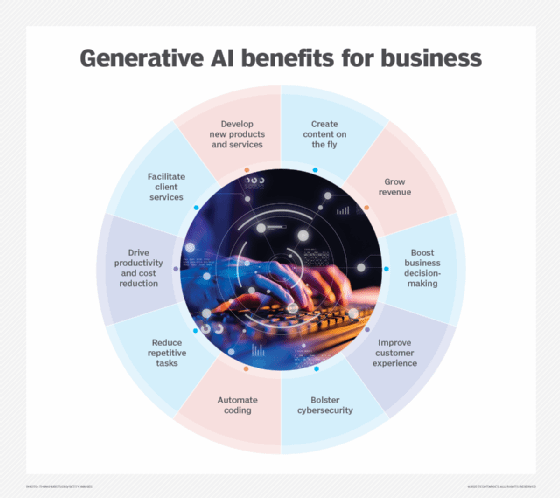
How Generative AI Benefits Businesses
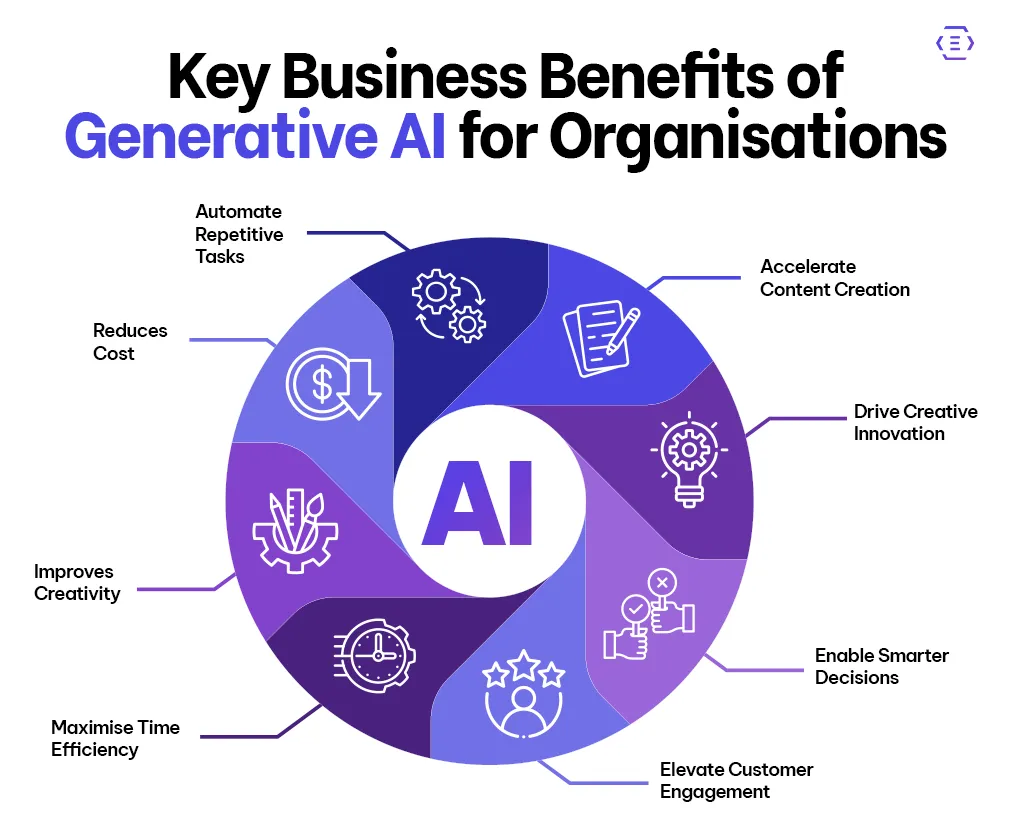
Generative AI can help businesses reduce routine work, serve customers, and make better use of internal knowledge. The value depends on the task, the quality of the data, and the controls around the tool.
Customer service
AI can draft replies, classify support requests, suggest troubleshooting steps, and summarize a customer’s history. A human agent can then review the answer and send it.
This may shorten response times and help agents handle more requests. It may also help new employees learn common answers.
AI should not send sensitive or high-impact replies without proper review. A customer may need a clear path to a human agent when the issue involves billing disputes, safety, identity, or legal rights.
Marketing and sales
Marketing teams can use generative AI to:
- Create early campaign ideas
- Adapt a message for different audiences
- Draft ad copy
- Write email subject lines
- Build customer survey questions
- Summarize campaign results
- Suggest content calendars
AI can reduce the time needed to create variations. It cannot prove that a claim is true or that a message follows advertising rules. Businesses must check claims, copyright concerns, brand standards, and privacy issues.
Software development
Generative AI can assist with code by:
- Explaining unfamiliar code
- Suggesting functions
- Creating test cases
- Finding possible bugs
- Converting code between languages
- Writing documentation
- Creating simple scripts
The developer must test the code and review it for security problems. AI-generated code may contain bugs, unsafe practices, or outdated methods.
Internal knowledge management
A company may use an AI system to help employees find information in approved internal documents. For example, workers could ask about a vacation policy or a standard process instead of searching many folders.
This works best when the source files are current, well organized, and access-controlled. If the source data is wrong, the AI may produce a confident but incorrect answer.
How Generative AI Benefits Individuals
Generative AI is not only a business tool. Individuals can use it for learning, planning, writing, and daily tasks.
Learning and study support
Students can ask AI to explain a topic, create practice questions, or review a draft. A strong study prompt might be:
Explain photosynthesis in simple terms. Then give me five questions without the answers so I can test myself.
This approach supports active learning better than asking AI to complete an assignment with no effort from the student.
Students should follow school rules. They should also check facts and avoid presenting AI-generated work as their own when disclosure is required.
Personal planning
AI can help create:
- Meal plans
- Travel checklists
- Study schedules
- Moving plans
- Budget categories
- Fitness questions for a professional
- Home project lists
For personal finance, health, or legal issues, AI should be treated as a general information tool. A person should confirm important guidance with a qualified professional and trusted official sources.
Writing and communication
People can use AI to make a message clearer, kinder, shorter, or more direct. This can help with:
- Cover letters
- Workplace emails
- Resumes
- Complaint letters
- School messages
- Volunteer announcements
The user should keep the message truthful and personal. AI should not invent work experience, qualifications, or events.
Idea development
A person can use AI to compare options before making a decision. It can list pros and cons, identify questions to ask, or show how different assumptions change a plan.
The value comes from better preparation, not from handing over the final decision.

A Practical Comparison of Generative AI Benefits
The table below connects common benefits with the work they support and the main condition for success.
| Benefit | Example task | Main value | Key condition |
|---|---|---|---|
| Time savings | Drafting an email | Less routine work | Review the draft |
| Higher productivity | Summarizing support cases | Faster task completion | Use accurate source data |
| Better access to information | Explaining a policy | Easier understanding | Check the original policy |
| Creative support | Brainstorming campaign ideas | More starting points | Select ideas with human judgment |
| Personalization | Adapting content for a group | Better fit for the reader | Avoid unfair assumptions |
| Accessibility | Translation or captions | Wider access | Check quality and meaning |
| Coding support | Creating test code | Faster development | Test for bugs and security |
| Learning support | Practice questions | More guided study | Do the work, not just copy answers |
The strongest use cases usually have three traits: the task is repetitive, the cost of a draft error is manageable, and a person can review the result.
What Are the Limitations and Risks of Generative AI?
Generative AI can produce useful work, but it also creates risks. Understanding these limits is part of using the technology well.
Inaccurate information
AI can generate false facts, incorrect citations, or invented sources. This problem is often called a hallucination.
Check important claims against primary sources, such as:
- Government websites
- Official regulations
- Original research
- Company documentation
- Professional guidance
- The source document supplied to the AI
Do not rely on an AI answer alone for a medical, legal, financial, safety, or employment decision.
Privacy and confidential data
Do not paste sensitive information into an AI tool unless you understand how the tool stores and uses that data. Sensitive information may include:
- Social Security numbers
- Bank details
- Medical records
- Passwords
- Private customer data
- Confidential business plans
- Trade secrets
Use approved business tools and follow your organization’s data policy.
Bias and unfair results
AI systems learn from data that may contain social bias. A response may use unfair assumptions about race, sex, age, disability, religion, income, or location.
Review AI outputs more carefully when they affect hiring, housing, credit, education, insurance, health care, or access to services. In these areas, organizations may also face legal and regulatory duties.
Copyright and ownership questions
AI-generated material may resemble existing work. The legal treatment of AI output can depend on the tool, the user’s contribution, the type of material, and the jurisdiction.
Keep records of the source material and prompts used for important projects. Do not assume that every output is free of copyright concerns.
Overreliance
A polished answer can feel more reliable than it is. This creates a risk known as automation bias: people may accept a machine’s suggestion without enough review.
Use AI to support judgment, not remove it. Ask:
- What source supports this claim?
- What could be wrong?
- What information is missing?
- Who could be harmed by an error?
- Does a qualified person need to review this?
How to Get Better Results From Generative AI
Good results usually come from clear instructions and useful context. A simple prompt often works better when it states the task, audience, limits, and desired format.
Use a clear prompt structure
Include these parts:
- Task: What should the AI do?
- Context: What does it need to know?
- Audience: Who will read or use the result?
- Limits: What should it avoid?
- Format: How should it present the answer?
- Review goal: What should it check?
Example:
Summarize this employee policy for new workers in the United States. Use plain English and five bullet points. Keep all dates and limits exact. If the policy does not answer a question, say so instead of guessing.
Give the AI source material when possible
An AI tool is more useful when it works from a trusted document. Ask it to use only the information in that document and to mark any answer that the document does not support.
This does not guarantee accuracy. It simply gives the tool a clearer basis for its response.
Ask for uncertainty
Prompts can request limits and missing information. For example:
List the facts you are unsure about and explain what source would confirm each one.
This can make errors easier to find.
Review the final result
Check:
- Names
- Dates
- Numbers
- Links
- Quotes
- Legal or medical claims
- Tone
- Private information
- Bias
- Instructions that could cause harm
The higher the risk, the more careful the review should be.
Who Benefits Most From Generative AI?
Generative AI can help many users, but it is most useful for people who have repeatable tasks and enough knowledge to review the result.
It may be a good fit for:
- Small business owners
- Writers and editors
- Teachers and students
- Software developers
- Customer service teams
- Researchers
- Marketing teams
- Administrative workers
- People who need language or accessibility support
It may be a poor fit when:
- Every answer must be exact
- The data is highly sensitive
- No qualified person can review the output
- The task involves a high-risk decision
- The tool cannot access current, trusted information
The deciding factor is not whether AI is advanced. It is whether the task allows safe review and correction.
A Simple Cost and Time Calculation
Businesses can estimate possible value with a basic calculation.
Estimated time value = hours saved × hourly labor cost
For example, suppose a worker saves 3 hours each week, and the company values that work at $30 per hour.
- 3 hours × $30 = $90 per week
- $90 × 52 weeks = $4,680 per year
This is only an estimate. It does not include tool fees, training, review time, errors, privacy controls, or workflow changes. If the tool creates costly mistakes, the real value may be much lower.
A better estimate compares:
- Time before AI
- Time after AI
- Review time
- Subscription or setup cost
- Error correction cost
- Training time
- Security and compliance cost
Frequently Asked Questions
Is generative AI better than human work?
Generative AI can be faster for some routine tasks, but it does not replace human judgment. People remain responsible for checking facts, setting goals, understanding context, and making high-impact decisions.
Can generative AI save a business money?
It can reduce time spent on some tasks, which may lower operating costs or let workers focus on higher-value work. Savings are not automatic. Businesses must account for software costs, training, review, security, and mistakes.
Is generative AI safe to use?
It can be used safely for many low-risk tasks when users protect private data and review the output. Extra care is needed for health, legal, financial, employment, education, and safety decisions.
Does generative AI always provide accurate information?
No. It can produce incorrect or invented information. Verify important answers with trusted, current sources.
How can students use generative AI responsibly?
Students can use it to explain concepts, create practice questions, improve clarity, and plan research. They should follow school rules, cite sources when required, and avoid submitting AI-generated work as their own when that is not allowed.
Evidence and Further Reading
The main findings in this guide draw on documented research and public guidance, including:
- National Institute of Standards and Technology: Artificial Intelligence Risk Management Framework
- National Bureau of Economic Research: Generative AI at Work
- U.S. Copyright Office: Copyright and Artificial Intelligence
- [National Institute of Standards and Technology: Generative AI Profile](https://www.nist.gov/itl/ai-risk-management-framework/ generative-ai-profile)
- U.S. Department of Education: Artificial Intelligence and the Future of Teaching and Learning
These sources support the use of generative AI as a tool with benefits and risks. They do not establish that one AI product is best for every person or organization.
Conclusion
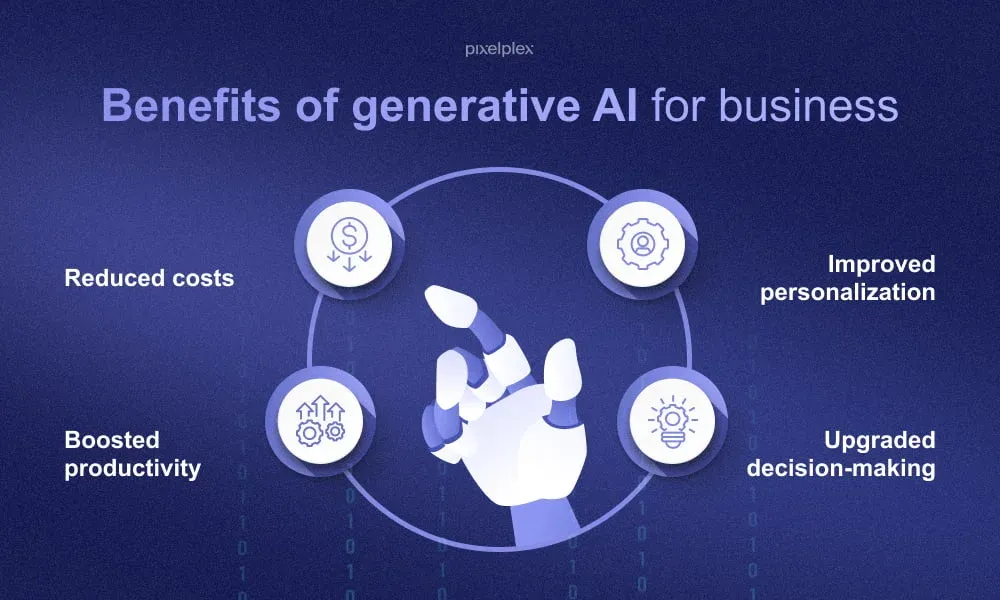
The benefits of using generative AI include faster routine work, easier content creation, stronger brainstorming, better access to information, coding support, personalized learning, and improved accessibility.
The best results come from a balanced approach. Use AI for drafts, summaries, ideas, and structured assistance. Then verify facts, protect private data, review for bias, and keep people responsible for important choices.
A practical next step is to choose one low-risk task, measure how long it takes before and after AI, and review the result for quality. This gives you a clearer view of the tool’s real value than broad promises alone.

Everett Ashford is a tech reviewer at mytechgrid.com specializing in SSDs, cameras, TVs, earbuds, headphones, and other consumer electronics. He provides honest, data-driven reviews based on hands-on testing and real-world performance analysis. Everett simplifies complex tech details to help readers make smart, confident buying decisions.