Sony FX3 and Canon C70 stand out as the best cameras for documentary filmmaking.
You carry a bag, a story, and not much time. You need a camera that can jump from a dim kitchen to a city street, keep faces sharp, capture clean audio, and still fit in your hands for hours. That’s the core problem every doc shooter faces. In this guide, I’ll show you what makes the best camera for documentary filmmaking, how to choose one that fits your style and budget, and the few smart accessories that can save you on tough days. I’ll lean on field-tested insights and gear I trust in real shoots.
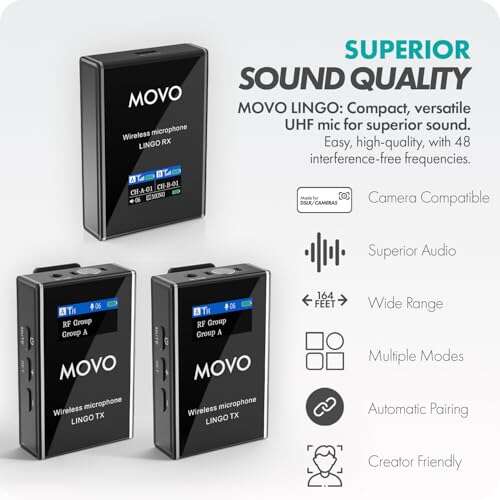
Movo Lingo-Duo UHF Wireless Lavalier Mic System

The Movo Lingo-Duo is a dual-channel UHF wireless lavalier kit that gives you clean voice capture without fuss. It pairs well with popular cameras like Canon, Sony, and Nikon. Setup is fast, with straightforward channel selection and gain control. For run-and-gun interviews, it helps you move fast and stay light.
On busy streets or in echoey rooms, the system holds a stable signal. The two transmitters let you mic a subject and a producer, or two speakers, at once. You can send a mix or separate tracks to your camera. That flexibility is gold when you cut later and need control.
Pros:
- Dual-channel system for two mics at once
- 48 UHF channels help avoid interference
- Simple setup and intuitive controls
- Good range for walk-and-talk interviews
- Compatible with Canon, Sony, and Nikon cameras
- Clear, natural voice tone with minimal hiss
- Includes lav mics and useful cables
Cons:
- UHF systems can be sensitive to crowded RF environments
- Plastic build is light but not as rugged as metal units
- Battery management needed for long shoot days
My Recommendation
If you shoot interviews, walk-and-talks, or quick bites on busy days, this kit is a smart buy. It shines when you need two voices and you need them now. Pair it with the best camera for documentary filmmaking and you get fast, clear, and safe audio. For solo shooters, it saves time. For small teams, it keeps your setup clean.
| Best for | Why |
|---|---|
| Two-person interviews | Dual transmitters record two speakers cleanly |
| Run-and-gun field work | Quick setup and reliable UHF channels |
| Solo documentary shooters | Simple controls and lightweight kit reduce stress |
Accsoon NP-F to V-Mount Battery Plate Adapter

The Accsoon NP-F to V-Mount plate lets you power monitors like the CineView M7 and other rigs with a lightweight NP-F battery while mounting on V-lock hardware. It gives you flexibility in how you build your doc rig. The quick release design makes swaps fast. It’s light, tidy, and helps solve power headaches.
If your monitor sits on a cage or top handle, this keeps your center of mass safe. It also means you can carry fewer battery types. In smaller crews, power simplicity is a relief. It pairs well with the best camera for documentary filmmaking when you want a lean setup that runs for hours.
Pros:
- Converts NP-F to V-mount for more mounting options
- Quick release for fast battery swaps
- Lightweight build suits mobile rigs
- Good fit for Accsoon CineView M7 and similar monitors
- Helps standardize batteries on set
- Reduces cable clutter with clean routing
- Affordable way to level up power management
Cons:
- Not a full V-mount battery replacement for high-draw cameras
- Compatibility varies by monitor and accessories
- May need extra plates or clamps for some cages
My Recommendation
Pick this if you use NP-F batteries and want V-mount style mounting. It helps you run a monitor all day without heavy bricks. It’s a nice fit for small crews on travel docs. Pair it with the best camera for documentary filmmaking and you’ll have a nimble system that still feels pro.
| Best for | Why |
|---|---|
| Lean travel rigs | Lightweight mount, fewer battery types to carry |
| Field monitors | Stable power and clean mounting on cages |
| Solo documentary creators | Fast swaps keep you shooting and reduce downtime |
How to choose the best camera for documentary filmmaking
I have spent long days in tight rooms and loud streets. I have shot with cinema bodies and tiny hybrids. The best camera for documentary filmmaking is not just about specs. It’s about trust. It must be ready when life happens. That is the standard I use.
Here is how I judge. I look at autofocus. I judge low light. I test stabilization. I check audio options. I push battery life. I watch the rolling shutter. I check media costs. I care about weight. I test color in mixed light. Then I ask a key question: can I move and still get the shot?
Autofocus and subject tracking
Good AF is a lifesaver. In doc work, people drift. They turn. They sit under dim bulbs. The best camera for documentary filmmaking locks eyes and holds them. Sony’s Real-time Eye AF and Canon Dual Pixel AF have a strong track record. Recent phase-detect systems from Panasonic and Fujifilm have grown fast. Always test your lens with your camera. AF is a team sport.
Face-priority with override is key. You want to tap and shift focus fast. You also need a manual focus plan. Practice pulling focus on a small rig. A camera that lets you set AF speed and response gives you more control. It saves your edit later.
Low light and dynamic range
Docs live in bad light. Kitchens. Basements. Night streets. The best camera for documentary filmmaking gives you clean ISO at 6400 or more. Look for dual native ISO or strong noise control. Dynamic range helps too. It keeps faces from blowing out when windows are hot.
Log profiles are great, but only if you expose right. Learn your camera’s exposure tools. False color, zebras, and waveform help. If your camera does not have them, add a monitor. Protect highlights on faces. It is better to keep skin safe and lift shadows in post than to lose detail in the bright spots.
Stabilization and rolling shutter
Good IBIS or a strong digital stabilizer helps when you walk. A small gimbal can help, but it adds time. The best camera for documentary filmmaking lets you handhold with confidence. Rolling shutter matters too. Fast sensors make pans look clean. If your work has fast motion or quick whip pans, test for skew.
Use lenses with optical stabilization when you can. Hybrid stabilization can look very smooth. Choose a lens with a wider field of view for handheld work. It hides shake better. Keep your elbows in. Breathe slow. These tiny habits add up on long days.
Audio inputs and monitoring
Audio is half the story. XLR inputs with good preamps help a lot. If your camera has a smart XLR handle or module, that is a win. The best camera for documentary filmmaking gives you headphone monitoring, level control, and safe tracks. If not, plan for a small mixer or a reliable wireless set like the Movo Lingo-Duo.
Always monitor with headphones. Wind screens on lavs and shotguns help. Keep a backup recorder if the scene is mission critical. Remember to slate or clap once for sync if you split audio. You will thank yourself in the edit.
Internal NDs, timecode, and pro features
Internal ND is a dream for docs. It lets you set exposure fast in sun to shade moves. Timecode support helps multi-cam shoots. Waveform and vectorscope help you expose and match colors. The best camera for documentary filmmaking gives you these tools in one body, or has easy add-ons.
Do not skip false color if you can get it. It teaches your eye fast. If your camera lacks NDs, carry a variable ND filter. Get one that does not shift color too much. Keep it clean. It is your lens cap in the field.
Battery life and media costs
Power is peace. You need at least two to three hours per battery on hybrid shoots. Cinema batteries go longer, but add weight. The best camera for documentary filmmaking finds a sweet spot between size and runtime. Carry a USB-C power bank if your camera supports it. That can save a scene.
Media matters too. CFexpress is fast but costly. SD UHS-II is cheaper and fine for many codecs. Plan for backups. Rotate cards. Label them. Keep a copy on set when you can. Never leave without a second copy if the scene cannot be done again.
Weight, size, and ergonomics
Your hands matter. Your back matters. Small and strong wins many doc days. If your camera is too big, you will leave it in the bag. The best camera for documentary filmmaking fits your hands and your strap. It should balance well with your lens and mic. Test the grip with gloves if you shoot in cold weather.
Buttons should be easy to hit by feel. Record, AF-ON, and audio level control should be at your fingertips. A flip screen can help with low and high angles. A bright EVF helps in sun. Try it before you buy if you can. Your body will tell you.
Top picks I trust for real documentary work
I judge cameras by miles, not spec sheets. I have shot with many, and I watch how they behave. The best camera for documentary filmmaking suits your budget and your scenes. Here are bodies that deliver strong results and hold up in the field.
Sony FX3
The FX3 is small and serious. It has great low light, strong AF, and helpful stabilization. The top handle with XLR inputs is a gift for lean crews. It takes the proven Z-battery that lasts a long time.
S-Cinetone looks good straight out of camera. S-Log3 grades well when exposed right. The FX3 lives between a hybrid and a cinema camera. It is compact enough to feel invisible, yet it feels made for films. Many shooters see it as the best camera for documentary filmmaking for solo days.
Canon C70
The C70 packs a cinema brain into a small box. The DGO sensor is great with highlights. Dual Pixel AF tracks faces well. Built-in ND saves time on set. Mini XLRs add clean audio.
The body is friendly for handheld. It balances well with compact zooms. It also pairs nicely with speed boosters for shallow depth of field. For many, this is the best camera for documentary filmmaking when audio and speed trump size.
Panasonic Lumix S5IIX
The S5IIX brought phase detect AF and strong codecs. It can record ProRes internally and shoot in open gate. IBIS is excellent for handheld. It is budget friendly for what it offers.
For travel docs, the S5IIX is a strong pick. It has nice color and flexible recording options. Add a compact shotgun mic and you are set. If price matters, this can be the best camera for documentary filmmaking that still looks high-end.
Blackmagic Cinema Camera 6K (Full-Frame)
Blackmagic’s image is beautiful. BRAW is easy to work with and grades very well. The full-frame sensor gives rich depth and latitude. Touchscreen menus are clear.
Autofocus is not as strong as others. Battery life needs planning. Yet the image payoff can be huge. For planned interviews or stylized vérité, it might be your best camera for documentary filmmaking if you love color work.
Fujifilm X-H2S
The X-H2S has a fast sensor with low rolling shutter. It offers good AF and solid stabilization. The color science is pleasing and flexible. ProRes options and good heat management help.
It is light, tough, and balanced. Perfect for all-day handheld work. If you like APS-C for reach and size, it is a smart choice. For many hybrid shooters, it can become the best camera for documentary filmmaking that doubles as a stills camera.
Sony FX6
The FX6 is larger but still nimble. It has stellar low light and strong AF. Internal NDs and pro audio make it ready for broadcast. It handles fast.
If you need a main A-cam for a series, this is worth a look. It costs more and weighs more than the FX3. Yet it can be the best camera for documentary filmmaking on bigger jobs where you still move fast.
Best lenses for documentary storytelling
Cameras get the talk. Lenses make the picture. The best camera for documentary filmmaking needs glass that fits your story. I like a wide-to-normal zoom for scenes and a fast prime for interviews. Keep it light, sharp, and honest.
Good sets to consider: a 24-70mm f/2.8 for coverage, and a 35mm or 50mm f/1.8 for faces. If you shoot in small rooms, a 20-24mm helps. For interviews, a 85mm gives space and clean isolation. Image stabilization on the lens is a plus for handheld.
Smart rigs that do not slow you down
Keep your rig simple. A cage with a top handle adds control. A small monitor helps with focus and exposure. Add the Accsoon NP-F to V-Mount plate to clean up power. Mount the Movo Lingo-Duo receiver on the camera and run XLR or 3.5mm to your input.
The best camera for documentary filmmaking should live on a strap, not a cart. Use quick release plates for speed. Pack a variable ND, extra batteries, and three clean cards. Store lav accessories in a small pouch you can reach in the dark.
Audio workflow that saves edits
Record two tracks when you can. One at normal level and one lower as a safety. Wind-sock your shotgun mic. Hide lav cables under clothes and tape a loop for strain relief. The Movo Lingo-Duo helps with two voices and simple setup.
Monitor in real time. Watch meters. Listen for hiss, hum, and clothing rustle. When you can, get room tone. It makes your cuts feel smooth. The best camera for documentary filmmaking is your eyes, but great audio is your glue.
Colors and codecs for fast posts
Choose a codec that fits your edit system. 10-bit is worth it. Log gives you range and style, but it needs care. If deadlines are tight, try a good baked look like S-Cinetone or a fine-tuned profile. The best camera for documentary filmmaking gives you both choices.
White balance matters more than many think. Set it. Do not let it roam. Keep gray and white cards in your bag. A quick check saves time later. Consistency makes your series look polished.
High-stakes moments: reliability under pressure
Docs happen once. Your camera must not overheat. It must boot fast. It must record when you press red. The best camera for documentary filmmaking has earned trust in the field. It may cost more, but meltdown costs more than money.
Test your gear before each job. Format cards. Clean contacts. Check mics. Make a short test clip and listen. Prepare a second power path. These habits turn chaos into a clean day.
Budget tiers and what you can expect
Under $2,000: You can get a strong hybrid with 10-bit, good AF, and IBIS. Pair it with a fast prime and a basic mic. It can be the best camera for documentary filmmaking if you keep your rig simple and focus on light and sound.
$2,000–$4,000: You get better AF, codecs, and low light. You might get XLR modules and longer battery life. This is the sweet spot for many solo makers. It gives you room to grow.
$4,000 and up: You get internal ND, timecode, better monitoring tools, and strong audio. You get bodies like the FX3, C70, and FX6. If your work is daily and paid, this tier pays back fast.
Field-tested checklists for real shoots
Before you leave: batteries full, cards empty, lenses clean, mics packed. Set your base profile or LUT. Make a white balance plan. Pack rain covers if clouds look mean. Load your bag so the most-used items sit high.
On set: monitor audio first. Watch exposure on faces. Use zebras or false color if you have them. Lock your strap to your wrist in crowds. Back up footage at the first break. The best camera for documentary filmmaking is only as good as these tiny habits.
Why accessories can beat fancy specs
Small tools make big differences. A good lav kit like the Movo Lingo-Duo saves takes. A smart power plate like the Accsoon NP-F to V-Mount keeps your monitor alive. A variable ND keeps your eyes on the story, not the menu. These add-ons turn a good camera into a calm camera.
Do not chase every new body. Instead, fix your weak link. If your audio fails, no new sensor saves you. If your power fails, your day fails. The best camera for documentary filmmaking lives inside a system that you know and trust.
FAQs Of best camera for documentary filmmaking
Is full-frame better than Super 35 for documentaries?
Not always. Full-frame gives shallow depth and better low light. Super 35 gives reach and lighter lenses. Both can be the best camera for documentary filmmaking if they fit your style.
Do I need internal ND filters?
They are very helpful. Internal ND speeds exposure changes. If you lack them, use a good variable ND. It is the next best thing.
How important is 10-bit recording?
Very. 10-bit gives smoother grades and cleaner skin. It is worth it if you shoot log or mixed light. It helps your edits hold up.
Should I record in log for every shoot?
Not always. Log is great for tough scenes and grading. For quick turn edits, a good baked profile works. The best camera for documentary filmmaking gives you both.
How many batteries and cards should I carry?
At least three batteries and three cards for a day. More if you shoot long. Back up at breaks. Keep a second copy before you leave.
Final Verdict: Which Should You Buy?
For audio, the Movo Lingo-Duo is a fast, reliable dual-lav kit that fits lean doc rigs. For power, the Accsoon NP-F to V-Mount plate keeps monitors running without heavy bricks.
Pair either with the best camera for documentary filmmaking, like an FX3 or C70, and you will move faster and stress less. Keep your rig simple. Keep your story first.
Jamie Lee is a seasoned tech analyst and writer at MyTechGrid.com, known for making the rapidly evolving world of technology accessible to all. Jamie’s work focuses on emerging technologies, product deep-dives, and industry trends—translating complex concepts into engaging, easy-to-understand content. When not researching the latest breakthroughs, Jamie enjoys exploring new tools, testing gadgets, and helping readers navigate the digital world with confidence.