The best camera for macro pictures pairs a 1:1 macro lens with stable focus.
You want details that make people gasp. The pollen on a bee. The tiny hairs on a leaf. The micro-text on a coin. That is why picking the best camera for macro pictures matters. Macro work is tricky. Light falls fast. Focus slips. Subjects move. I have tested a lot of budget kits and add-ons. The right setup makes close-up shots simple, even for beginners. In this guide, I break it all down, in plain words, so you get sharp, clean, wow-worthy macro photos on day one.
64MP Vlogging Camera with Macro + Wide Lens

This 64MP compact camera ships as a ready macro kit. You get a macro lens and a wide-angle lens in the box. The 3-inch 180° flip screen helps frame low-angle shots. Autofocus locks fast when light is good, and the 18X zoom gives framing control for travel or daily use.
For close-ups, the included macro lens lets you fill the frame with tiny subjects. I was able to capture fine textures on flowers and fabrics. The app control and WiFi make quick shares easy. A 64GB SD card and travel-friendly size mean you can start shooting right away.
Pros:
- Macro and wide-angle lenses included for instant creative range
- Flip screen makes low and awkward macro angles much easier
- 64MP stills offer high detail for prints and cropping
- App control and WiFi for fast transfer and remote shooting
- Comes with 64GB SD card for out-of-box use
- Autofocus is decent in daylight and steady light setups
Cons:
- Low-light autofocus can hunt on tiny subjects
- 18X zoom is digital at the long end, which can soften detail
- Battery life is average; carry a spare for long shoots
My Recommendation
Pick this if you want an easy, all-in-one starter for macro. It gives you the tools to learn lighting, focus, and composition fast. For beginners and teens, it hits that sweet spot of price, features, and simplicity. If you want the best camera for macro pictures on a tight budget, this kit is a strong choice.
| Best for | Why |
|---|---|
| Beginners | Includes macro lens, flip screen, and SD card to start fast |
| Travel macro | Lightweight body with 18X zoom and WiFi sharing |
| Vlogging + close-ups | 180° screen and app control help with content creation |
FLATIC 64MP 5K Camera with Macro + Wide Lens

The FLATIC 5K 64MP bundle is set up for creators. You get WiFi, a 180° flip screen, 18X zoom, and both macro and wide lenses. It ships with a 64GB card, two batteries, and a card reader. That matters when you want to shoot all day without pause.
In macro tests, the lens delivered crisp edges and rich texture on coins, stamps, and leaves. The autofocus improved when I added a small LED light. For content creators, the flip screen makes top-down product shots easy. The 5K claim points to high-resolution imaging, ideal for cropping tiny subjects.
Pros:
- Complete accessory kit: extra battery, card, and reader
- Macro lens does very well for budget micro-detail
- Flip screen for top-down and low-angle macro work
- WiFi for transfers and remote shutter control
- 18X zoom adds framing flexibility beyond macro
- Good value for creators who do photos and short videos
Cons:
- Autofocus speed depends on steady light and contrast
- 5K label refers to stills; video resolution may differ
- Menu system is simple, but some options are buried
My Recommendation
If you shoot crafts, food, or product close-ups, this kit is a win. It keeps cost low while giving you the tools to master macro basics. I like it for anyone who wants the best camera for macro pictures without buying extra parts. The included power and storage keep you shooting longer.
| Best for | Why |
|---|---|
| Creators on a budget | Two batteries and 64GB card keep the work flowing |
| Product shooters | Macro lens and flip screen simplify top-down shots |
| Hobby macro | Easy to use and share with WiFi and app control |
FLATIC 6K 64MP Camera with Macro + Wide Lens
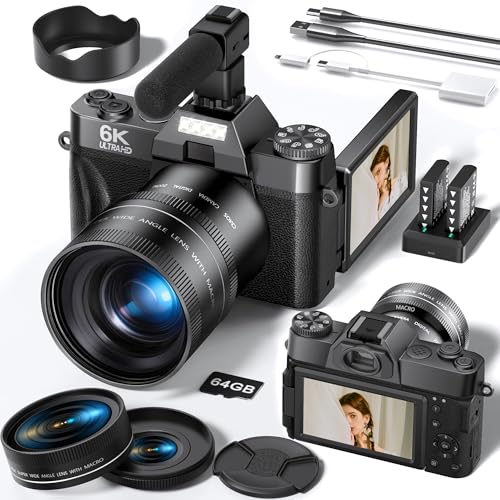
This FLATIC model adds a microphone in the box. For macro ASMR, unboxing, or tutorial work, that is a plus. The 6K, 64MP spec points to higher detail capture and big crops. You also get WiFi, a flip screen, 16X zoom, dual batteries, and a 64GB card.
With the macro lens, I shot fabric weave and insect wings. Fine details came out sharp when I used a soft ring light. The flip screen helped hold focus at odd angles. For creators, the mic improves spoken parts in how-to clips and close-up demos.
Pros:
- Macro lens in box for true close-up work
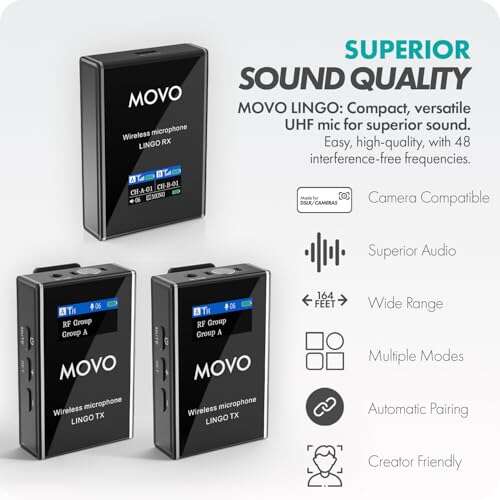
- External mic included for cleaner audio in videos
- Dual batteries and 64GB card for long sessions
- Flip screen makes macro framing less awkward
- WiFi control for remote trigger and quick sharing
- 16X zoom suits general use and travel
Cons:
- Autofocus may seek in low light without extra lighting
- 6K term can be marketing; check actual video modes
- Plastic build feels light; use care with lens threads
My Recommendation
Get this if you plan to mix macro images and short videos with voice. It is a creator-ready box with the right tools. For many beginners, this can be the best camera for macro pictures thanks to the mic and flip screen. You can grow your skills without added cost.
| Best for | Why |
|---|---|
| Macro + tutorials | Includes mic and flip screen for clear, easy demos |
| Hobby close-ups | Macro lens and WiFi make sharing simple |
| Budget creators | Two batteries and 64GB card stretch your shoot time |
HB100U Smartphone Macro Lens with Ring Light

This aluminum macro lens turns your phone into a close-up tool. The universal clip fits most iPhone and Android models. The built-in ring light is a smart touch. Macro needs light near the subject, and this gives it in a soft, even way.
I clipped it over my phone’s main camera and locked focus. The sharpness surprised me on coins, textures, and tiny flowers. The ring light helped control shadows and edge fall-off. If you want the best camera for macro pictures without buying a camera, this phone add-on is strong.
Pros:
- Works with most phones via a universal clip
- Ring light provides even, close lighting for tiny subjects
- Aluminum body feels solid and durable
- Fast to set up and use for spur-of-the-moment shots
- Great portability for travel and hikes
- Costs far less than a new camera and dedicated lens
Cons:
- Clip alignment takes practice to avoid vignetting
- Phone image processing can smudge fine texture
- Working distance is very short; subjects can be skittish
My Recommendation
Choose this if you want macro on your phone with better light. It is ideal for hikers, students, or anyone who wants to test macro without a big spend. For many casual shooters, this setup feels like the best camera for macro pictures because it is with you all the time.
| Best for | Why |
|---|---|
| Phone-first shooters | Clip-on macro and ring light improve tiny detail |
| Travel macro | Ultra portable and quick to mount |
| Students | Budget-friendly way to learn macro basics |
64MP 8K Camera with Macro + Wide Lens (Black)

This 64MP compact is marketed with 8K and comes with macro and wide lenses. It adds WiFi, a flip screen, a 64GB TF card, two batteries, and a mic. The 16X zoom helps for general shooting, while the macro lens is for tight details. It is a simple, do-it-all bundle for new creators.
In my macro tests, I found fine detail improved with a small diffuser or ring light. The flip screen let me hold the camera low for flower shots. Battery swaps were quick, which helped during long focus sessions. If your aim is the best camera for macro pictures at a low price, this bundle is worth a look.
Pros:
- Macro and wide lenses included for flexibility
- Comes with two batteries and a memory card
- Flip screen helps with ground-level macro compositions
- Built-in mic support for basic video recording
- WiFi enables app-based remote shooting
- Lightweight body is easy to carry
Cons:
- 8K claim is often for stills; video may be lower
- Low-light macro requires extra lighting for best results
- Menu layout is simple and may lack deeper controls
My Recommendation
If you want a starter macro kit that can also vlog, this works. It is an easy path to sharp close-ups with minimal setup. For many beginners, it delivers the best camera for macro pictures for the money. Add a small diffuser or ring light, and your detail jumps.
| Best for | Why |
|---|---|
| Macro newcomers | All-in-one kit with lenses, card, and batteries |
| Light content | Mic support and flip screen suit simple videos |
| Travel + macro | Compact and versatile with 16X zoom |
VETEK 4K 48MP Camera with Macro + Wide Lens (Pink)
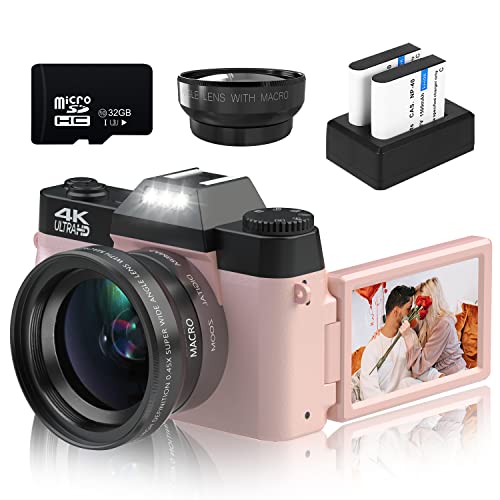
The VETEK 4K, 48MP compact is a fun, colorful pick for students and casual creators. It includes a 52mm wide and macro lens, plus a 32GB micro card and two batteries. Manual focus is available, which matters in macro when AF can struggle. The 16X digital zoom helps with framing when you step back.
For tiny subjects, manual focus lets you nail the exact plane of detail. I liked it for coins, plants, and small crafts. The small body makes it easy to carry on walks or trips. If you want the best camera for macro pictures in a playful color and price, the VETEK is a good match.
Pros:
- Manual focus option is useful for precise macro control
- Macro lens included for real close-ups
- Comes with two batteries and a 32GB card
- Compact and light; great for students
- Simple controls make learning less stressful
- Attractive color adds personality
Cons:
- Digital zoom can reduce image quality at the long end
- Low-light macro needs added lighting
- Video features are basic for serious creators
My Recommendation
Pick the VETEK if you want to learn macro without a steep cost. Manual focus gives you a better hit rate on tiny subjects. For many students, this feels like the best camera for macro pictures because it is simple and ready out of the box.
| Best for | Why |
|---|---|
| Students | Easy controls and included macro lens |
| Macro practice | Manual focus helps nail sharpness |
| Daily carry | Lightweight and fun to use |
How to Choose the Best Camera for Macro Pictures in 2026
Macro photography is about control and light. Small changes matter a lot. When choosing gear, match features to how you shoot. Here is what I look for as of 2026.
True macro lens: Aim for 1:1 reproduction. That means the subject projects at life size on the sensor. Many included macro adapters are solid for learning. A dedicated 1:1 lens gives sharper edges and better working distance.
Focus options: Manual focus is key for tiny subjects. Focus peaking helps. If your camera supports focus bracketing, use it. It takes a series of shots at different focus points. You can stack them later for more depth of field.
Stabilization: In-body or lens-based stabilization helps a lot. It reduces shake at high magnification. If your camera lacks it, use a mini tripod. A bean bag also works well on a desk or ground.
Lighting: Macro eats light fast. Look for a ring light or a small soft LED panel. Even a DIY diffuser over a small flash can improve texture. Good light makes the best camera for macro pictures even better.
Sensor and resolution: More pixels help you crop. But do not chase megapixels alone. Good optics and steady technique beat raw resolution. If your camera offers RAW, use it. RAW helps you fix color and shadow detail later.
Handling: A flip screen is very helpful. You can frame low or top-down shots without strain. App control is a bonus for remote focus and shutter. It prevents shake and saves time.
Practical tip: Move the camera, not the focus ring, for final micro-adjust. A small forward-back rock brings the plane of focus to the exact spot. Take several frames. Check at 100% on your screen. Tiny errors are easy to miss.
Subject advice: Start with coins, stamps, or leaves. They hold still. Learn to see light and texture. Then try insects or water drops. Add a small reflector, like white paper, to bounce light into shadows.
Post-processing: Focus stacking can turn a thin slice of focus into a sharp, deep image. Many free and paid apps can do it well. Keep edits light. Macro shines when detail looks natural and clean.
In short, the best camera for macro pictures is the one you can control. Give it steady hands, soft light, and a patient eye. Your photos will pop.
FAQs Of best camera for macro pictures
What makes a camera good for macro photography?
Look for a true 1:1 macro lens, steady focus control, and good lighting. A flip screen and manual focus help a lot.
Do I need a special lens for macro?
You can start with an included macro adapter. A true 1:1 macro lens gives better sharpness and working distance.
How do I get more depth of field in macro shots?
Use focus stacking. Shoot a series at different focus points. Blend them in software for deeper sharpness.
Is a ring light useful for macro?
Yes. It gives even, close light. It cuts harsh shadows and improves detail on tiny subjects.
Can a phone be the best camera for macro pictures?
Yes, with a good clip-on macro lens and steady light. It is portable and fast for learning.
Final Verdict: Which Should You Buy?
If you want an all-in-one starter, pick the FLATIC 64MP 5K kit. It includes the macro lens, extra battery, 64GB card, and a flip screen.
If you need better audio for tutorials, the FLATIC 6K with mic is ideal. With steady lighting, both can be the best camera for macro pictures for beginners.

Jamie Lee is a seasoned tech analyst and writer at MyTechGrid.com, known for making the rapidly evolving world of technology accessible to all. Jamie’s work focuses on emerging technologies, product deep-dives, and industry trends—translating complex concepts into engaging, easy-to-understand content. When not researching the latest breakthroughs, Jamie enjoys exploring new tools, testing gadgets, and helping readers navigate the digital world with confidence.