Yes. Massachusetts has data centers that can support artificial intelligence workloads, but the state has fewer large, purpose-built AI campuses than major U.S. data center markets such as Northern Virginia, Texas, Arizona, and Georgia.
The key distinction is this: an AI data center does not always have “AI” in its name. AI models can run in cloud data centers, colocation facilities, university supercomputing centers, and private company facilities. These sites may host GPUs, high-speed networks, and advanced cooling systems without being marketed as dedicated AI data centers.
Massachusetts has several relevant facilities and research centers, including:
- Commercial data centers in the Boston area
- Cloud and colocation facilities that can support GPU workloads
- The Massachusetts Green High Performance Computing Center in Holyoke
- University and research computing sites linked to MIT, Harvard, UMass, and other institutions
- Private enterprise facilities used for advanced computing, research, and machine learning


What counts as an AI data center?
An AI data center is a facility designed or equipped to run demanding artificial intelligence workloads. These workloads include training large language models, processing images and video, running scientific simulations, and serving AI applications to users.
A normal server room may run websites, business software, or databases. An AI-focused site usually needs more computing power and more electricity.
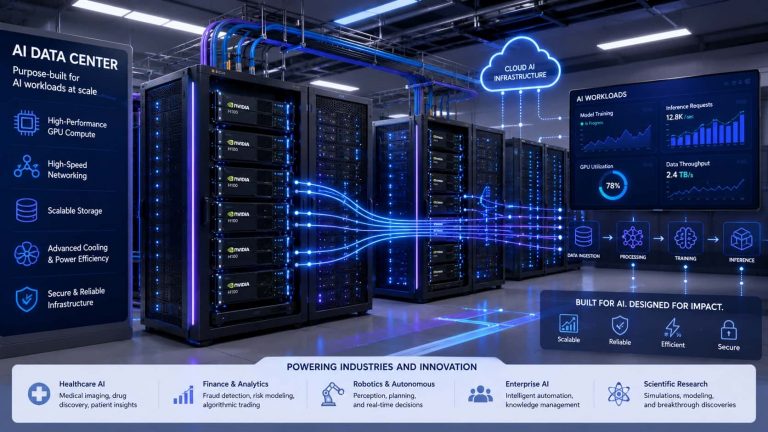
Common features include:
- GPU servers: Graphics processing units can run many calculations at once. This makes them useful for AI training and inference.
- High-speed networking: AI servers often need to exchange large data sets quickly.
- High power density: AI racks can use far more power than ordinary enterprise racks.
- Advanced cooling: Air cooling may not be enough for dense AI hardware. Some sites use direct-to-chip or other liquid cooling systems.
- Large data storage systems: Training data and model files can require substantial storage.
- Reliable power: AI jobs can be costly to interrupt, so operators often use backup power and redundant systems.
The term AI data center can therefore describe more than one type of site:
| Type of facility | Typical role | Could it support AI? |
|---|---|---|
| Cloud data center | Runs public cloud services and hosted applications | Yes, if GPU capacity is available |
| Colocation facility | Rents space, power, and network access to customers | Often, subject to power and cooling limits |
| Supercomputing center | Supports research, science, and engineering | Yes, often at high performance |
| Enterprise data center | Serves one company or institution | Yes, if equipped with suitable hardware |
| Dedicated AI campus | Built mainly for large-scale AI training | Yes, but these are less common in Massachusetts |
This means a facility may support AI without being a dedicated AI campus. The public evidence often confirms that a site provides data center or high-performance computing services, but it may not disclose the customers, GPU count, or exact AI workloads.


Which Massachusetts facilities are connected to AI and advanced computing?
Massachusetts has both commercial data center infrastructure and research computing infrastructure. The two groups serve different users.
Commercial data centers in the Boston region
The Boston metropolitan area has commercial data center operators, including major colocation and data center providers. Companies such as Digital Realty, Iron Mountain Data Centers, Cologix, and TierPoint have operated or marketed facilities in the region.
These facilities may provide:
- Colocation space
- Dedicated cages or private suites
- Network connections
- Cloud on-ramps
- Managed infrastructure
- Backup power
- Security and monitoring
A commercial facility may be suitable for AI inference, enterprise machine learning, or smaller model training. Large AI training projects require a different review. The customer must confirm that the site can provide enough power per rack, cooling capacity, network bandwidth, and physical space.
Public facility pages do not always identify AI customers. They also may not state whether a site supports the latest GPU systems. For that reason, a provider’s general claim that it offers data center space does not prove that it can host every AI cluster.
The Massachusetts Green High Performance Computing Center
The Massachusetts Green High Performance Computing Center, or MGHPCC, is one of the state’s most important advanced computing sites.
MGHPCC is located in Holyoke and supports high-performance computing for Massachusetts research institutions. Its members and users include major universities and research organizations. The center was developed to provide shared computing infrastructure for science, engineering, and other research work.
High-performance computing and AI are closely related, but they are not identical. A supercomputing center may run:
- Scientific models
- Climate simulations
- Medical research
- Engineering calculations
- Data analysis
- Machine learning and AI research
MGHPCC is therefore a strong example of Massachusetts infrastructure that can support AI-related research. It should not automatically be described as a commercial, dedicated AI training campus.
University computing facilities
Massachusetts has a large research and technology sector. Institutions such as MIT, Harvard University, and the University of Massachusetts system operate or use advanced computing resources.
These resources may support:
- AI research
- Robotics
- Natural language processing
- Computer vision
- Biomedical modeling
- Semiconductor research
- Data science
- Scientific computing
University systems often have specialized clusters rather than one large public data center. Their hardware, access rules, and workloads can change over time. Some resources are limited to researchers, students, or approved projects.
Private company facilities
Technology, health care, finance, defense, and biotechnology firms in Massachusetts may operate private computing facilities or use hosted cloud resources. Some may run AI workloads on company-owned systems. Others may lease GPU capacity from a cloud or colocation provider.
These private sites are harder to identify. Companies generally do not publish detailed information about their infrastructure, security, power use, or hardware inventory.
The documented presence of private AI workloads is therefore not the same as a publicly advertised AI data center.


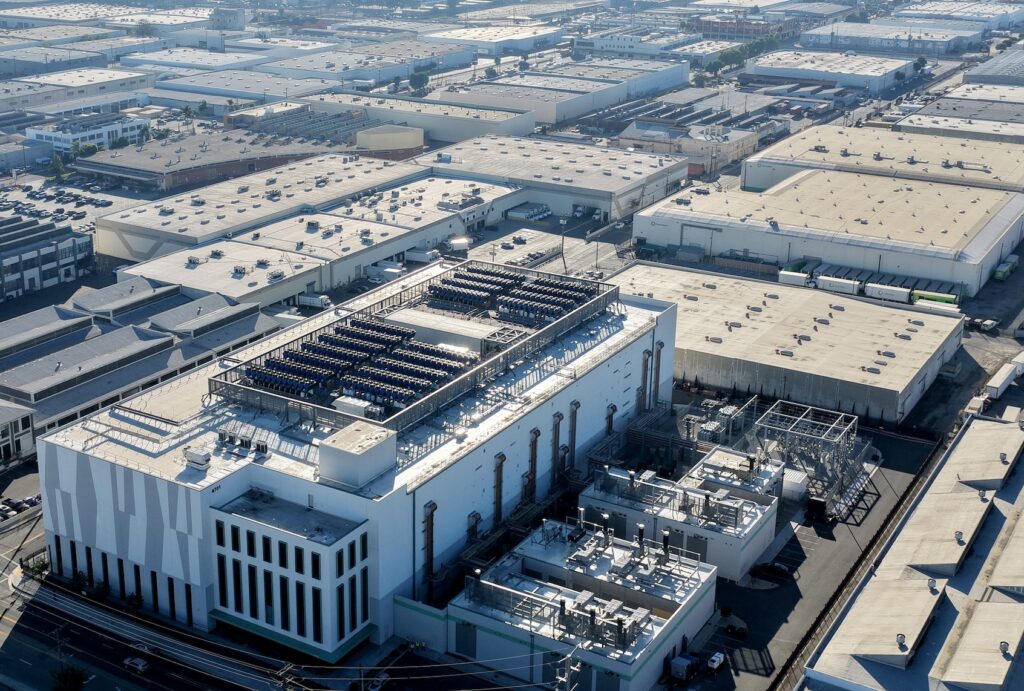
Does Massachusetts have large, dedicated AI data centers?
Massachusetts has AI-capable computing sites, but publicly available evidence does not show the same scale of dedicated AI data center development seen in the largest U.S. markets.
Several factors explain this difference.
Land and power are major limits
Large AI campuses need:
- Large parcels of land
- High-capacity electric service
- New substations or transmission upgrades
- Backup generation
- Water or other cooling resources
- Fiber connectivity
- Local permits
- Community support
The Boston area has strong fiber networks, universities, research talent, and technology customers. However, it also has high land costs and dense development. Those conditions can make large greenfield data center campuses difficult to build.
AI hardware raises power demand
A conventional enterprise rack may use far less power than a dense rack filled with modern AI accelerators. The exact demand depends on the hardware, rack design, workload, cooling method, and utilization rate.
A simple planning example shows why this matters:
Hypothetical calculation:
If a facility runs 100 racks at an average of 50 kilowatts per rack, the IT load is 5 megawatts. If the facility’s total power use, including cooling and other systems, is 20% higher, the total site load would be about 6 megawatts.
This is only an example. Actual design values vary. A large AI cluster can require much more power than this example, while a small inference cluster can require much less.
Massachusetts has a research advantage
Massachusetts has strengths that can offset its lack of very large AI campuses:
- Major research universities
- Biotechnology and health care companies
- Defense and aerospace research
- Financial services
- Semiconductor and robotics work
- A deep software and engineering workforce
- Existing network and data center infrastructure
This creates demand for AI computing even when the hardware is located in a cloud region or colocation facility outside the state.
Where are AI-capable data centers located in Massachusetts?
The most visible concentration is in and around Greater Boston, while major research computing infrastructure exists in Holyoke and at Massachusetts universities.
Greater Boston
Boston and nearby communities have the state’s strongest concentration of commercial data center services. The region benefits from:
- Large enterprise customers
- Universities and hospitals
- Financial and technology companies
- Carrier and internet connectivity
- Access to skilled technical workers
A company seeking AI infrastructure in Massachusetts would normally begin by checking Boston-area colocation providers and cloud connectivity options.


That does not mean every Boston facility can host a GPU cluster. The customer must ask about:
- Available power per rack
- Liquid-cooling support
- Weight limits for dense hardware
- Cross-connect and bandwidth options
- Physical security
- Fire protection
- Generator capacity
- Deployment lead time
- Rules for customer-owned equipment
Holyoke
Holyoke is home to MGHPCC, a major research computing center. Its location is significant because the facility was designed around high-performance computing and energy considerations.
The center supports academic and scientific work rather than functioning like a general-purpose retail colocation site. A business seeking commercial GPU hosting should not assume that research-center access is available in the same way as a commercial data center lease.
University campuses
Universities across Massachusetts may have AI clusters, research servers, and access to national computing systems. These resources are usually governed by institutional policies.
Access may depend on:
- Academic affiliation
- Research funding
- Project approval
- Data security requirements
- Export-control rules
- Institutional computing policies
A university GPU cluster may be ideal for research but unsuitable for a company that needs 24-hour commercial service-level commitments.
Can companies rent GPU servers in Massachusetts?
Possibly, but availability depends on the provider, hardware, power design, and date of inquiry.
Some companies may rent GPU servers through:
- Cloud platforms
- Managed hosting providers
- Colocation companies
- GPU-specialist providers
- University partnerships
- Private infrastructure agreements
The physical server may be in Massachusetts, in another U.S. state, or in a broader cloud region. A company should not assume that a Massachusetts billing address or local sales office means the GPU is physically located in the state.
Before signing an agreement, ask the provider for written answers to these questions:
-
Where will the equipment be located?
Ask for the country, state, and facility if location matters for compliance or latency. -
Which GPU or accelerator model is available?
“GPU access” is not a complete specification. Model, memory, interconnect, and quantity matter. -
Is the hardware dedicated or shared?
Shared systems may be cheaper but can have different performance and scheduling limits. -
What is the guaranteed capacity?
Confirm whether the provider guarantees a fixed number of GPUs or offers capacity only when available. -
What network connection is included?
Large training jobs may need fast links between storage and compute nodes. -
How is customer data protected?
Ask about encryption, access control, audit logs, data deletion, and staff access. -
What happens during an outage?
Review backup power, maintenance windows, service credits, and recovery procedures. -
Can the provider support liquid-cooled hardware?
This matters if you plan to install dense, high-power AI servers.


A provider that cannot answer these questions may still offer useful services, but the buyer should treat the arrangement as general hosting rather than confirmed AI infrastructure.

Are Massachusetts data centers powered by clean energy?
Some Massachusetts data center and research computing projects emphasize energy efficiency, renewable power, or lower environmental impact. However, the answer depends on the specific facility and the meaning of “clean energy.”
A site may use:
- Renewable energy credits
- Direct renewable power contracts
- Grid electricity with a renewable supply product
- On-site solar for a small portion of demand
- Efficient cooling systems
- Waste-heat recovery
- High-efficiency power equipment
These options are not interchangeable. A renewable energy credit may support renewable generation elsewhere, while direct power delivery describes the electricity physically serving the site.
Readers should ask for the facility’s exact claim and documentation. Useful questions include:
- Does the claim apply to the whole site or only part of the load?
- Is the figure annual or hourly?
- Does it cover tenant equipment?
- Does it include backup generators?
- Is the figure independently verified?
- Is the provider reporting power usage effectiveness, or PUE?
PUE is a common efficiency measure:
[
\text{PUE} = \frac{\text{Total facility energy}}{\text{IT equipment energy}}
]
A lower PUE generally means less overhead energy for cooling, power conversion, and other facility systems. PUE alone does not show total environmental impact. A very efficient building can still use a great deal of electricity if it contains a large AI cluster.
How does Massachusetts compare with other U.S. AI data center markets?
Massachusetts has a strong technology and research base, but it is not usually grouped with the largest U.S. data center hubs.
| Factor | Massachusetts | Major large-scale U.S. data center hubs |
|---|---|---|
| Research universities | Very strong | Varies by market |
| AI and software talent | Strong | Strong in leading hubs |
| Existing enterprise demand | Strong in Boston | Strong in major metro markets |
| Large available land parcels | More limited near Boston | Often greater outside dense metros |
| Power availability for new campuses | Site-specific and constrained | Varies widely |
| Dedicated AI campus visibility | More limited publicly | More visible in some states |
| Commercial connectivity | Strong in Boston | Strong in established hubs |
| Cost of land and construction | Often high near Boston | Lower in some emerging markets |
This comparison does not mean Massachusetts lacks AI infrastructure. It means the state’s strengths are more concentrated in research, enterprise use, and regional connectivity than in huge publicly announced AI campuses.
A company choosing a location should compare the full operating picture, not just the number of data centers. Power cost, latency, workforce, tax treatment, permitting, data rules, and expansion plans may matter more than the state label.

What should you check before calling a Massachusetts facility “AI-ready”?
Use a technical checklist. A facility is not AI-ready simply because it has servers or a reliable internet connection.
Power
Check:
- Total available megawatts
- Power available to your suite or rack
- Utility delivery schedule
- Backup power design
- Redundancy level
- Metering method
- Expansion capacity
Cooling
Check:
- Maximum rack density
- Air-cooling limits
- Liquid-cooling support
- Coolant distribution systems
- Maintenance procedures
- Leak detection
- Customer equipment requirements
Network
Check:
- Internet carriers
- Cloud connections
- Private interconnection options
- Port speeds
- Latency to your users and data sources
- Data transfer fees
- Cross-connect costs
Hardware
Check:
- Supported GPU models
- GPU memory
- Number of accelerators per server
- NVLink or similar interconnect support
- Local storage
- High-speed shared storage
- Replacement and repair process
Security and compliance
Check:
- Physical access controls
- Video monitoring
- Visitor procedures
- SOC reports
- ISO certifications, if required
- HIPAA or other sector-specific controls
- Data location
- Incident response
Commercial terms
Check:
- Minimum contract length
- Setup fees
- Power charges
- Remote-hands rates
- Hardware installation rules
- Insurance requirements
- Exit and removal fees
- Service-level terms
The signs of a strong fit are specific answers, clear limits, and written documentation. Vague claims such as “built for the AI era” do not establish technical capacity.
Common misunderstandings about Massachusetts AI data centers
“No giant AI campus means no AI infrastructure”
That conclusion is incorrect. AI can run in ordinary cloud regions, colocation suites, university clusters, and private facilities.
“A data center automatically supports GPUs”
It may not. Power density, cooling, floor loading, network design, and hardware policies can prevent a conventional facility from hosting dense AI equipment.
“A Massachusetts cloud service means the servers are in Massachusetts”
Not necessarily. Cloud providers often use multiple regions and availability zones. Confirm the physical location and data-residency terms.
“High-performance computing and AI are the same thing”
They overlap, but they serve different purposes. High-performance computing often focuses on scientific and engineering workloads. AI workloads may require specialized accelerators, model software, and different storage and networking designs.
“Renewable energy means zero environmental impact”
That statement is too broad. Energy sourcing, water use, backup generation, equipment manufacturing, and total electricity demand all affect environmental impact.
“A public announcement proves that capacity is available”
A proposed project, partnership, or expansion does not guarantee that customers can lease space today. Confirm the operating date, available capacity, equipment support, and contract terms directly with the operator.
Frequently asked questions
Are there AI data centers in Boston?
Boston has commercial data center infrastructure and access to cloud and high-performance computing resources. Some facilities may support AI workloads, but not every site is a dedicated AI data center. Confirm GPU support, rack power, cooling, and location with the operator.
Where is the main research supercomputing center in Massachusetts?
The Massachusetts Green High Performance Computing Center is in Holyoke. It supports advanced research computing for participating institutions and is an important part of the state’s high-performance computing network.
Can I rent an NVIDIA GPU in Massachusetts?
You may be able to rent GPU capacity from a cloud, hosting, or colocation provider, but the physical location and GPU model vary. Ask for the exact accelerator, region, availability guarantee, and data-location terms before purchase.
Does Massachusetts need more AI data centers?
Demand may grow as companies use more AI, but the answer depends on power, land, grid upgrades, cooling, local permits, and customer demand. More capacity is not automatically beneficial if it lacks reliable power or creates unacceptable local impacts.
Are Massachusetts data centers good for AI startups?
They can be useful for startups that need local networking, access to Boston customers, research partnerships, or controlled infrastructure. Cloud services may be easier for early testing, while colocation or dedicated servers may make more sense for stable, high-volume workloads.
Bottom line
Yes, Massachusetts has data centers and advanced computing facilities that can support AI. The state’s strongest assets are its Boston-area commercial infrastructure, research universities, technology companies, and the Massachusetts Green High Performance Computing Center in Holyoke.
The more precise answer is that Massachusetts has AI-capable infrastructure, but publicly documented evidence does not place the state among the largest U.S. markets for massive, dedicated AI data center campuses.
If you need AI capacity in Massachusetts, start by defining the workload. Then verify the facility’s physical location, GPU model, power density, cooling method, network design, security controls, and available capacity in writing. That process matters more than whether a provider uses the phrase “AI data center” in its marketing.
Sources and verification notes
This article is based on publicly available information reviewed through June 2024, including:
- Massachusetts Green High Performance Computing Center
- Massachusetts Clean Energy Center
- Digital Realty data center locations
- Iron Mountain Data Centers
- Cologix data centers
- U.S. Department of Energy: Data Centers
- National Institute of Standards and Technology AI Risk Management Framework
Availability, ownership, capacity, GPU hardware, utility conditions, and facility specifications can change. Verify current details with the facility operator before making a purchase, lease, or site-selection decision.

Everett Ashford is a tech reviewer at mytechgrid.com specializing in SSDs, cameras, TVs, earbuds, headphones, and other consumer electronics. He provides honest, data-driven reviews based on hands-on testing and real-world performance analysis. Everett simplifies complex tech details to help readers make smart, confident buying decisions.