In the United States, artificial intelligence already supports tasks such as fraud checks, medical image review, customer service, search, and traffic planning. Most of these tools do one job well. They do not think across every subject like a person.
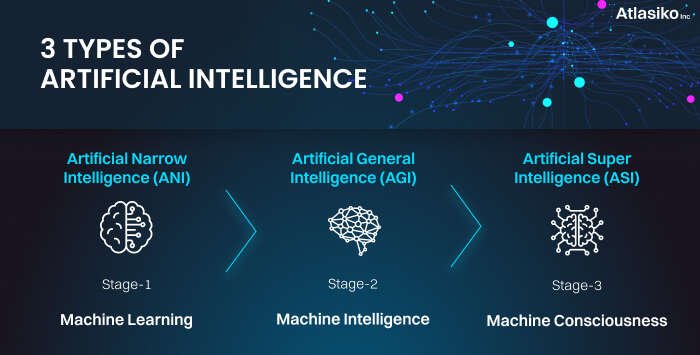
The two widely discussed types of AI are narrow AI, also called artificial narrow intelligence (ANI), and artificial general intelligence (AGI). Narrow AI exists today. AGI is a research goal and has not been clearly achieved or agreed upon as a standard.
This guide explains how the two types differ, where they are used, and why terms such as “strong AI” and “superintelligence” can cause confusion.

Quick answer: What are the two types of AI?
The two types are:
- Narrow AI: An AI system built for a specific task or limited group of tasks. Examples include spam filters, voice assistants, recommendation systems, and image recognition tools.
- Artificial general intelligence: A proposed AI system that could learn, reason, and apply knowledge across many different tasks at a human-like level.
Narrow AI is a documented part of modern technology. AGI remains an unsettled research concept. No widely accepted test proves that a current AI system has reached true AGI.
What is narrow AI?
Narrow AI is designed to perform a defined task, or a narrow set of related tasks. It may appear smart, but its skill usually depends on its training, data, software, and operating limits.
A fraud detection system, for example, may spot unusual credit card activity. It does not follow that the same system can write a legal brief, repair a car, or teach a child math. Its ability stays within the job for which it was built.
Narrow AI is also called:
- Weak AI
- Applied AI
- Specialized AI
- Artificial narrow intelligence
- Task-specific AI
The term “weak” does not mean that the system is poor at its assigned task. A narrow model may perform very well in a limited setting. The word describes its scope, not its quality.
Common examples of narrow AI
Most AI tools used in the United States today fit this category:
- Recommendation systems: Suggest films, music, products, or news.
- Spam filters: Classify unwanted email.
- Navigation tools: Estimate routes and travel times.
- Speech recognition: Convert spoken words into text.
- Computer vision: Detect objects, faces, defects, or patterns in images.
- Fraud systems: Flag unusual payment activity.
- Medical support tools: Help identify patterns in scans or patient data.
- Generative AI tools: Produce text, images, audio, or code within the limits of their design.
- Chatbots: Respond to questions using learned patterns and supplied information.
Generative AI can handle many kinds of prompts, which may make it seem general. However, broad output alone does not prove general intelligence. A model can write an email, summarize a report, or create code while still having major limits in memory, planning, reliability, physical action, and real-world understanding.
Strengths and limits of narrow AI
Narrow AI can process large data sets quickly and repeat a task with steady speed. It can also find patterns that are hard for people to spot.
Its limits matter just as much:
- It may fail when a situation differs from its training data.
- It can produce an answer that sounds right but is false.
- It may reflect errors or bias in its data.
- It may not explain its reasoning clearly.
- It does not automatically understand goals, values, or context.
- It cannot safely perform a new task just because it performs one task well.
For high-impact uses, people should review the system’s purpose, data, accuracy, privacy controls, and failure modes. The National Institute of Standards and Technology AI Risk Management Framework provides a U.S. framework for managing these risks.

What is artificial general intelligence?
Artificial general intelligence, or AGI, refers to a hypothetical AI system that could learn and use knowledge across a wide range of tasks.
An AGI system would not need a separate tool for every narrow job. It might learn a new language, plan a trip, study a scientific problem, use software, and explain its choices without being rebuilt for each task.
There is no single legal or technical definition of AGI. Different researchers may focus on different abilities, such as:
- Flexible learning
- Reasoning
- Planning
- Transfer of knowledge
- Problem solving
- Understanding context
- Working with unfamiliar tasks
- Learning with limited examples
- Adapting to new goals
Because the definition varies, claims about whether a system is “general” can be hard to compare.
Is AGI available today?
AGI has not been clearly established as a current, agreed-upon technology.
Modern AI models can perform many tasks. Some can work with text, images, audio, code, and tools. Yet strong performance across many tasks is not the same as reliable human-level intelligence in every setting.
Important open questions include:
- Can the system learn new tasks without major retraining?
- Does it understand the world or mainly predict patterns?
- Can it plan over long periods without losing track of its goal?
- Does it know when it is uncertain?
- Can it act safely in changing environments?
- Can independent tests measure its abilities in a fair way?
A system may show general-looking behavior in one test and still fail at basic reasoning, factual accuracy, or unfamiliar tasks. For that reason, avoid treating marketing language as proof of AGI.
Why AGI matters
AGI could change work, research, education, health care, and public services if it became reliable and safe. It could also create serious risks.
Potential benefits might include:
- Faster scientific research
- Help with complex engineering tasks
- Personalized education
- Support for people with disabilities
- Better analysis of large information sets
- Assistance with difficult planning problems
Potential risks might include:
- Misuse at large scale
- Unclear responsibility for decisions
- Job disruption
- Privacy loss
- Security threats
- Concentration of power
- False or harmful advice
- Weak human oversight
These outcomes are not guaranteed. They depend on system design, access, regulation, deployment, and human choices.

Narrow AI vs. AGI: What is the difference?
The main difference is scope and flexibility. Narrow AI focuses on a defined job. AGI would apply learning and reasoning across many different jobs.
| Feature | Narrow AI | Artificial general intelligence |
|---|---|---|
| Main purpose | Performs a specific task | Handles many types of tasks |
| Status | Exists in practical systems | Proposed or hypothetical |
| Learning | Usually limited to its design and data | Would transfer learning across domains |
| Adaptability | May struggle with unfamiliar cases | Would adapt to new tasks |
| Example | A system that detects spam | A system that can learn to detect spam, teach math, and plan a project |
| Human oversight | Often needed, especially in high-risk uses | Would still need safety controls and oversight |
| Main weakness | Limited scope and possible errors | Undefined performance, safety, and control challenges |
The table shows why a tool can be powerful without being general. A chess program may defeat top players, but that does not mean it can drive a truck or manage a household. Skill in one area does not automatically transfer to another.
A simple example
Imagine two systems:
- System A reviews chest images and marks areas that may need attention.
- System B can study medical images, learn a new language, plan a research project, explain a budget, and adjust its approach when conditions change.
System A is narrow AI. System B resembles the usual idea of AGI, even if its abilities would still need careful testing.

Are there other ways to classify AI?
Yes. “Two types of AI” is not the only classification system. Some books and websites divide AI by function, while others divide it by capability.
Classification by capability
This approach usually lists:
- Narrow AI
- General AI
- Superintelligence
Superintelligence means a hypothetical system that exceeds human abilities across nearly all important intellectual tasks. It is not one of the two main types in the usual narrow-versus-general comparison. It is a separate future concept.
Classification by function
Another model describes AI by how it operates:
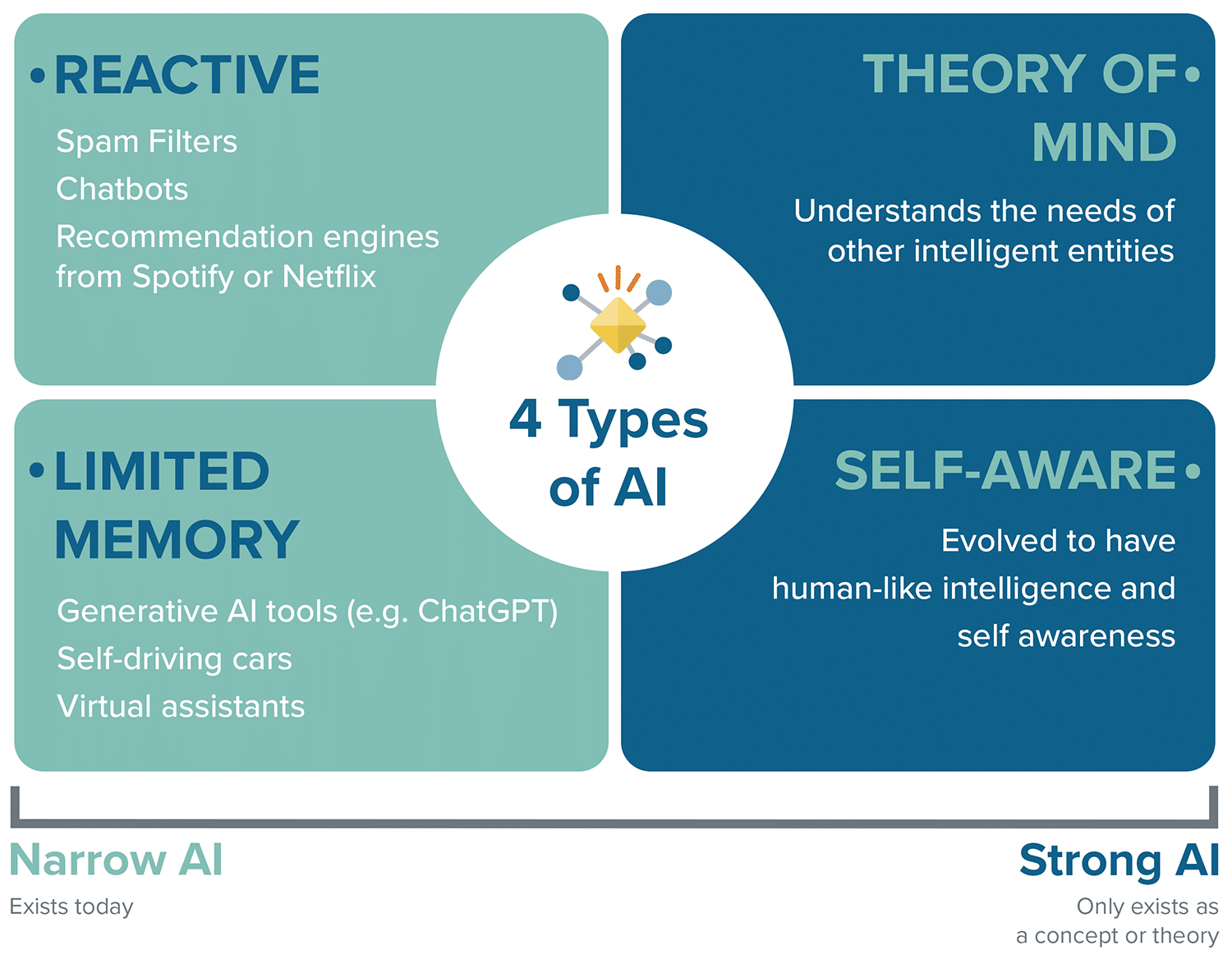
- Reactive machines: Respond to current inputs without meaningful memory of past events.
- Limited-memory systems: Use stored or recent data to make decisions.
- Theory-of-mind AI: A proposed system that could understand beliefs, goals, or emotions.
- Self-aware AI: A hypothetical system with consciousness or self-awareness.
This model is useful for basic teaching, but its categories can oversimplify modern AI. For example, many current systems use stored training data and recent context, but that does not mean they have human memory or awareness.
Which classification should you use?
Use the narrow AI versus AGI model when you want to compare the breadth of an AI system’s abilities.
Use the reactive versus limited-memory model when you want to discuss how a system uses information.
Do not mix these models as if they describe the same feature. “Narrow” describes capability and scope. “Limited memory” describes one part of system behavior.

How can you tell which type of AI you are using?
Ask what the system can do outside its advertised task. A tool is likely narrow AI if it:
- Has one clear purpose
- Works only with certain inputs
- Needs a separate model or workflow for other tasks
- Fails when the setting changes
- Relies on human review for unusual cases
- Cannot explain or transfer its knowledge reliably
A system may appear more flexible if it can use tools, retrieve documents, or switch between tasks. Those features can expand its usefulness, but they do not by themselves prove AGI.
Before relying on an AI system, check:
- Purpose: What problem was it built to solve?
- Evidence: Has its performance been tested on your type of data?
- Limits: What cases can cause errors?
- Human review: Who checks important outputs?
- Privacy: What information does the system collect or retain?
- Security: Who can access the data and results?
- Accountability: Who corrects an error or harmful decision?
For medical, legal, financial, employment, housing, or safety decisions, AI should not replace qualified human judgment. A confident output is not proof that the output is correct.

Common misunderstandings about the two types of AI
“Any chatbot is AGI”
A chatbot can answer many questions and still be a specialized system. The key question is not how many topics it can discuss. The better question is whether it can reliably learn, reason, and transfer knowledge across unfamiliar tasks.
“Narrow AI is simple”
Narrow systems can be highly complex. A weather model, aircraft control system, or medical imaging tool may use advanced mathematics and large data sets. Its narrow label refers to its purpose, not the amount of engineering behind it.
“AGI has one official test”
No universal test defines AGI. Researchers may use different tasks, benchmarks, and standards. A strong score on one benchmark does not settle the larger question.
“Human-like language proves understanding”
Natural language can make an AI system feel thoughtful. But language fluency does not guarantee accurate facts, stable reasoning, awareness, or human experience.
“AI makes decisions exactly like people”
AI systems learn patterns from data and follow programmed or trained procedures. They may support human decisions, but they do not automatically share human judgment, common sense, values, or responsibility.
Key takeaways
- The two commonly discussed types are narrow AI and artificial general intelligence.
- Narrow AI performs a defined task or group of related tasks.
- Most AI tools used in the United States today are narrow AI.
- AGI would learn and reason across many different tasks.
- AGI remains a research concept without one accepted definition or proof standard.
- “Reactive,” “limited memory,” and “superintelligence” belong to other classification models.
- A system’s usefulness does not prove that it has general intelligence.
- Human review, privacy protection, and safety checks remain important for high-impact uses.
FAQs about the two types of AI
What is the main difference between AI and AGI?
AI is the broad field of systems that perform tasks linked to human intelligence. AGI is a proposed form of AI that could handle a wide range of tasks with flexible, human-like learning and reasoning.
Is ChatGPT narrow AI or AGI?
A chatbot such as ChatGPT is generally treated as an AI system rather than confirmed AGI. It can perform many language and reasoning tasks, but broad capability alone does not establish reliable, human-level general intelligence.
Is strong AI the same as AGI?
In many discussions, “strong AI” is used as another name for AGI. The terms are not always used in exactly the same way, so check the definition in the source you are reading.
What is the third type of AI?
Some classifications name superintelligence as a third type after narrow AI and AGI. Superintelligence is a hypothetical system that would surpass human ability across most intellectual tasks.
Will narrow AI become AGI?
A narrow AI system does not automatically become AGI as it receives more data or features. Reaching general intelligence would require broad, reliable learning and transfer across many tasks, and researchers still disagree about the path and test for that goal.
Conclusion
The clearest answer to “what are the two types of AI?” is narrow AI and artificial general intelligence. Narrow AI is real and widely used for focused tasks. AGI describes a broader form of intelligence that could learn and work across many domains, but it remains undefined by one universal standard and has not been clearly confirmed.
When judging an AI tool, focus less on impressive labels and more on its purpose, evidence, limits, data use, and need for human oversight.

Everett Ashford is a tech reviewer at mytechgrid.com specializing in SSDs, cameras, TVs, earbuds, headphones, and other consumer electronics. He provides honest, data-driven reviews based on hands-on testing and real-world performance analysis. Everett simplifies complex tech details to help readers make smart, confident buying decisions.