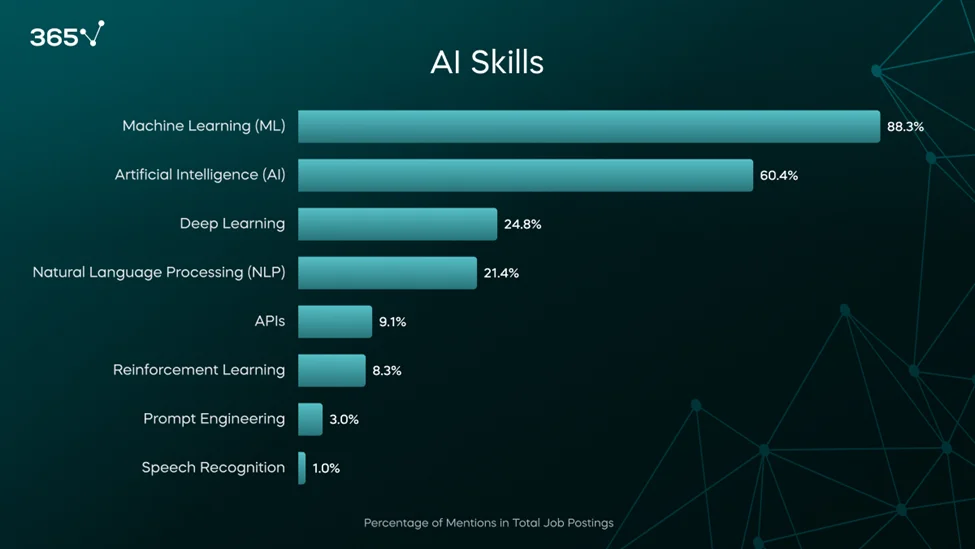
Yes. AI and machine learning engineers are in demand across the United States. U.S. companies use AI for search, fraud checks, health care, defense, finance, retail, logistics, and software tools. This demand creates jobs for people who can build, test, deploy, and maintain machine learning systems.
The job market is strong, but the role is not easy to enter. Employers often seek skills in Python, statistics, cloud tools, data systems, software engineering, and machine learning. A short course may help you start, but real projects and strong software skills usually matter more.
This guide explains the evidence, pay outlook, skills, degree needs, and best path into an AI/ML engineering career in the U.S.

Why AI/ML Engineers Are in Demand
AI/ML engineers help companies turn AI research into working products. They build systems that can process data, find patterns, make predictions, or create text, images, code, and other content.
Demand comes from several U.S. business needs:
- Companies want to automate routine work.
- Firms need better forecasts and risk checks.
- Product teams want to add AI features.
- Businesses need tools that can search large data sets.
- Hospitals and drug firms use models to support research.
- Banks use machine learning to detect fraud.
- Government agencies need secure data and AI systems.
- Cloud providers need tools that run AI models at scale.
The role also grows because AI systems need care after launch. A model may become less accurate when user behavior or data changes. Engineers must monitor results, fix errors, control costs, and protect private data.
What the U.S. labor data shows
The federal government does not track every “AI engineer” job as one separate occupation. Employers may list similar work under several titles, such as:
- Machine learning engineer
- AI engineer
- Data scientist
- Software engineer, AI
- Research engineer
- MLOps engineer
- Applied scientist
- Computer and information research scientist
The U.S. Bureau of Labor Statistics projects strong growth in nearby occupations:
| Occupation | BLS projected growth, 2023–2033 | Median annual pay, May 2023 |
|---|---|---|
| Data scientists | 36% | $108,020 |
| Computer and information research scientists | 26% | $145,080 |
| Software developers | 17% | $132,270 |
These figures do not measure AI/ML engineers as a separate job group. Still, they show strong demand in the main fields that support AI work.
The BLS also projects about 59,400 openings for data scientists, 3,400 openings for computer and information research scientists, and 140,100 openings for software developers each year, on average, from 2023 to 2033.
Sources: BLS Data Scientists, BLS Computer and Information Research Scientists, and BLS Software Developers.

What an AI/ML Engineer Does
An AI/ML engineer builds systems that use data and models to solve business or technical problems. The job often sits between software engineering, data science, and research.
Typical work includes:
- Collecting and cleaning data.
- Choosing a model or learning method.
- Training the model.
- Testing its accuracy and limits.
- Building an application around it.
- Deploying it to the cloud or a company system.
- Tracking speed, cost, bias, and errors.
- Updating the model when results decline.
For example, a machine learning engineer at a bank may build a fraud detection system. The system must find suspicious activity without blocking too many valid payments. The engineer must balance accuracy, speed, customer impact, and legal risk.
A generative AI engineer may build a customer service assistant. That person may work with large language models, search tools, prompt design, evaluation tests, and guardrails. The goal is not only to make the assistant sound useful. It must also give reliable answers and avoid exposing private data.
AI engineer versus ML engineer
The titles often overlap, but they can suggest different work.
| Role | Common focus |
|---|---|
| AI engineer | Broad AI applications, including generative AI and automation |
| ML engineer | Training, deploying, and maintaining predictive models |
| Data scientist | Analysis, experiments, insights, and model development |
| Software engineer | Reliable software, APIs, systems, and applications |
| MLOps engineer | Model deployment, monitoring, tools, and infrastructure |
| Research scientist | New methods, theories, and advanced model research |
A small company may use one person for all of these tasks. A large company may split them across several teams.
Where AI/ML engineers work
AI/ML engineering jobs appear in many U.S. industries:
- Technology and software
- Banking and insurance
- Health care
- Retail and online commerce
- Manufacturing
- Transportation
- Energy
- Telecommunications
- Defense and aerospace
- Government
- Education
- Media and entertainment
This spread helps protect demand. If one sector slows, another may still invest in AI. However, hiring can vary by city, industry, interest rates, and company budget.

Which AI/ML Skills Are Most in Demand?
The strongest candidates usually combine software skills with machine learning knowledge. Knowing how to train a model is not enough if you cannot put that model into a safe, useful product.
Core technical skills
Most AI/ML engineers benefit from these skills:
- Python
- SQL
- Data structures and algorithms
- Statistics and probability
- Linear algebra
- Model training and evaluation
- Data cleaning
- Version control with Git
- Testing and debugging
- APIs and software design
- Cloud computing
- Linux and command-line tools
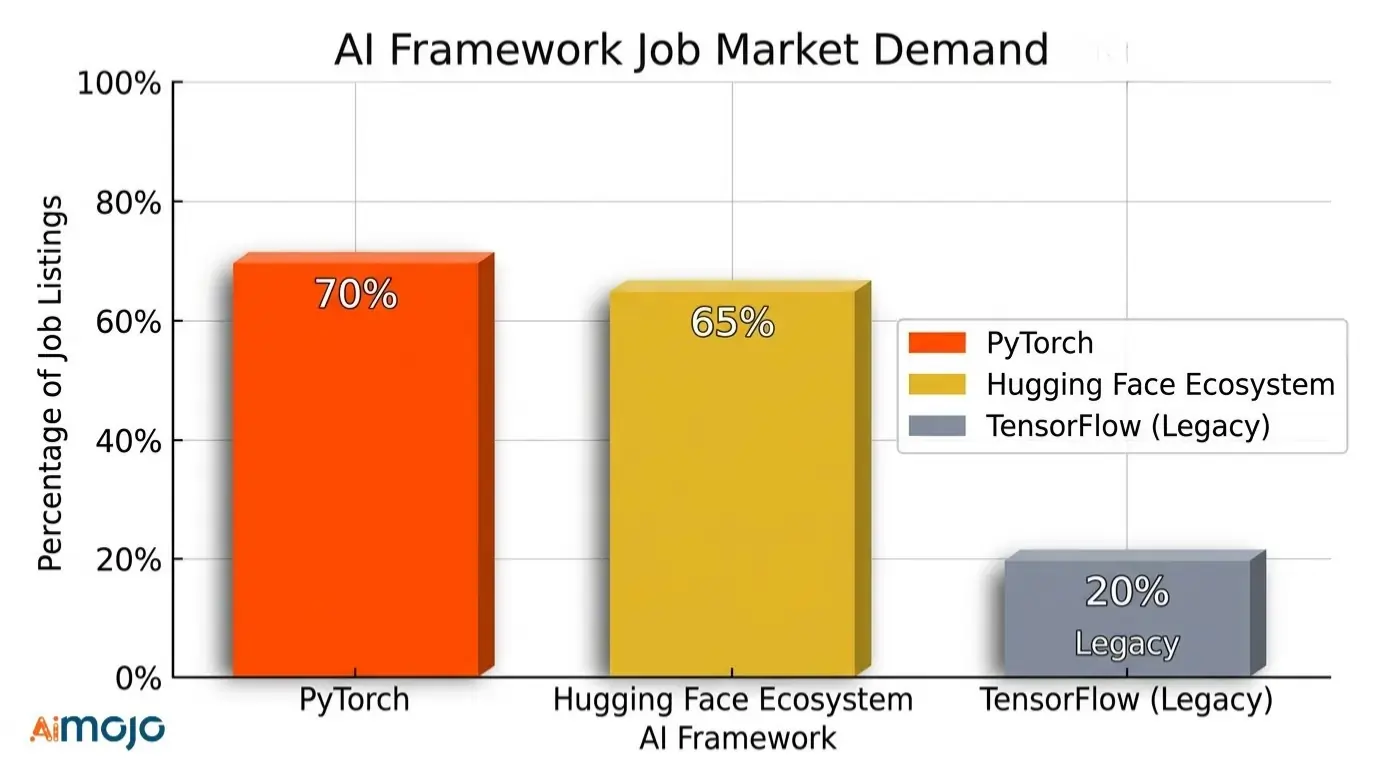
Common machine learning tools include scikit-learn, PyTorch, TensorFlow, XGBoost, and related libraries. Job postings vary, so learning every tool at once is not useful. Strong basics transfer better than memorizing one framework.
Production and MLOps skills
Production work often separates an employable engineer from someone who only completes tutorials. Important areas include:
- Docker
- Kubernetes
- Continuous integration and delivery
- Model versioning
- Data pipelines
- Feature stores
- Model monitoring
- Logging
- Cloud security
- Cost control
- Batch and real-time inference
MLOps means the tools and practices used to manage machine learning systems in production. It helps teams move from a notebook to a system that users can trust.
Generative AI skills
Many U.S. job listings now include generative AI tasks. Useful skills may include:
- Large language model basics
- Embeddings
- Vector search
- Retrieval-augmented generation
- Prompt design
- Fine-tuning
- Model evaluation
- AI safety testing
- Content filters
- Data privacy controls
A candidate should understand the limits of these tools. A fluent answer is not always a correct answer. Good evaluation is as important as good prompting.
Human skills
AI/ML engineers also need to explain trade-offs. They may need to tell a product manager why a model is slower, a security team why data must be restricted, or a client why a prediction is uncertain.
Clear writing, teamwork, and business judgment can improve job prospects. Employers want engineers who can solve the right problem, not just build a complex model.

Do You Need a Degree to Become an AI/ML Engineer?
A degree is common, but it is not always required. The right path depends on the job level and the type of work.
Many employers prefer a bachelor’s degree in:
- Computer science
- Data science
- Mathematics
- Statistics
- Electrical engineering
- Physics
- A related technical field
Research-heavy roles may require a master’s degree or Ph.D. The BLS says computer and information research scientists typically need at least a master’s degree, while software developers and data scientists commonly enter with a bachelor’s degree.
A degree can help because it provides structured study in algorithms, math, systems, and programming. It may also help with internships and campus recruiting.
Still, employers can value proof of skill. A strong portfolio may include:
- A complete machine learning application
- A deployed model with an API
- A data pipeline
- A model evaluation report
- A project that explains errors and limits
- Tests, documentation, and clear code
- A contribution to an open-source project
A portfolio should show the full process. A notebook with a high accuracy score is weaker than a small working product with careful testing.
A practical path for beginners
A beginner can follow this sequence:
- Learn Python and basic SQL.
- Study statistics, probability, and linear algebra.
- Learn supervised and unsupervised learning.
- Build small projects with public data.
- Learn software testing and Git.
- Deploy one project through an API or cloud service.
- Study data pipelines and model monitoring.
- Apply for internships, junior software roles, data roles, or ML roles.
Many people enter AI/ML engineering through software engineering or data science first. This is not a failure or a detour. It can provide the production experience that AI teams need.

How Much Do AI/ML Engineers Earn in the U.S.?
AI/ML engineer pay can be high, but there is no single national salary for the title. Pay depends on:
- Location
- Years of experience
- Industry
- Company size
- Technical scope
- Education
- Security clearance
- Equity or bonus
- Remote work policy
The BLS provides useful comparison points, not a direct AI/ML engineer salary. In May 2023, the median annual pay was $132,270 for software developers, $108,020 for data scientists, and $145,080 for computer and information research scientists.
Some private salary surveys report higher pay for AI-focused roles, especially at large technology companies. These figures may include bonuses, stock, senior workers, or selected job postings. They should not be treated as a guaranteed starting salary.
A new graduate may earn less than a senior engineer who designs large-scale systems. A role in a major technology market may pay more but also face higher living costs. Government and nonprofit roles may pay less than private firms but offer different benefits and work conditions.
The best way to judge a specific offer is to compare the full package:
- Base salary
- Bonus
- Equity
- Health coverage
- Retirement benefits
- Paid leave
- Location costs
- Work hours
- Learning opportunities
- Job stability
Is AI/ML Engineering a Good Career in 2025 and Beyond?
AI/ML engineering is a strong career option for people who enjoy both coding and applied problem-solving. The long-term outlook is positive because companies continue to invest in software, data systems, automation, and AI products.
That does not mean every AI job is secure or every course leads to employment. Tools change quickly. Some tasks may become easier through automated platforms. Employers may also reduce hiring during economic slowdowns.
The durable skill is not one model or one prompt method. It is the ability to:
- Understand a real problem
- Work with imperfect data
- Build a reliable system
- Measure results
- Explain limits
- Protect users
- Improve the system over time
The career may be less suitable for someone who dislikes math, debugging, long testing cycles, or constant learning. AI work can look exciting from the outside, but much of the job involves data quality, failed experiments, system maintenance, and careful review.
What could reduce demand?
Several factors may change the number and type of jobs:
- Companies may use ready-made AI services instead of training models.
- Automation may reduce some entry-level tasks.
- Economic pressure may delay AI projects.
- New rules may increase review and documentation needs.
- A shortage of quality data may slow deployment.
- Some experimental AI products may not become profitable.
These changes do not remove the need for skilled engineers. They may shift demand toward people who can connect AI tools to safe, useful business systems.

How Can You Stand Out in the AI/ML Job Market?
The best way to stand out is to show useful work, not only course certificates.
Build two or three complete projects
Choose projects that show different skills. For example:
- A prediction model with clear evaluation
- A search or recommendation system
- A generative AI app with retrieval and safety checks
- A real-time inference API
- A model monitoring dashboard
For each project, explain:
- The problem
- The data source
- The method
- The baseline
- The main metric
- The errors
- The cost or speed
- The limits
- The next improvement
A project that admits weak points can look more credible than one that claims perfect results.
Gain software experience
AI teams need engineers who can write maintainable code. Practice:
- Unit tests
- API design
- Error handling
- Documentation
- Code review
- Secure data handling
- Deployment
- Performance checks
A model that works only on a personal laptop is not the same as a production system.
Read job descriptions before choosing tools
Search several U.S. job postings for the role you want. Record repeated requirements. Separate them into:
- Must-have skills
- Helpful skills
- Skills for senior roles
- Skills tied to one employer
This method can prevent wasted study time. You do not need every tool listed in every posting.
Use responsible AI practices
Employers may ask how a system handles:
- Personal data
- Bias
- Security attacks
- Incorrect output
- Human review
- Explainability
- Model drift
- Copyright and data rights
The NIST AI Risk Management Framework offers a U.S. framework for managing AI risks. It does not guarantee that a system is safe, but it gives teams a useful structure for identifying and managing risks.

Common Mistakes When Planning an AI/ML Career
Mistake 1: Learning only prompt writing
Prompt skills can help, but they do not replace programming, data work, testing, and system design. Tools and model behavior can change quickly.
Mistake 2: Chasing every new framework
A long list of tools does not prove deep skill. Learn the basics first, then use new tools to solve a real task.
Mistake 3: Ignoring software engineering
Many AI projects fail because of weak data pipelines, poor testing, slow systems, or unclear requirements. Software skills make machine learning useful outside a notebook.
Mistake 4: Trusting model accuracy without context
Accuracy can hide serious errors. Check precision, recall, false positives, false negatives, fairness, cost, and performance on new data.
Mistake 5: Treating certificates as proof
Certificates can show effort. They do not replace a working portfolio, internship, or experience with real systems.
Mistake 6: Using private data in public tools
Never upload confidential company, customer, patient, or personal data to a public AI tool unless you have permission and understand the data policy. Follow your employer’s security rules.

Frequently Asked Questions
Is AI/ML engineering still in demand in the U.S.?
Yes. Demand remains strong across software, finance, health care, defense, retail, manufacturing, and other industries. The exact number of openings changes with the economy, and the federal government does not publish one separate category for every AI/ML engineering title.
Is AI/ML engineering hard to learn?
It can be challenging because it combines programming, math, data, and system design. You do not need to master everything at once. Start with Python, SQL, basic statistics, and small projects.
Can I become an AI/ML engineer without a computer science degree?
Yes, but the path may require more self-study and proof of skill. Build real projects, learn software engineering, and consider entry-level software, data, or analyst roles that can lead toward machine learning.
Is an AI/ML engineer the same as a data scientist?
No. The roles overlap, but data scientists often focus more on analysis, experiments, and insights. AI/ML engineers often focus more on software, deployment, scaling, and system maintenance.
What is the best first job for an aspiring AI/ML engineer?
A junior software engineer, data engineer, data scientist, research assistant, or ML intern role can provide useful experience. The best choice is the role that builds strong coding, data, testing, and production skills.
Conclusion
AI and machine learning engineers are in demand in the United States, and the field has a strong outlook. Official labor data shows fast growth in data science, research computing, and software development—the main job families that support AI work.
The strongest path is practical. Learn programming and math, build complete projects, understand production systems, and show that you can measure risks and results. If you are starting today, focus less on a trendy job title and more on becoming an engineer who can make AI work reliably for real users.

Everett Ashford is a tech reviewer at mytechgrid.com specializing in SSDs, cameras, TVs, earbuds, headphones, and other consumer electronics. He provides honest, data-driven reviews based on hands-on testing and real-world performance analysis. Everett simplifies complex tech details to help readers make smart, confident buying decisions.