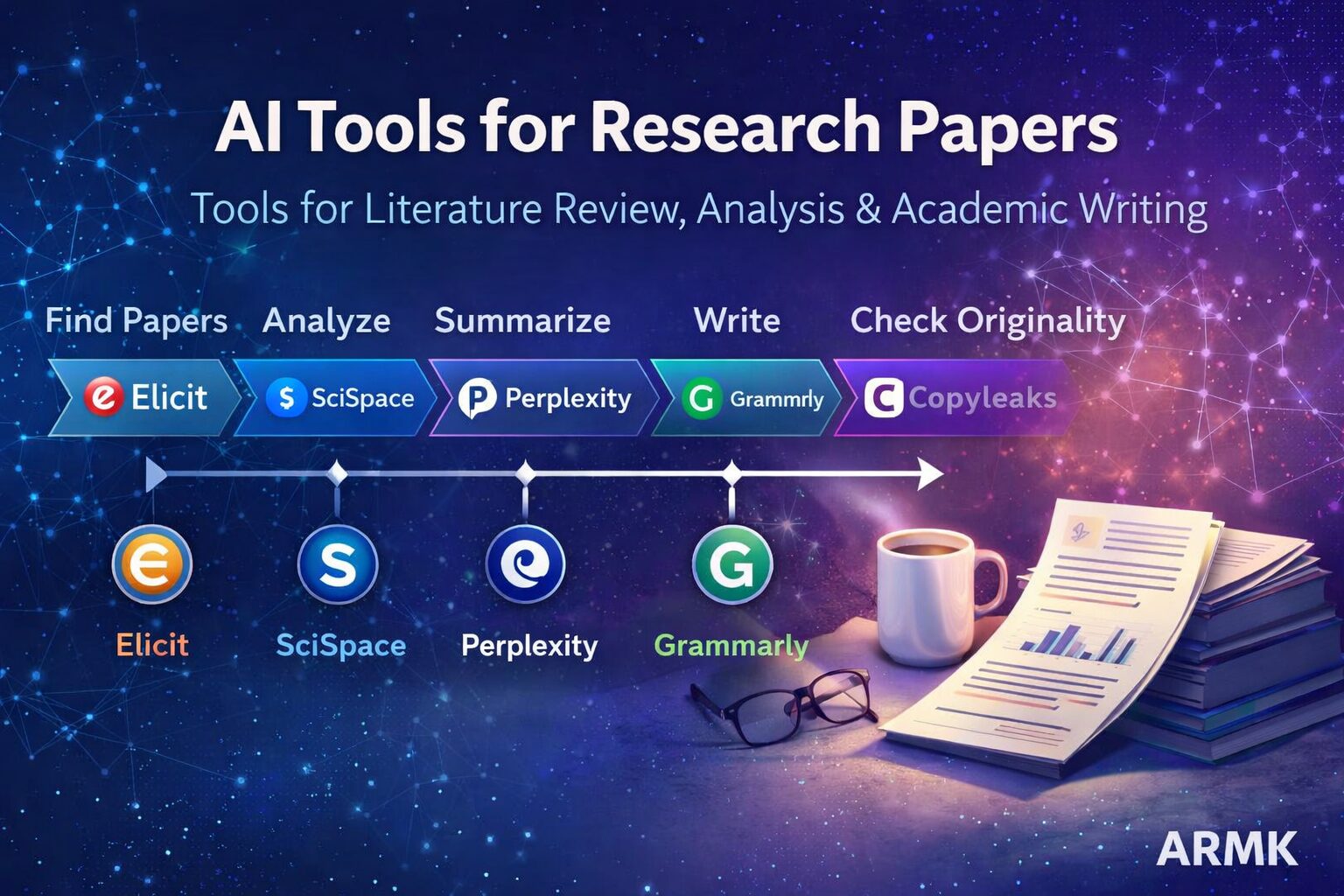
AI can help you find sources, explain difficult ideas, compare evidence, and organize notes. But it should not replace source checking or human judgment. The safest method is to use AI as a research assistant—not as the final authority.
For researchers in the United States, this means checking AI-generated claims against reliable sources such as government agencies, universities, peer-reviewed journals, court records, company filings, and established news organizations. U.S. guidance from the National Institute of Standards and Technology, the Federal Trade Commission, and federal research agencies can help you assess accuracy, risk, and responsible use.
This guide explains how to use AI for research while reducing errors, bias, fabricated citations, privacy risks, and overreliance on automated answers.


What Does It Mean to Research Using AI?
Researching with AI means using an artificial intelligence tool to support parts of the research process. It may help you:
- Define a research question
- Find useful search terms
- Explain technical language
- Summarize documents
- Compare arguments
- Extract data from text
- Organize notes
- Identify gaps or unanswered questions
- Draft an outline
- Suggest sources for further review
AI does not automatically make information true. A language model predicts likely text based on patterns in its training data or connected sources. It may produce a confident answer even when the answer is incomplete, outdated, or wrong.
The key distinction is simple:
AI can help you process evidence, but the evidence itself must come from sources you can inspect.
Use AI for speed and structure. Use primary sources and careful reasoning for proof.
AI research terms to know
| Term | Meaning | Why it matters |
|---|---|---|
| Generative AI | Software that creates text, images, code, or other content | It can produce useful drafts but may also invent details |
| Large language model | An AI system trained to predict and generate language | It does not reason like a human expert in every situation |
| Retrieval-augmented generation | AI that searches a source collection before answering | Results depend on the quality and scope of that collection |
| Citation | A reference that supports a claim | A citation must lead to a real, relevant source |
| Primary source | Original evidence, such as a study, law, dataset, filing, or interview | Usually the best source for verifying a specific claim |
| Secondary source | Analysis or explanation based on primary sources | Useful for context, but it may contain interpretation or error |
| Hallucination | A false or unsupported AI-generated statement | It is one of the main risks of AI-assisted research |



Step 1: Define the Research Question Before Using AI
Start with a narrow question. A vague request often produces a vague answer.
Instead of asking:
“Tell me about artificial intelligence in education.”
Ask:
“What does peer-reviewed research published from 2020 through 2024 say about how generative AI affects undergraduate writing instruction in U.S. colleges?”
The second question gives you:
- A topic
- A population
- A location
- A time range
- A research area
- A type of evidence
Use the question framework
Write down five parts:
- Subject: What are you studying?
- Scope: What is included and excluded?
- Place: Does the question concern the United States, a state, or another country?
- Time: What dates matter?
- Evidence standard: What type of proof do you need?
For example:
“How have U.S. state privacy laws treated biometric data since 2020, and what duties do businesses have under those laws?”
This is stronger than:
“What are the laws about biometrics?”
The first version tells AI what to focus on. It also helps you recognize when a source is outside your scope.
Ask AI to improve the question, not answer it
A useful prompt is:
I am researching [topic] for [audience or purpose].

Help me turn this broad topic into five focused research questions.
For each question, identify:
- the population or subject,
- the location,
- the time period,
- the main variables,
- and the evidence I would need.

Do not answer the questions or invent sources.
Review the suggestions yourself. AI may recommend a question that is too broad, biased, or difficult to answer with available evidence.



Step 2: Use AI to Build a Search Plan
AI can help you find better search terms. It should not be your only search tool.
Ask for:
- Synonyms
- Related terms
- Older terms
- Legal or technical terms
- Names of relevant agencies
- Possible datasets
- Common disagreements
- Search terms used in academic research
Example:
Create a search plan for this question:

What evidence exists that remote work affects employee productivity in U.S. companies?

Give me:
- broad search terms,
- narrow search terms,
- academic database terms,
- government and labor data sources,
- terms for opposing findings,
- and terms that may reveal limitations.

Do not make claims about the answer.
Search across several source types
A balanced search usually includes more than one kind of source.
| Source type | Best use | Main limitation |
|---|---|---|
| Government agency | Laws, rules, official statistics, public guidance | May not explain every practical effect |
| Peer-reviewed study | Methods, findings, and scholarly debate | May cover a narrow sample |
| University research center | Background and analysis | May summarize rather than provide original evidence |
| Company filing | Business disclosures and financial facts | The company has an interest in how it presents information |
| Court opinion | Legal reasoning and case facts | Applies within a specific legal context |
| News report | Timelines and public events | Quality and depth vary |
| Industry report | Market data and trends | Methods may be less transparent |
| Community discussion | Questions, lived experience, and possible issues | Not reliable proof by itself |
For U.S. topics, search official domains such as .gov, university domains, court databases, and agency publications. A government domain does not make every statement universally applicable, so check the date, jurisdiction, and purpose.
Useful search operators
Search operators can make research faster:
site:.gov— limits results to U.S. government websitessite:.edu— limits results to many academic institutions"exact phrase"— searches for an exact phrasefiletype:pdf— finds PDF documentsintitle:report— searches for pages with “report” in the title-term— excludes a word from results
Example:
site:.gov generative AI higher education report filetype:pdf
Use these operators to find sources. Do not assume that the first result is the strongest source.

Step 3: Ask AI to Find Leads, Then Verify Every Lead
Some AI tools can search the web or a document library. These features can save time, but they do not remove the need for verification.
When AI gives you a source, check:
- Does the URL work?
- Does the source actually exist?
- Does it support the claim?
- Is the source primary or secondary?
- Is it within your location and date range?
- Does the source describe the same population or case?
- Does the full document support the same conclusion?
A common failure occurs when AI cites a real paper that does not say what the answer claims. The title may sound relevant, but the study may examine a different group, country, or outcome.
Use a source verification prompt
I will provide a claim and a source.

Evaluate whether the source supports the claim.
Return:
- the exact relevant passage,
- what the source clearly establishes,
- what it does not establish,
- the population and date,
- the research method,
- and any important limitation.

If the source does not support the claim, say so clearly.
Do not fill gaps with assumptions.
Do not ask AI to “make the citation work.” Ask it to test the citation.
Keep a claim record
A claim record helps you avoid losing the connection between evidence and conclusions.
| Claim | Source | Evidence type | Conditions | Confidence |
|---|---|---|---|---|
| A rule applies to a certain business | State statute or agency guidance | Primary legal source | Depends on jurisdiction and effective date | High for the stated scope |
| A treatment improved an outcome | Peer-reviewed study | Empirical research | Depends on sample and method | Limited to study conditions |
| Users report a recurring problem | Several named reports or interviews | Reported experience | May not represent all users | Moderate or uncertain |
| A product is faster | Documented benchmark | Test or manufacturer claim | Must identify hardware and test method | Conditional |
Record the source title, author, publication date, URL, and the page or section that supports the claim. For important work, save a copy or note the access date because web pages can change.


Step 4: Give AI the Source Material When Possible
AI is more reliable when you provide the text it must analyze. This reduces the chance that it will rely on vague memory or unrelated information.
You can provide:
- A report
- A research paper
- A public filing
- A transcript
- A policy document
- A court opinion
- A dataset description
- Several articles for comparison
Before uploading material, check whether you have permission to use it. Do not paste confidential business data, private medical details, personal identifiers, unpublished research, or sensitive client information into a public AI service.
Prompts for source analysis
Summarize without adding facts
Summarize this document in 250 words.

Use only information in the document.
Separate:
- the research question,
- the method,
- the main findings,
- the limits,
- and the authors' stated conclusion.

Do not add outside facts.
Extract facts into a table
Extract the following from this report:
- study date,
- location,
- sample size,
- population,
- method,
- main result,
- comparison group,
- stated limitations.

If a detail is missing, write "not reported."
Compare two documents
Compare these two sources.

Create a table with:
- shared claims,
- conflicting claims,
- different samples,
- different dates,
- different methods,
- and possible reasons for disagreement.

Do not decide which source is correct unless the evidence supports that conclusion.
The phrase “not reported” is valuable. It prevents AI from guessing.
Step 5: Check the Quality of the Evidence
Not all sources answer the same question. A study may show an association without proving causation. A survey may describe opinions but not actual behavior. A law may apply to one jurisdiction but not another.
Match the source to the claim
Use the source that best fits the statement:
- What does a law require? Read the statute, regulation, court ruling, or official agency guidance.
- How common is something? Check a credible dataset and its method.
- Does an intervention work? Look for systematic reviews, controlled studies, or well-designed evaluations.
- What happened in a specific event? Use official records and credible reporting.
- What does a company claim? Read its filing, product documentation, and independent evaluations.
- What do people experience? Use interviews, surveys, or clearly identified user reports.
Watch for common evidence errors
Correlation and causation
If two things occur together, that does not prove that one caused the other.
For example, people who use a productivity app may report higher output. That finding does not prove the app caused the increase. Highly motivated workers may be more likely to use the app.
Small or narrow samples
A study of 50 employees in one industry may provide useful evidence. It does not automatically describe all U.S. workers.
Outdated information
Laws, prices, product features, software versions, and statistics can change. Check dates before relying on them.
Conflicts of interest
A company-funded study may still be sound, but its funding and methods deserve attention. Funding alone does not prove that a result is false.
Missing comparison groups
A result has little meaning without a baseline or comparison. Ask: compared with what?
Ask AI to challenge your conclusion
Here is my conclusion and the sources behind it.

Act as a critical reviewer. Identify:
- unsupported claims,
- overstatement,
- missing comparison groups,
- weak sources,
- possible confounding factors,
- outdated information,
- and alternative explanations.

Do not rewrite the conclusion yet.
This is one of the best uses of AI. It can help you see weak points before a reader, editor, professor, or client finds them.


Step 6: Use AI to Analyze Data Carefully
AI can help explain a dataset, write code, or suggest a method. It can also misread columns, use the wrong statistical test, or create code that looks correct but produces a wrong result.
Before analysis, document:
- Where the data came from
- The date range
- The unit of analysis
- Missing values
- Duplicate records
- Definitions for each field
- Any changes made to the data
- The method used
- The software or code version
Start with simple checks
Ask AI to help you:
- Count rows and columns.
- Identify missing values.
- Find duplicate records.
- Review unusual values.
- Check units and date formats.
- Compare categories.
- Create a plain-language summary.
Use a prompt like this:
Review this dataset description and analysis plan.

Before suggesting calculations, identify:
- the unit of analysis,
- possible duplicate records,
- missing fields,
- unclear definitions,
- possible selection bias,
- and variables that should not be treated as causal.

Explain each issue in plain language.
Do not treat AI-generated code as verified. Run it in a controlled environment, inspect the output, and compare the result with a manual calculation or trusted statistical tool.
For high-stakes research, have a qualified statistician or subject expert review the method.

Step 7: Organize Notes and Draft the Research
After source review, ask AI to organize your notes by claim rather than by article. This makes it easier to see which statements have strong support and which need more research.
A useful structure is:
- Research question
- Short answer
- Main findings
- Evidence for each finding
- Conflicting evidence
- Limits
- Open questions
- Practical implications
- Source list
Use a claim-evidence matrix
| Finding | Supporting source | Opposing or limiting source | Your interpretation |
|---|---|---|---|
| Finding 1 | Source A | Source B | The result may depend on the sample |
| Finding 2 | Source C | No direct comparison | Evidence is suggestive, not conclusive |
| Finding 3 | Source D | Source E | Methods differ, so results cannot be combined directly |
Ask AI to draft only after you have reviewed the evidence.
Using only the verified notes below, create an outline.

For every major claim, include:
- the evidence source,
- the strength of support,
- an important limitation,
- and any point of disagreement.

Do not add facts that are not in the notes.
When drafting, keep fact, interpretation, and recommendation separate:
- Fact: The report found a change in the measured outcome.
- Interpretation: The change may be linked to the intervention, but the design does not prove causation.
- Recommendation: Organizations should consider further testing before adopting the intervention at scale.
This separation makes your work more honest and easier to review.

A Complete AI Research Workflow
The following workflow works for school, journalism, business analysis, policy research, and general fact-finding:
- Define the question and scope.
- Ask AI for related terms and possible subquestions.
- Search primary and secondary sources.
- Save the source details.
- Read the relevant passages yourself.
- Give source text to AI for extraction or comparison.
- Record each important claim and its evidence.
- Check dates, location, sample, method, and limitations.
- Search for disagreement or contrary evidence.
- Ask AI to critique your reasoning.
- Draft from verified notes.
- Check every citation before publishing or submitting.
The workflow is strongest when AI handles repetitive work and you handle judgment.
Example: researching a workplace policy
Suppose you want to study whether a four-day workweek improves employee outcomes in the United States.
You might:
- Define “improves” as productivity, retention, absenteeism, or employee well-being.
- Limit the question to U.S. employers between specific years.
- Search for peer-reviewed studies, employer trials, and labor data.
- Ask AI to extract sample size, schedule design, comparison group, and outcome.
- Separate voluntary company experiments from controlled studies.
- Look for evidence from employers that did not report improvement.
- Avoid claiming that one result applies to every industry.
- State what the evidence can and cannot show.
The final answer may be less dramatic than a simple yes or no. That is a strength, not a weakness.

Common Mistakes When Using AI for Research
Treating an AI answer as a source
An AI response is not proof. It is a starting point unless every important claim is connected to a verifiable source.
Accepting citations without opening them
Fake, incomplete, or mismatched citations are common failure points. Open the source and read the relevant section.
Asking leading questions
A prompt such as “Why does this policy fail?” assumes failure. Use neutral wording:
“What evidence supports and challenges the effectiveness of this policy?”
Using one source for every claim
One article rarely supports an entire argument. Match each claim to the source best suited to it.
Ignoring jurisdiction
U.S. federal law, state law, local rules, and agency guidance may differ. Legal research should identify the exact jurisdiction and date.
Uploading private information
Remove names, account numbers, medical details, customer records, and confidential business information before using an AI tool.
Letting AI flatten disagreement
If two studies differ, do not ask AI to create a single average conclusion without examining their methods. Differences may result from sample, date, measurement, or design.
Confusing polished writing with strong research
A clear paragraph can still contain unsupported claims. Review evidence before editing style.
How to Tell Whether Your AI-Assisted Research Is Good
Your research is in better shape when:
- The question has a clear scope.
- Each important claim has a source.
- Sources are real, relevant, and accessible.
- Primary evidence is used where available.
- Dates and locations are clear.
- You considered conflicting evidence.
- You separated fact from interpretation.
- You documented methods and limitations.
- You removed unsupported certainty.
- Another person could repeat your search and reach the evidence.
A useful final test is the “source trail” test:
Can a careful reader move from your conclusion to the exact passage, table, dataset, or rule that supports it?
If not, the claim needs more work.
For research involving medical care, legal rights, financial decisions, public safety, or employment decisions, use qualified professional review where the stakes require it. AI can assist with preparation, but it should not be the only basis for a consequential decision.

Recommended Sources for Responsible AI Research
These resources provide useful starting points for U.S.-focused research and responsible AI use:
- NIST AI Risk Management Framework
- [NIST Generative AI Profile](https://www.nist.gov/itl/ai-risk-management-framework/ generative-ai-profile)
- Federal Trade Commission guidance on AI claims
- U.S. Government Publishing Office for federal publications and official documents
- Data.gov for U.S. government datasets
- PubMed for biomedical and health research
- Congress.gov for federal legislation
- SEC EDGAR for public company filings
- Pew Research Center for public opinion and social research
Check each source’s scope, method, date, and intended use. An official source may be authoritative for one question and irrelevant to another.

Key Takeaways
- Use AI to plan, search, summarize, compare, and organize research.
- Do not treat AI-generated text as proof.
- Verify every important claim against the original source.
- Prefer primary evidence for laws, statistics, studies, and official records.
- Record the source, date, passage, method, and limits for each major claim.
- Ask AI to find weaknesses and opposing evidence.
- Protect private and confidential information.
- Use professional review for high-stakes decisions.
FAQs
Can AI do research without human help?
AI can perform many research tasks, but it should not complete important research without human review. People must define the question, judge source quality, check citations, and interpret limitations.
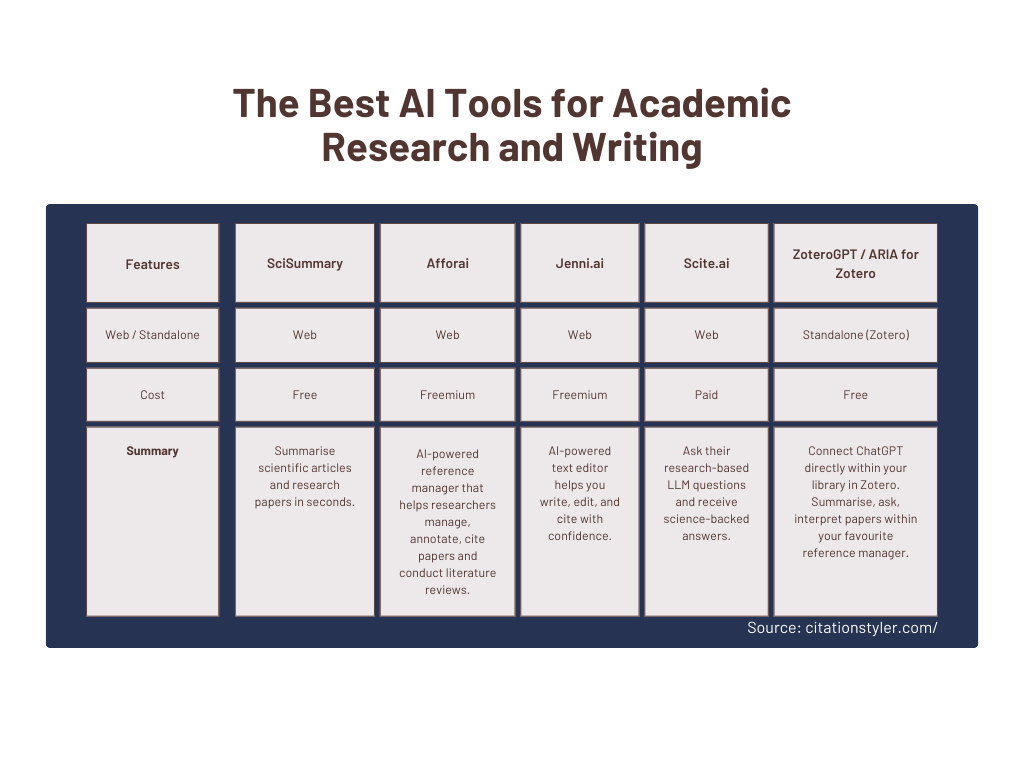
Which AI tools are best for research?
The best tool depends on the task. A general AI assistant may help with brainstorming and summaries. A tool connected to verified documents may help with source-based analysis. Academic databases, government websites, and library systems remain essential for finding reliable evidence.
How do I stop AI from making up sources?
Tell the tool not to invent citations, ask it to state when information is missing, and verify every source yourself. Providing the original documents also lowers the risk of unsupported claims.
Can I use AI-generated text in a school or work project?
Check your school, employer, publisher, or client policy first. You may need to disclose AI use, preserve your research notes, or avoid submitting generated text as your own work. AI output still requires fact checking and proper attribution.
Is AI research safe for legal, medical, or financial questions?
AI can help you prepare questions and understand general information. It should not replace a licensed attorney, health professional, or financial professional when a decision affects your rights, health, money, or safety.
Conclusion
The most reliable way to do research using AI is to divide the work clearly. Let AI help with speed, structure, and comparison. Let verified sources support the claims. Let human judgment decide what the evidence means and where its limits lie.
Start with one focused question. Build a search plan. Check the original sources. Record the evidence. Then use AI to test your reasoning before you publish or act on the result.

Everett Ashford is a tech reviewer at mytechgrid.com specializing in SSDs, cameras, TVs, earbuds, headphones, and other consumer electronics. He provides honest, data-driven reviews based on hands-on testing and real-world performance analysis. Everett simplifies complex tech details to help readers make smart, confident buying decisions.