Introduction
For people in the United States, no AI chatbot is best for every medical question. For general health education, a leading chatbot such as ChatGPT, Claude, or Gemini can explain medical terms, prepare questions for a doctor, and summarize reliable sources. However, none should replace a licensed U.S. health professional, emergency care, a diagnosis, or a treatment plan.
The safest choice depends on the task:
- General health information: Use a reputable chatbot, then check its answer against MedlinePlus, the CDC, the FDA, or a trusted medical organization.
- Symptoms: Contact a doctor, nurse line, urgent care center, or emergency service when needed. AI cannot safely rule out serious illness.
- Medication questions: Ask a pharmacist or prescriber. AI may miss drug interactions, dose changes, allergies, kidney problems, or pregnancy risks.
- Research and sources: Choose an AI tool that shows links to primary or official sources, but open and read those sources yourself.
- Private health details: Avoid entering names, medical record numbers, insurance data, or other sensitive information into a consumer chatbot.
Think of AI as a health information assistant, not a doctor. It can help you prepare for care, but it should not decide whether you need care.

The short answer: Which AI is best for medical questions?
The best AI for medical questions is the one that gives a clear, cautious answer, shows trustworthy sources, states its limits, and helps you take the right next step.
For most U.S. readers, a general-purpose chatbot can be useful for low-risk tasks such as:
- Explaining a diagnosis that a clinician has already given you
- Translating medical language into plain English
- Creating a list of questions for an appointment
- Summarizing a patient handout
- Comparing common treatment options at a high level
- Helping you organize symptoms, dates, medicines, and test results
No chatbot should be your only source when you have new, severe, or worsening symptoms.
A practical comparison
| Tool type | Best use | Main strength | Main limit |
|---|---|---|---|
| General AI chatbot | Education and question preparation | Flexible, conversational explanations | May produce errors or miss key context |
| AI with web citations | Finding current information | Can point to source material | A link does not prove the answer is correct |
| Symptom checker | Basic symptom triage | May suggest possible care levels | Cannot safely diagnose every condition |
| MedlinePlus or CDC | Verified health education | U.S. government sources | Not a personal diagnosis |
| Doctor, nurse, or pharmacist | Personal medical decisions | Can assess your history and examine you | Requires access and time |
| 911 or an emergency department | Life-threatening symptoms | Immediate emergency care | Not for routine questions |
The right answer is often AI plus a trusted health source plus a qualified clinician. Each serves a different role.

What makes an AI tool useful for health questions?
A useful medical AI answer is not simply the longest answer. It should be accurate enough for the task, clear about uncertainty, and safe about what to do next.
Look for these features.
1. It asks for missing context
a safe answer may ask about:
- Age range
- Pregnancy or breastfeeding
- Symptoms and when they began
- Severity and whether symptoms are getting worse
- Existing conditions
- Current medicines and supplements
- Allergies
- Recent surgery, travel, injury, or exposure
- Test results and the date of testing
If a tool gives a firm diagnosis without asking for basic context, treat that as a warning sign.
2. It separates facts from possibilities
A good answer should distinguish between:
- What is known
- What is possible
- What cannot be determined online
- What symptoms require prompt care
For example, chest pain can have many causes. An AI tool should not casually label it as heartburn simply because heartburn is common.
3. It uses reliable sources
For U.S. health information, useful sources include:
- MedlinePlus
- Centers for Disease Control and Prevention
- U.S. Food and Drug Administration
- National Cancer Institute
- National Library of Medicine
- Medical organizations such as the American Academy of Pediatrics or the American College of Physicians, when relevant
A source should match the claim. The FDA is a strong source for drug safety and approved medical products. The CDC is useful for public health and infectious disease guidance. A hospital blog may be helpful, but it is not the same as a government guideline or clinical review.
4. It gives a sensible safety boundary
The answer should tell you when to contact:
- Your primary care clinician
- A specialist
- A pharmacist
- An urgent care clinic
- Your health plan’s nurse advice line
- Poison Control at 1-800-222-1222
- 911 or an emergency department
In the United States, call 911 for severe trouble breathing, signs of a stroke, severe chest pain, loss of consciousness, uncontrolled bleeding, or another possible emergency.
5. It does not pretend to be a clinician
Avoid tools or answers that claim to provide a guaranteed diagnosis, promise a cure, or tell you to stop a prescribed medicine without speaking with your clinician.
Which popular AI tools can help with medical questions?
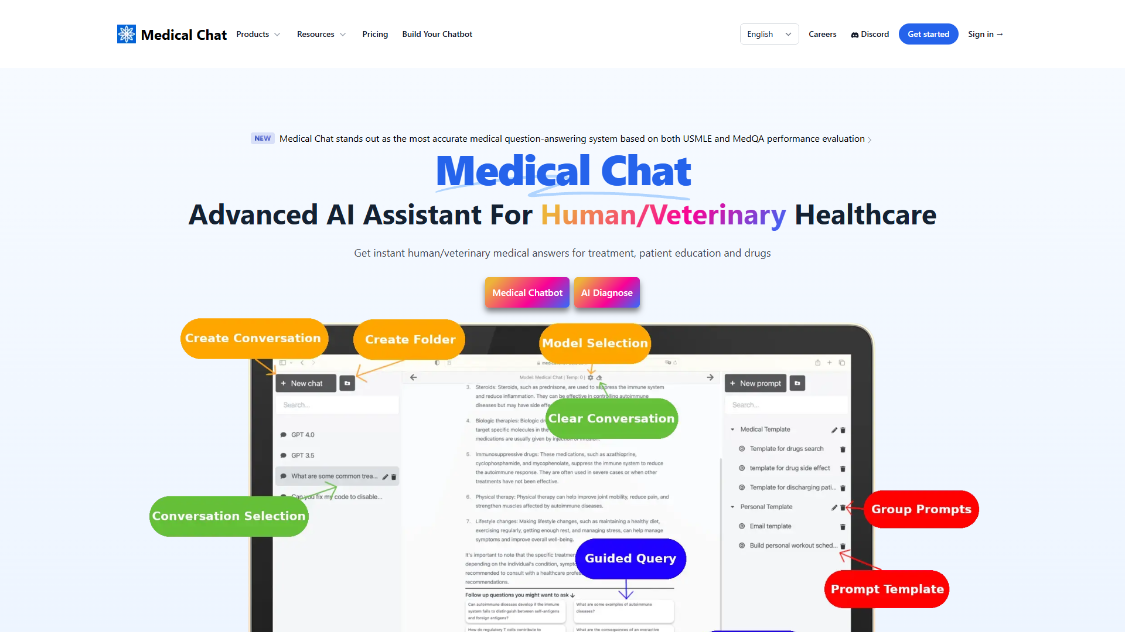
Several general AI tools can explain health topics. Their quality can change with the model, app version, search settings, prompt, and information provided. Do not assume that a familiar brand is always correct.
ChatGPT
ChatGPT can help explain medical terms, organize questions, and summarize information. If a version provides web sources, review the original pages rather than trusting the summary alone.
It may be a good fit when you want:
- A plain-language explanation
- A structured list of questions for a doctor
- Help understanding a lab report’s terms
- A summary of a long patient handout
It is not a safe substitute for a physical examination, diagnosis, or medication review.
Claude
Claude can be useful for summarizing long documents and rewriting complex medical language. This may help when you have a discharge instruction sheet or several pages of notes.
Its limitations are similar to those of other large language models. It can misunderstand a report, omit an important detail, or state an incorrect medical fact with confidence.
Google Gemini
Gemini may help with general explanations and, depending on the product and settings, finding information on the web. Check the date, source, and medical authority behind each claim.
Do not assume that search access makes an answer medically reliable. Search systems can surface outdated, commercial, or poorly reviewed pages.
Perplexity and other citation-focused tools
Citation-focused AI tools can make it easier to find source material. They may be helpful for research questions such as, “What do current U.S. guidelines say about colorectal cancer screening?”
Their main weakness is that citations can be incomplete, mismatched, or based on a secondary article. Open each source and confirm that it actually supports the answer.
Dedicated symptom checkers
Symptom checkers may help with basic triage. They are not all alike, and performance can vary by condition, age, language, and symptom pattern.
Use one only as a starting point. If symptoms are severe, sudden, unusual, or worsening, contact a clinician instead of relying on a checker.

How to use AI safely for a medical question
Use AI to prepare for care, not to delay care. The following process lowers the chance of misunderstanding.
Step 1: Decide whether the question is urgent
Before opening a chatbot, check for danger signs. Call 911 for a possible emergency, such as:
- Trouble breathing
- Severe or crushing chest pain
- New weakness or numbness on one side
- Trouble speaking or sudden confusion
- Fainting or unresponsiveness
- A severe allergic reaction with breathing problems
- Heavy bleeding that will not stop
- A seizure that is new, prolonged, or repeated
- Serious injury
For a possible poisoning in the United States, call Poison Control at 1-800-222-1222. Do not wait for an AI answer.
Step 2: Remove personal identifiers
Do not paste:
- Your full name
- Address
- Social Security number
- Medical record number
- Insurance member number
- Phone number
- Full birth date
- Photos that show identifying information
Use a general description instead. For example, write “a 62-year-old adult” rather than a full identity.
Consumer AI services may use different data practices. The fact that a service is used by a hospital does not mean its public consumer app has the same privacy protections. Read the service’s privacy policy and terms.
Step 3: Give clear, relevant facts
Include the information that changes the answer. A useful format is:
I am an adult in the United States. I have had [symptom] for [time]. It is [mild, moderate, or severe] and is [improving, stable, or worsening]. I take [medicine names], have [relevant conditions], and have [or do not have] fever, pregnancy, allergies, or recent injury. What questions should I ask a clinician, and what warning signs mean I should seek urgent care?
Do not ask, “What disease do I have?” Ask for possible explanations, warning signs, and the right level of care.
Step 4: Ask for sources and uncertainty
Add:
Please separate common causes from serious causes. State what cannot be determined without an examination. Link to current U.S. government or medical organization sources.
This does not guarantee a correct answer. It makes weak reasoning easier to spot.
Step 5: Verify the answer
Check important claims against:
- MedlinePlus
- The FDA
- The CDC
- Your prescription label
- Your pharmacist
- Your clinician’s instructions
If the AI answer conflicts with your care plan, ask your clinician or pharmacist. Do not choose the AI answer because it sounds more confident.
Step 6: Take the appropriate next action
The goal is not to receive a diagnosis from a chatbot. The goal is to decide what to do next safely:
- Monitor a mild issue with clear instructions
- Schedule a routine appointment
- Contact a clinician soon
- Call a pharmacist
- Visit urgent care
- Call 911

Best AI uses for common medical tasks
AI is most useful when the task is educational or organizational.
Understanding medical terms
Ask:
Explain “benign positional vertigo” in plain English. What does the word mean, what symptoms are common, and what questions should I ask my clinician?
This can help you understand a diagnosis already discussed with a professional. It cannot confirm that the diagnosis is correct.
Preparing for a doctor’s appointment
Ask AI to turn your notes into a short timeline:
- When the symptom began
- What makes it better or worse
- What you tried
- Any related symptoms
- Questions you want answered
This can help you use limited appointment time well.
Reading a lab report
AI can explain terms such as “reference range,” “high,” “low,” or “flagged.” But a lab value needs context, including age, sex, pregnancy status, symptoms, medicines, the laboratory’s range, and the reason for testing.
Ask:
Explain each term in this report. Do not diagnose me. Which results should I discuss with my clinician, and what context changes their meaning?
Never change a medicine based only on an AI interpretation.
Understanding medicine instructions
A pharmacist is the best source for personalized medication questions. AI can help you create a list, such as:
- What is this medicine for?
- When should I take it?
- Can I take it with food?
- What side effects need urgent help?
- Does it interact with my other medicines or supplements?
- What should I do if I miss a dose?
For a new prescription, confirm the final instructions with the pharmacist.
Translating health information
AI can rewrite complex content into simpler English or another language. Ask it to preserve:
- Doses
- Time periods
- Warnings
- Contraindications
- Follow-up dates
Then compare the rewritten version with the original. A translation error can change a medical instruction.
When AI should not be your main source
AI should not be your main source when a wrong answer could cause serious harm or delay treatment.
Use a clinician, pharmacist, or emergency service for:
- New or severe symptoms
- Symptoms in an infant, older adult, or pregnant person
- Suicidal thoughts or a mental health crisis
- Chest pain or breathing problems
- Possible stroke symptoms
- Serious allergic reactions
- Medication doses, interactions, or withdrawal
- Insulin, blood thinner, seizure medicine, or chemotherapy decisions
- Cancer treatment choices
- Pregnancy complications
- Persistent symptoms with no clear cause
- Test results that may require urgent follow-up
- Decisions about surgery or stopping prescribed treatment
For a mental health crisis in the United States, call or text 988 for the Suicide & Crisis Lifeline. Call 911 if there is immediate danger.
AI also performs poorly when the question is vague. “Why do I feel bad?” gives too little information for a safe answer. A detailed prompt improves the response, but it does not turn a chatbot into a medical examination.
How accurate are AI medical answers?
AI medical answers can be helpful, but accuracy is uneven. Performance differs by disease, question type, language, patient age, symptom severity, and model version.
Research has found that some chatbots can produce useful and empathetic answers to health questions. That does not prove that they can safely diagnose individuals. A response can sound polished while still missing a rare but dangerous condition.
The World Health Organization has warned about risks from large language models in health, including false information, automation bias, privacy problems, and unequal performance. “Automation bias” means trusting a computer’s answer too much simply because it came from a computer.
The FDA’s Artificial Intelligence and Machine Learning-Enabled Medical Devices information describes regulated medical devices that use AI. That list is not a blanket approval of every consumer chatbot. A general chatbot and an FDA-authorized clinical device are different categories.
A safe rule is simple: the higher the medical risk, the less you should rely on an AI-only answer.

How to compare AI tools for medical questions
Use this checklist before choosing a tool.
Source quality
Does it link to current U.S. government guidance, medical organizations, drug labels, or peer-reviewed research? Are the links real and relevant?
Transparency
Does it say when it is uncertain? Does it explain what information is missing? Does it avoid claiming to diagnose you?
Safety advice
Does it identify emergency warning signs? Does it suggest an appropriate care setting without causing needless panic?
Privacy
Does the service explain how it stores and uses your information? Can you use it without entering identifying health data?
Clarity
Does it explain medical terms in plain language? Does it avoid jargon and distinguish a common possibility from a dangerous one?
Scope
Is the tool meant for general education, symptom triage, clinical documentation, or another purpose? A tool designed for clinicians may not be suitable for patients.
Update process
Does it provide dates for guidelines, drug information, or public health advice? Medical recommendations can change.
A tool that performs well on one task may be poor at another. A document summarizer may be useful for a discharge paper but unsafe for symptom triage.

Common mistakes to avoid
Treating confidence as proof
AI often uses a smooth, certain tone. Confidence is not evidence. Ask for sources and look for missing facts.
Asking for a diagnosis first
Start with safety and next steps. Ask what information matters and which warning signs require care.
Entering too much private information
Remove identifiers before using a consumer tool. Sensitive details are rarely needed for a general explanation.
Using old health information
A page from several years ago may not reflect current screening advice, drug warnings, or public health guidance. Check the date.
Stopping or changing medicine without advice
Do not stop a prescription, change a dose, or combine medicines because a chatbot suggested it. Contact the prescriber or pharmacist.
Ignoring symptoms because AI called them mild
If symptoms worsen or concern you, seek care even when an AI tool sounds reassuring.
Assuming citations guarantee accuracy
A citation may not support the exact claim. Open it, check the date, and read the relevant section.
Frequently asked questions
Is ChatGPT safe for medical questions?
ChatGPT can help with general education and appointment preparation. It is not a doctor and should not be used alone for diagnosis, emergencies, medication changes, or treatment decisions. Avoid entering identifying health information.
Is there an AI that can diagnose me?
Some clinical systems and symptom checkers support assessment, but no consumer AI should be treated as a confirmed diagnosis. Diagnosis often requires a history, examination, vital signs, testing, and professional judgment.
Can AI read my lab results?
AI can explain common lab terms and help create questions for your clinician. It cannot reliably interpret every result without your medical history, symptoms, the laboratory’s reference range, and the reason for testing.
Should I trust an AI answer with medical citations?
Citations improve transparency but do not prove correctness. Confirm that the source is current, authoritative, and directly supports the claim.
Can I use AI instead of calling my doctor?
Use AI to prepare for the call, not to replace it when symptoms are serious, persistent, worsening, or unclear. A pharmacist may be the fastest qualified source for many medicine questions.
Key takeaways
- There is no single best AI for all medical questions.
- General chatbots can help with education, summaries, and appointment preparation.
- Use MedlinePlus, the CDC, the FDA, and qualified clinicians to verify important information.
- Do not use AI alone for emergencies, diagnosis, medication changes, pregnancy concerns, or serious symptoms.
- Protect your privacy by removing names, medical record numbers, and other identifiers.
- If an answer conflicts with your clinician’s advice, ask the clinician or pharmacist before acting.
Conclusion
The best AI for medical questions is a careful assistant that explains information, shows its sources, admits uncertainty, and points you toward appropriate care. The safest approach in the United States is not “AI instead of a doctor.” It is AI for preparation, trusted sources for verification, and licensed professionals for personal medical decisions.
If your symptoms may be an emergency, skip the chatbot and call 911. For a routine question, use AI to organize the facts and write down what you want to ask at your next appointment.

Everett Ashford is a tech reviewer at mytechgrid.com specializing in SSDs, cameras, TVs, earbuds, headphones, and other consumer electronics. He provides honest, data-driven reviews based on hands-on testing and real-world performance analysis. Everett simplifies complex tech details to help readers make smart, confident buying decisions.