Introduction
In the United States, people use the term AI skill in several ways. A job seeker may mean an ability such as prompt writing or data analysis. A software team may mean a task that an AI agent can perform, such as searching files or sending an email. An AI system may also have built-in skills, such as recognizing images, summarizing text, or writing code.
An AI skill is a specific ability that an artificial intelligence system can use to complete a task. It may come from the model itself, a connected tool, a set of instructions, or a combination of all three.
For example, “answer questions” is a broad ability. “Read a PDF, find all payment dates, and place them in a table” is a more useful AI skill because it has a clear task, input, and result.


What Does “Skill” Mean in AI?
In AI, a skill is a repeatable capability that helps a system reach a defined goal. The skill may be simple, such as classifying an email, or complex, such as planning a delivery route.
A useful AI skill usually has five parts:
- A goal — what the system must do.
- An input — the text, image, file, data, or command it receives.
- A method — the model, instructions, code, or tool it uses.
- An output — the result it produces.
- A limit or rule — what it must not do or when it must ask for help.
For example:
Skill: Review a customer complaint
Input: An email from a customer
Method: Read the email, identify the issue, and compare it with company policy
Output: A short summary and suggested next step
Limit: Do not issue a refund without human approval
This structure makes the skill easier to test and safer to use.
The word “skill” is not one universal technical standard. Different AI companies, software teams, and researchers may use it in different ways. In one product, a skill may be a saved prompt. In another, it may be a software module that gives an AI agent access to a database or application.


The core idea remains the same: a skill gives an AI system a focused way to perform useful work.
How Are AI Skills Different From AI Models?
An AI model is the underlying system that processes information. An AI skill is a task or capability built on top of that model.
Think of the model as an engine. A skill is a specific vehicle or tool that uses the engine for a purpose.
| Term | Meaning | Example |
|---|---|---|
| AI model | The system that processes data and generates results | A large language model |
| AI capability | A general ability of the model | Understanding language |
| AI skill | A focused task the system can perform | Extract key terms from a contract |
| AI tool | An external function the system can call | A calculator or database |
| AI agent | A system that can choose steps and use tools | Find a file, analyze it, and draft a report |
A model may know how to write text. That does not mean it can access a company database. It needs a tool, permission, and instructions for that task.
This distinction matters because people often blame the model for a missing tool or poor workflow. If an AI cannot check a live inventory system, improving the prompt will not give it access. The system needs a connection to that data source.

What Are Examples of AI Skills?
AI skills appear in consumer apps, workplaces, research systems, and automated services. Common examples include:
Language skills
These skills work with written or spoken language:
- Answering questions
- Summarizing reports
- Translating text
- Rewriting content
- Extracting names, dates, or prices
- Classifying customer messages
- Drafting emails
- Checking grammar and style
Data skills
These skills work with structured or numerical information:
- Sorting records
- Finding trends
- Cleaning data
- Creating formulas
- Building charts
- Comparing financial values
- Detecting unusual entries
- Converting files between formats
AI-generated calculations should be checked when the result affects money, safety, compliance, or a business decision. A language model can produce a confident-looking number and still make a basic arithmetic or data-entry error.
Vision skills
Computer vision skills allow an AI system to analyze images or video. Examples include:
- Reading printed text from an image
- Identifying objects
- Comparing product photos
- Checking whether a form is complete
- Detecting visual defects
- Describing a scene
Vision systems can fail when an image is blurry, cropped, poorly lit, or outside the data used to train the system.
Audio skills
Audio-related AI skills include:
- Converting speech to text
- Identifying speakers
- Removing background noise
- Translating speech
- Detecting certain sounds
- Generating spoken responses
Voice systems can misunderstand accents, names, technical terms, or overlapping speakers. A transcript should be reviewed when accuracy matters.


Action skills
Action skills let an AI system do more than produce an answer. They may include:
- Creating a calendar event
- Updating a customer record
- Searching a knowledge base
- Sending a draft for approval
- Calling an application programming interface, or API
- Running approved code
- Generating a support ticket
Action skills need stronger controls because they can change data or affect other people. Read-only access, approval steps, activity logs, and limited permissions can reduce risk.

What Is an AI Agent Skill?
An AI agent skill is a defined ability that an agent can select and use while working toward a goal.
An agent usually has more flexibility than a basic chatbot. It may:
- Understand the user’s goal.
- Break the goal into smaller tasks.
- Choose a skill or tool.
- Use the result.
- Decide whether another step is needed.
- Return an answer or request approval.
Suppose a user asks:
“Find our latest sales report, compare it with last quarter, and write a short summary.”
An agent may need several skills:
- Search company files
- Open a spreadsheet
- Calculate changes
- Create a summary
- Follow company data rules
The agent is not using one magical ability. It is combining several smaller skills.
A well-designed skill should state when it should be used, what information it needs, what it returns, and what it cannot do. Without those details, an agent may choose the wrong skill or use the right skill in the wrong way.

What Is a Skill in Generative AI?
In generative AI, a skill is often a repeatable way to produce or transform content. The content may be text, images, audio, video, code, or structured data.
Examples include:
- Write a product description in a set style
- Turn meeting notes into action items
- Create a lesson plan for a specific grade
- Generate software test cases
- Convert a report into presentation points
- Produce image ideas from a written brief
A generative AI skill normally depends on more than a short prompt. Strong results may require:
- Clear instructions
- Examples of good output
- A required format
- Relevant source material
- A quality checklist
- A human review step
For instance, “write a legal contract” is too broad for a safe general-purpose skill. A narrower task, such as “identify defined terms in this draft and list them,” has a clearer scope. Legal documents still require review by a qualified professional when legal rights or duties are involved.


What Skills Should People Learn for AI Jobs?
When people ask, “What is a skill in AI?” they may be asking about a human career skill. In that context, an AI skill is knowledge or ability used to build, operate, evaluate, or govern AI systems.
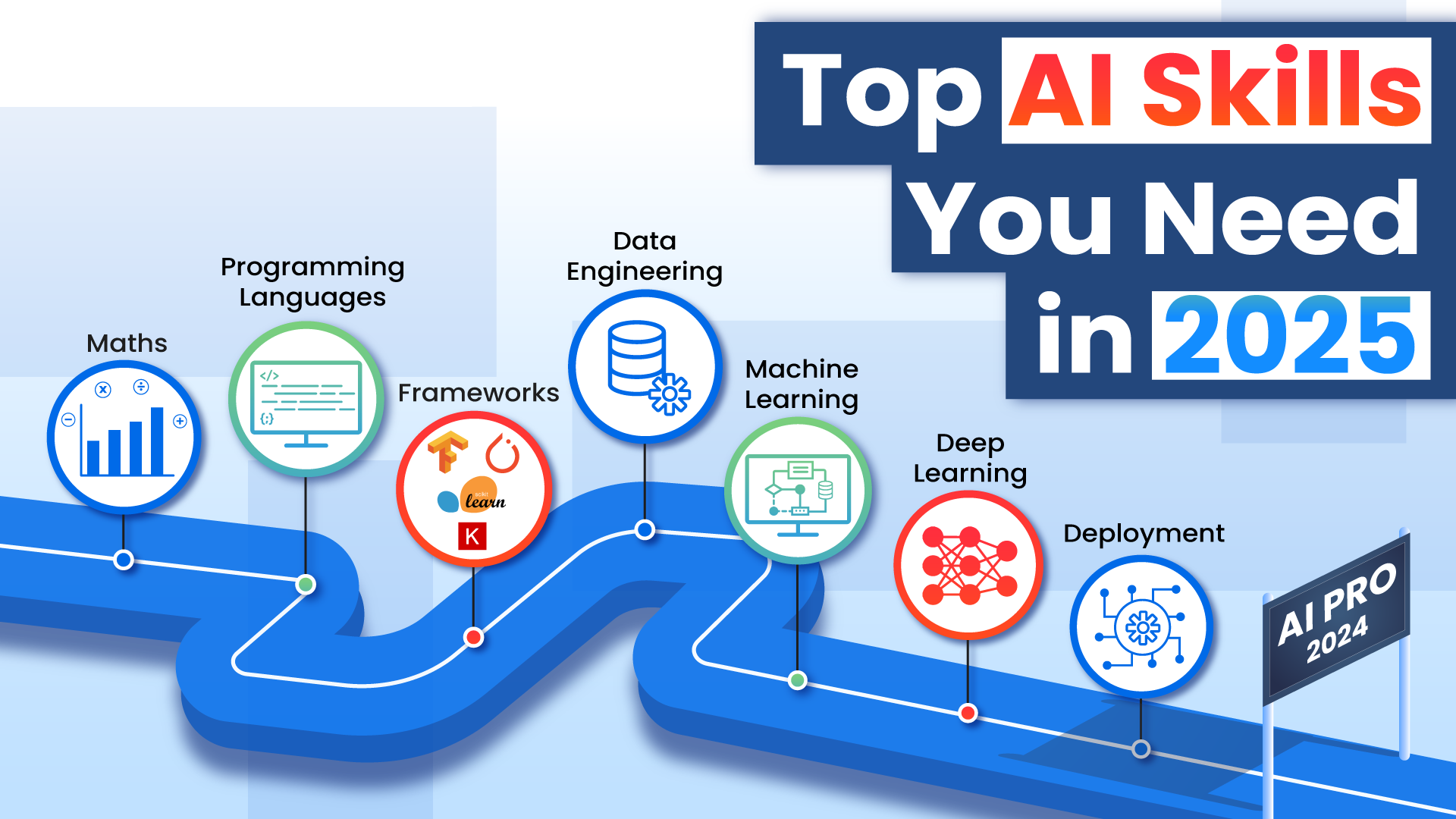
Important AI career skills include:
Data literacy
Data literacy means knowing how to read, clean, question, and explain data. It includes basic statistics, data quality checks, and an understanding of bias in datasets.
Prompt design
Prompt design means giving an AI system clear instructions, useful context, examples, and output rules. Good prompts reduce confusion, but they cannot fix missing data or unreliable tools.
Programming
Python is widely used in AI work, along with SQL, JavaScript, and other languages. Programming helps people prepare data, connect APIs, test models, and build applications.
Machine learning
Machine learning includes methods that allow systems to learn patterns from data. Key ideas include training data, validation data, features, labels, overfitting, and model evaluation.
AI evaluation
Evaluation tests whether an AI system works well for its intended use. It may check accuracy, fairness, consistency, safety, cost, speed, and resistance to misleading input.
Domain knowledge
A nurse, teacher, accountant, engineer, or customer support specialist may spot errors that a general AI system misses. Subject knowledge helps people create better workflows and review outputs.
AI governance and security
Organizations also need people who understand privacy, access controls, documentation, risk management, and responsible use. The National Institute of Standards and Technology provides the AI Risk Management Framework, which helps organizations manage risks linked to AI systems.
The best skill set depends on the job. A content editor may need prompt design and fact-checking. A machine learning engineer may need statistics and software development. An AI compliance role may focus more on governance, documentation, and risk.

How Do You Build an AI Skill?
You can build an AI skill by turning a vague goal into a small, testable workflow.
1. Define the task
Start with one clear job. Avoid goals such as “make the AI smarter.”
A better goal is:


“Extract invoice numbers, dates, and totals from uploaded PDF files.”
2. Define the input
State what the system will receive. Include file types, language, length, and likely quality problems.
Example:
- PDF invoices
- English text
- One invoice per file
- Some scans may need optical character recognition
3. Define the output
Specify the desired format. A table, JSON object, email, or short paragraph may work better than an open-ended answer.
Example fields:
- Invoice number
- Vendor
- Invoice date
- Total amount
- Confidence or review flag
4. Add rules
Rules should cover both quality and safety.
Examples:
- Do not guess a missing invoice number.
- Mark unclear text for review.
- Keep the original currency.
- Do not approve payment.
- Cite the page where each value appears.
5. Connect needed tools
If the task requires current information or action, connect an approved tool. The tool may be a search system, spreadsheet, database, calculator, or business application.
The AI should receive only the access it needs. A system that only reads reports should not have permission to delete records.
6. Test with real examples
Use normal cases, difficult cases, and cases that should fail. Include:
- Clear input
- Missing fields
- Conflicting values
- Poor scans
- Long files
- Unusual wording
- Malicious or irrelevant instructions
7. Set a review point
Some outputs should go to a person before they are used. This is especially important for medical, legal, financial, employment, safety, and security decisions.

How Do You Measure Whether an AI Skill Works?
An AI skill works when it produces the required result with acceptable accuracy, consistency, speed, cost, and risk.
Use a test set that represents real use. Then compare the output with a trusted answer or review standard.
Useful measures include:
- Accuracy: How often is the answer correct?
- Completeness: Did it find all required items?
- Precision: How many flagged items were truly relevant?
- Consistency: Does it behave similarly with similar inputs?
- Latency: How long does it take?
- Cost: How much does each task use in computing or service fees?
- Failure rate: How often does it need human correction?
- Safety: Does it follow access, privacy, and approval rules?
A simple hypothetical example can show the difference between two measures. If an AI skill flags 100 messages and 90 truly need review, its precision is 90%. If 120 messages truly need review but the skill finds only 90, its recall is 75%.
These figures are useful only when the test set, labels, and conditions are clear. A small test with easy examples may make a skill look better than it performs in daily use.

What Are the Limits of AI Skills?
An AI skill is not the same as reliable understanding. A system may complete a task while still making errors.
Common limits include:
- Hallucination: The system creates information that is not supported by its sources.
- Ambiguous instructions: The task has more than one reasonable meaning.
- Poor data: The input is incomplete, biased, outdated, or incorrectly labeled.
- Tool failure: A connected service is unavailable or returns bad data.
- Context limits: The system cannot process all required material at once.
- Prompt injection: Untrusted content tries to change the system’s instructions.
- Automation bias: A person accepts an AI result without checking it.
- Drift: Data, user behavior, or business rules change over time.
The safest design treats AI output as a result to evaluate, not as proof. Add source links, confidence flags, audit logs, approval steps, and clear failure messages where the risk requires them.
Do not use a general AI skill as the sole basis for a high-impact decision about a person. U.S. organizations should also review applicable privacy, consumer protection, employment, accessibility, and sector rules. The right legal requirements depend on the use, location, industry, and data involved.

AI Skill vs. AI Tool vs. AI Capability
These terms overlap, but they describe different parts of a system.
| Term | Main question | Example |
|---|---|---|
| Capability | What can the model generally do? | Understand text |
| Skill | What focused task can it perform? | Extract risks from a report |
| Tool | What outside function can it use? | Search a document database |
| Workflow | What sequence connects tasks? | Search, compare, summarize, and request approval |
| Agent | What system selects and performs steps? | An assistant that chooses tools to complete a goal |
A calculator is a tool. “Calculate the monthly payment and explain the assumptions” is a skill. A system that decides when to use the calculator, checks the inputs, and reports the result is an agent or agent workflow.
This distinction helps when planning an AI project. If the problem is missing access, add a tool. If the problem is unclear instructions, improve the skill. If the problem is poor decision-making across many steps, redesign the workflow and add controls.

Common Mistakes When Creating AI Skills
Making the task too broad
A skill such as “handle customer service” contains many different jobs. Split it into smaller skills, such as classify a request, find a policy, draft a reply, and route an exception.
Giving no failure behavior
The skill should say what to do when information is missing or unclear. “Ask for clarification” or “send to human review” is often safer than guessing.
Assuming the model has current data
A language model may not know the latest company policy, product price, or inventory level. Connect an approved source and show the source date.
Measuring only fluent writing
A polished answer can still be wrong. Test facts, completeness, calculations, and rule compliance.
Giving too much access
Use the least access needed. Separate read, write, and approval permissions.
Skipping human review
Automation is not always the right goal. A short review step can prevent a costly or harmful mistake.
Ignoring maintenance
A skill may fail after a policy change, software update, new document format, or shift in user behavior. Review performance on a set schedule and after major changes.

Key Takeaways
- An AI skill is a focused ability that helps an AI system complete a defined task.
- A model provides general processing power; a skill applies that power to a specific job.
- AI skills may use prompts, code, external tools, data, or agent workflows.
- Human AI skills include data literacy, programming, prompt design, evaluation, domain knowledge, and governance.
- A good skill defines its goal, input, method, output, limits, and review process.
- Test AI skills with realistic examples, including cases where the system should refuse or ask for help.
- Use extra controls for tasks involving personal data, money, health, legal rights, employment, or safety.
Frequently Asked Questions
Is prompt engineering an AI skill?
Yes. Prompt engineering is a human skill for writing clear instructions and providing useful context to an AI system. It is one part of AI work, not a replacement for data quality, software design, testing, or subject knowledge.
Are AI skills the same as machine learning skills?
No. Machine learning skills usually refer to human abilities used to build and study models. AI skills can also mean tasks performed by an AI system, such as summarizing text or searching a database.
Can an AI learn a new skill?
An AI can appear to gain a new skill when developers add instructions, examples, tools, code, or access to new data. Whether the underlying model has truly learned a lasting new capability depends on how the system was changed and tested.
What is the best first AI skill to learn?
For most beginners, start with clear task design and output review. Learn how to define a goal, provide context, check the result, and protect private information. Then add skills that match your work, such as spreadsheet analysis, coding, research, or content editing.
Can AI skills work without internet access?
Yes. Some AI systems and workflows can run locally with stored data and local software. They may not have access to current websites, cloud applications, or live databases. Offline systems also need suitable hardware, models, updates, and security controls.
Conclusion
An AI skill is a focused, repeatable ability that turns a general AI system into a useful tool for a specific task. It may involve language, data, images, audio, code, or actions in another application.
The strongest AI skills are not just clever prompts. They have clear inputs, defined outputs, useful tools, measurable tests, limits, and human review when the risk is high. Start with one small task, test it with real examples, and improve the workflow based on its errors.

Everett Ashford is a tech reviewer at mytechgrid.com specializing in SSDs, cameras, TVs, earbuds, headphones, and other consumer electronics. He provides honest, data-driven reviews based on hands-on testing and real-world performance analysis. Everett simplifies complex tech details to help readers make smart, confident buying decisions.