Introduction
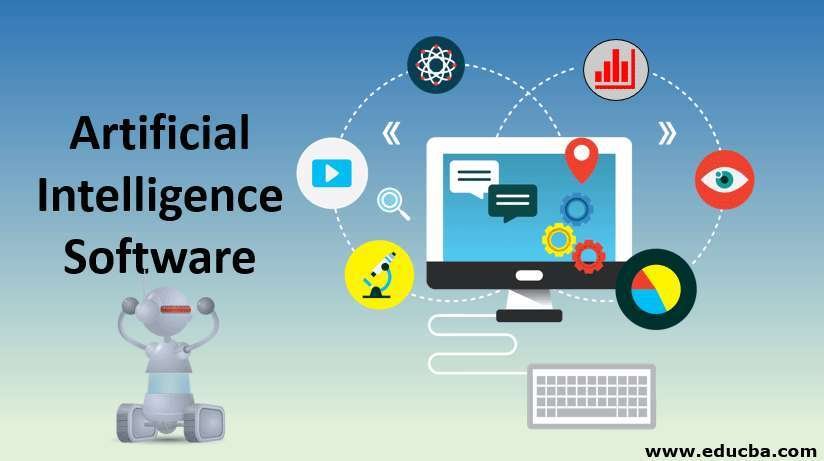
Artificial intelligence in software is the use of computer systems that can learn from data, spot patterns, understand language, make predictions, or create content. In the United States, people use AI software in many common tools, from fraud checks at banks and voice assistants to medical imaging, online shopping, and customer service.
Unlike basic software, which follows fixed rules, AI software can often handle new data and improve its results over time. It does not “think” like a person. It uses models, data, and computing power to produce an answer, prediction, recommendation, or action.

What Does Artificial Intelligence in Software Mean?
Artificial intelligence in software means adding AI methods to a program so it can perform tasks that usually need human judgment. These tasks may include:
- Understanding written or spoken language
- Recognizing faces, objects, or images
- Predicting future events
- Recommending products or content
- Finding unusual activity
- Creating text, images, audio, or code
- Automating choices within set limits
A normal program may use a rule such as:
If the account balance is below zero, show an alert.
An AI program may review many signals, such as payment history, location, device data, and spending patterns. It can then estimate whether a transaction may be fraudulent.
The key difference is how the software reaches its result. Traditional software mainly uses rules written by people. AI software uses a trained model that finds patterns in data and applies those patterns to new cases.
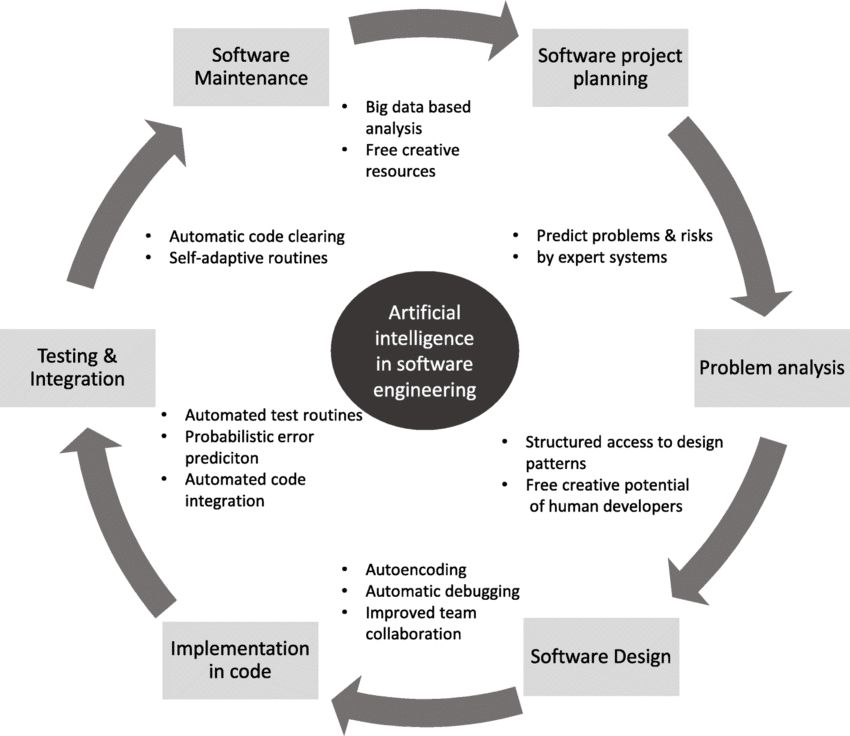
AI is not one single tool. It is a broad field that includes machine learning, deep learning, natural language processing, computer vision, robotics, and generative AI.

How Does AI Software Work?
AI software usually works through five connected parts: data, a model, training, an application, and feedback.
1. Data
Data gives an AI system examples to study. It may include:
- Customer records
- Product descriptions
- Images
- Audio files
- Sensor readings
- Business transactions
- Written documents
- Software code
The quality of the data affects the quality of the result. Incomplete, outdated, or biased data can lead to poor predictions.
2. An AI Model
A model is a mathematical system that detects patterns in data. For example, a model trained on labeled email may learn to separate likely spam from normal messages.
The model does not store a simple list of rules for every possible case. Instead, it uses learned relationships to estimate an outcome.
3. Training
Training is the process of showing data to a model and adjusting its internal settings. The goal is to reduce errors on known examples and improve performance on new examples.
For example, a bank may train a fraud model with past transactions marked as legitimate or suspicious. The model learns signals linked with each category.
Training can require large data sets, powerful computers, and careful testing. For high-risk uses, developers also need strong controls for privacy, fairness, security, and human review.
4. inference
Inference occurs when a trained model receives new data and produces an output. The output may be:
- A category
- A score
- A forecast
- A recommendation
- A generated response
- A proposed action
If an email tool receives a new message and labels it as “spam,” that is an inference.
5. Feedback and Monitoring
AI software needs ongoing checks after launch. Data can change. Customer behavior can shift. A model can become less accurate over time.
Developers may monitor:
- Accuracy
- False alarms
- Missed cases
- Response time
- Cost
- Security events
- Differences between user groups
- Changes in the input data
Monitoring helps a team detect model drift and decide when to retrain or replace a model.

What Are the Main Types of AI Used in Software?
The best type of AI depends on the task, data, risk, and required level of control.
| AI type | What it does | Common software examples |
|---|---|---|
| Machine learning | Learns patterns from data | Fraud detection, demand forecasts |
| Deep learning | Uses layered neural networks for complex patterns | Image search, speech recognition |
| Natural language processing | Works with human language | Chatbots, search, translation |
| Computer vision | Analyzes images and video | Quality checks, medical scans |
| Generative AI | Creates new text, images, audio, video, or code | Writing tools, design tools, coding assistants |
| Recommendation systems | Predicts what a user may prefer | Shopping, music, video suggestions |
| Expert systems | Applies rules and stored knowledge | Troubleshooting and decision support |
| Reinforcement learning | Learns through rewards and penalties | Robotics, game systems, some optimization tasks |
These categories can overlap. A customer support tool may use natural language processing to read a question, machine learning to classify it, generative AI to draft a reply, and rules to decide whether a human must approve the response.

What Is the Difference Between AI, Machine Learning, and Generative AI?
Artificial intelligence is the broad field. Machine learning is one way to build AI systems. Generative AI is a type of AI that creates new content.
A simple way to view the relationship is:
- Artificial intelligence: The broad goal of making software perform tasks linked with human intelligence.
- Machine learning: A method that lets software learn patterns from data.
- Deep learning: A machine learning method that uses large neural networks.
- Generative AI: AI that produces new content based on learned patterns.
For example, a spam filter is AI software. It may use machine learning to classify messages. A writing assistant may use generative AI to create a draft.
Generative AI can produce useful results, but it can also make errors. A fluent answer is not proof that the answer is correct.
How Is AI Different From Traditional Software?
Traditional software normally follows instructions that developers write in advance. If the inputs and rules stay the same, the output is often predictable.
AI software uses a model that can estimate an output from patterns in data. This makes it useful for tasks where fixed rules are difficult to write.
| Feature | Traditional software | AI software |
|---|---|---|
| Main logic | Handwritten rules | Learned patterns, rules, or both |
| Output | Often predictable | Often probabilistic |
| Data role | Provides input | May also train the model |
| Updates | Code changes | Code, data, model, or prompts may change |
| Errors | Often caused by logic defects | May result from data, model, or input limits |
| Testing | Test known rules and cases | Test accuracy, fairness, safety, and drift |
| Explanation | Usually easier to trace | Can be harder to explain |
Many real systems combine both approaches. A health care application, for example, may use AI to flag an image for review but use fixed rules to control access, record activity, and require a licensed professional to make the final decision.

Where Is AI Used in Software?
AI appears in consumer apps, business systems, public services, and professional tools across the United States.
Customer service
AI can sort support requests, suggest answers, summarize calls, and route complex cases to staff. A well-designed system should make it easy for a customer to reach a person when the issue is sensitive or unusual.
Cybersecurity
Security software can use AI to detect unusual logins, malware patterns, or suspicious network activity. These systems may reduce the time needed to review large volumes of alerts.
AI is not a complete security plan. Attackers can target the model, poison its data, or exploit weak access controls.
Health care
AI software can assist with image analysis, scheduling, documentation, research, and risk prediction. In the United States, some medical AI tools may fall under oversight by the U.S. Food and Drug Administration, depending on their function and use.
AI output should not replace a qualified clinician’s judgment when a medical decision affects a person’s care.
Finance
Banks and other financial firms use AI for fraud detection, customer support, credit risk analysis, and transaction monitoring. Financial decisions can affect access to important services, so organizations need controls for accuracy, fairness, notice, and review.
Retail and e-commerce
Retail software may use AI to recommend products, forecast demand, personalize search results, and manage inventory. Recommendations are predictions of likely interest, not proof that a product is suitable.
Software development
AI coding tools can explain code, write drafts, find possible bugs, and create tests. Developers still need to review the output for security, licensing, accuracy, and performance.
Government and public services
Public agencies may use AI to process documents, detect fraud, improve service delivery, or analyze public data. Higher-risk uses call for clear oversight, records, human review, and a way to challenge incorrect results.

What Are the Benefits of AI in Software?
AI can help software handle large volumes of information and support decisions at a useful speed. Its value depends on the task and the quality of its controls.
Common benefits include:
- Automation: AI can handle repetitive tasks, such as sorting documents or answering routine questions.
- Pattern detection: It can find links in data that may be difficult to spot by hand.
- Personalization: It can adjust recommendations or content to a user’s past behavior.
- Faster analysis: It can review large data sets more quickly than a person.
- Prediction: It can estimate demand, risk, or likely outcomes.
- Accessibility: Speech recognition, captions, translation, and text-to-speech can help more people use software.
- Decision support: It can give staff useful signals while leaving final decisions to people.
The main benefit is not that AI replaces every human task. In many cases, the better use is to help people focus on work that needs context, judgment, empathy, or accountability.
What Are the Risks and Limits of AI Software?
AI software can be wrong, unfair, insecure, or difficult to explain. These risks rise when the system affects health, employment, housing, education, credit, safety, or legal rights.
AI can produce false results
A model may give an incorrect answer with confidence. Generative AI systems can invent facts, sources, or details. This behavior is often called a hallucination.
Check important outputs against trusted records or qualified professionals.
AI can reflect bias
If training data contains unfair patterns, an AI system may repeat or increase them. A model can also work better for some groups than others if the data does not represent the people who will use the system.
Testing should compare results across relevant groups and conditions.
AI can expose private data
AI tools may process personal, business, or confidential information. Before entering data into a tool, check its privacy terms, data controls, retention rules, and employer policy.
Do not place sensitive information into a public AI service unless you have permission and understand the risks.
AI can be attacked
Threats include prompt injection, data poisoning, model theft, adversarial inputs, and unauthorized access. Security teams should treat an AI model as part of the software attack surface.
AI can be hard to explain
Some models produce accurate results without offering a clear reason that a person can understand. Explainability matters when users need to review, challenge, or appeal a decision.
AI can create unclear responsibility
A company cannot avoid responsibility by saying that “the AI made the decision.” People and organizations still need to set the purpose, limits, approval process, and review path.

How Do Developers Build AI Into Software?
Building AI into software is a process, not a single coding step.
Step 1: Define the task
Start with a clear problem. “Use AI to improve the business” is too broad. A better goal might be:
Classify incoming support requests and send urgent cases to a trained employee.
Define what success means before choosing a model.
Step 2: Decide whether AI is needed
A fixed rule may be cheaper, easier to test, and more reliable when the task is simple. AI is more useful when the task involves complex patterns, uncertain inputs, or large data sets.
Step 3: Gather and prepare data
Developers identify lawful data sources, remove errors, label examples, and protect personal information. They should also check whether the data represents real users and real operating conditions.
Step 4: Choose a model
The team may build a model, use an open model, or connect to an application programming interface, often called an API. The choice depends on:
- Accuracy needs
- Cost
- Speed
- Privacy
- Data location
- Security
- Customization
- Legal and industry requirements
Step 5: Train or configure the system
Some systems require model training. Others use an existing model with prompts, retrieval from approved documents, rules, or fine-tuning.
Step 6: Test before release
Testing should include normal cases, edge cases, bad inputs, security attacks, and cases where the model should refuse or escalate.
Step 7: Add human controls
The software should define when a person reviews the result. High-impact decisions usually need stronger human oversight than low-risk suggestions.
Step 8: Monitor after launch
The team should track performance, user complaints, unexpected outputs, and changes in the data. A launch is the start of monitoring, not the end of development.

How Should a Business Choose AI Software?
A business should choose AI software based on the task, risk, data, and total cost rather than on a claim that a product is “smart.”
Use this basic decision check:
| Question | Why it matters |
|---|---|
| What exact task will the tool perform? | Prevents vague goals and wasted spending |
| What data will it use? | Reveals privacy, quality, and access needs |
| What happens when it is wrong? | Sets the required level of review |
| Can users correct the output? | Supports safe recovery from errors |
| Does the vendor explain data use? | Helps assess privacy and confidentiality |
| Can the tool connect to current systems? | Reduces deployment problems |
| How will performance be measured? | Turns marketing claims into testable results |
| What is the full cost? | Includes setup, usage, support, training, and monitoring |
| Can the business export its data? | Reduces dependence on one provider |
| Who is accountable? | Creates a clear owner for the system |
Before broad deployment, run a limited pilot with representative data. Measure both success and failure. A tool that saves time but creates costly errors may not provide real value.

What Is an AI Model, and What Is an AI Application?
An AI model is the pattern-finding component. An AI application is the complete software product that uses one or more models.
An application may include:
- A user interface
- An AI model
- A database
- Business rules
- Security controls
- User permissions
- Logging
- Human approval steps
- Monitoring tools
This difference matters because a model’s performance does not tell you everything about the application. A strong model can still be placed in a poor workflow with weak privacy controls or unclear instructions.
When reviewing an AI product, look beyond the model name. Ask how the complete system handles data, errors, access, updates, and user complaints.

What Laws and Frameworks Guide AI Software in the United States?
The United States does not use one single federal law for every AI system. Requirements can depend on the industry, the use case, the data, the state, and the effect on individuals.
Relevant sources may include:
- Federal consumer protection rules
- Health privacy and medical device requirements
- Financial services rules
- Employment and civil rights laws
- State privacy laws
- State and local AI requirements
- Contract and intellectual property rules
- Industry standards and internal policies
The National Institute of Standards and Technology publishes the AI Risk Management Framework, which helps organizations manage risks related to trustworthy and responsible AI. The framework is voluntary unless an organization adopts it through policy or a contract.
The Federal Trade Commission has also addressed deceptive or unfair uses of AI. The exact legal answer depends on the system and facts, so organizations handling high-impact use cases should obtain advice from qualified U.S. legal and compliance professionals.
Common Mistakes When Using AI in Software
Treating AI output as fact
AI can create a polished answer that is still wrong. Verify important facts, calculations, citations, and decisions.
Using poor or unrelated data
A model trained on old or narrow data may perform poorly in real use. Test with data that matches the actual users and environment.
Skipping human review
Automation should not remove human judgment when an error could cause serious harm.
Sending confidential data to an unapproved tool
Use approved systems and follow company, client, and legal requirements. Privacy settings can differ by product and plan.
Measuring only speed
Faster output is not enough. Track accuracy, error costs, user impact, fairness, security, and total operating cost.
Failing to plan for change
Models, vendors, data, laws, and user behavior can change. Create a process for updates, audits, incident response, and retirement.
Assuming an AI detector proves authorship
AI detection tools can produce false positives and false negatives. A detector score alone does not establish who wrote content or whether content is accurate.
Key Takeaways
- AI in software uses data and models to recognize patterns, make predictions, understand inputs, or create content.
- Machine learning is one method used to build AI systems.
- Generative AI creates new content but may produce confident errors.
- Traditional rules and AI models often work together in one application.
- Data quality, privacy, security, testing, and human review are central to safe use.
- Choose AI software by its task, evidence, limits, controls, and total cost.
- For high-impact uses, involve qualified legal, technical, compliance, and subject-matter professionals.
Frequently Asked Questions
Is artificial intelligence the same as software?
No. AI is a type of technology used inside some software. Software can follow fixed instructions without using AI.
Does AI software think like a human?
No. AI software processes data with mathematical models. It can imitate reasoning or language, but it does not have human awareness, needs, or understanding.
Can AI work without machine learning?
Yes. Some AI systems use rules, search methods, logic, planning, or knowledge bases. Many modern AI applications combine these methods with machine learning.
Is ChatGPT an example of AI software?
Yes. ChatGPT is a generative AI application that can produce text and interact with users. Its output still needs review because language fluency does not guarantee accuracy.
Can small businesses use AI software?
Yes. Small businesses can use AI for tasks such as document drafting, customer support, scheduling, search, transcription, and analysis. They should begin with low-risk tasks, protect confidential data, and measure whether the tool saves time without creating new errors.
What should I learn to build AI software?
Start with programming, data handling, statistics, software testing, and basic machine learning. For production systems, also learn privacy, cybersecurity, model evaluation, cloud or server operations, and responsible AI practices.
Conclusion
Artificial intelligence in software is the use of data-driven models and related methods to help programs recognize patterns, predict outcomes, understand information, or create content. It can make software more useful, but it also introduces risks that ordinary rule-based programs may not have.
The safest approach is practical: define a clear task, use suitable data, test real conditions, protect private information, keep people involved when the stakes are high, and monitor the system after launch. If you are evaluating an AI tool, begin with one limited use case and measure both its benefits and its failures.

Everett Ashford is a tech reviewer at mytechgrid.com specializing in SSDs, cameras, TVs, earbuds, headphones, and other consumer electronics. He provides honest, data-driven reviews based on hands-on testing and real-world performance analysis. Everett simplifies complex tech details to help readers make smart, confident buying decisions.