Introduction
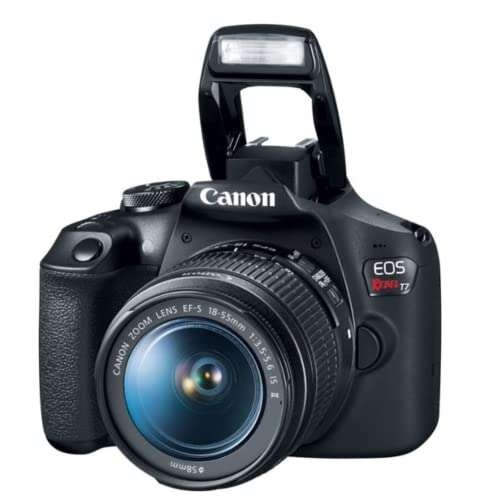
A DSLR camera usually weighs about 0.8 to 2.2 pounds (350 to 1,000 grams) for the camera body alone. Small entry-level models may weigh less than 1 pound, while professional full-frame DSLRs often weigh close to 2 pounds before adding a lens.
For a complete camera setup in the United States, expect a total weight of roughly 1.5 to 4 pounds (0.7 to 1.8 kilograms). The lens often adds as much weight as the camera body, and a large telephoto lens can add several more pounds.
The exact answer depends on the DSLR model, sensor size, battery, memory card, lens, strap, and other accessories. This guide explains how manufacturers list camera weight, compares common DSLR sizes, and shows how to estimate the weight you will carry.

Quick answer: How much does a DSLR camera weigh?
Most DSLRs fall into these weight ranges:
| DSLR type | Body-only weight | Approximate weight |
|---|---|---|
| Small entry-level DSLR | 350–550 g | 0.8–1.2 lb |
| Mid-range APS-C DSLR | 550–750 g | 1.2–1.7 lb |
| Full-frame DSLR | 650–900 g | 1.4–2.0 lb |
| Professional DSLR | 900–1,300+ g | 2.0–2.9+ lb |
| DSLR with standard lens | 650–1,300 g | 1.4–2.9 lb |
| DSLR with large telephoto lens | 1,500–3,500+ g | 3.3–7.7+ lb |
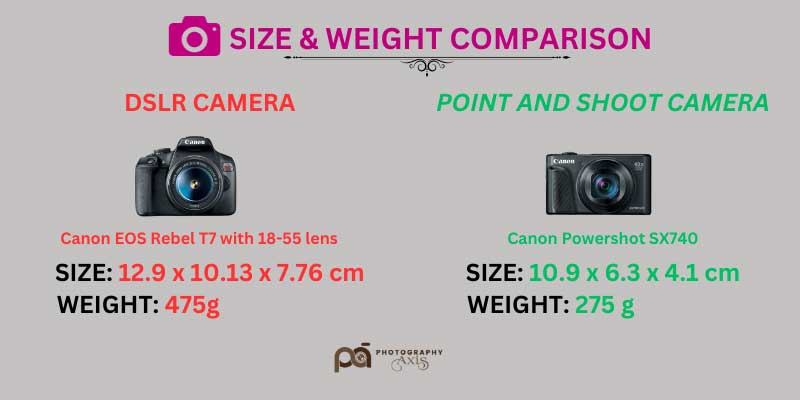
These are useful planning ranges, not fixed limits. A compact DSLR with a small 50mm lens may weigh less than 2 pounds. A professional body with a 70–200mm f/2.8 lens can weigh more than 5 pounds.
For a simple everyday setup, a realistic estimate is 2 to 3 pounds. For travel, hiking, or long events, that difference can affect comfort more than many buyers expect.
Why DSLR weight varies so much
DSLR weight changes because camera makers use different sensors, bodies, batteries, viewfinders, and weather seals. The lens can also change the total by a large amount.
Camera body design
Entry-level DSLRs often use smaller bodies and lighter materials. Their bodies may include a plastic outer shell over a rigid internal frame. This keeps weight and cost down.
Mid-range and professional cameras may use stronger frames, larger grips, more controls, and better sealing against dust and moisture. These features can make the camera more durable, but they also add weight.
A larger body may feel more stable with a heavy lens. A smaller body may be easier to carry, but it can feel cramped for people with large hands.
Sensor size
Most DSLRs use one of two sensor formats:
- APS-C: A smaller sensor used in many entry-level and mid-range cameras.
- Full frame: A larger sensor with the same approximate size as a 35mm film frame.
Full-frame DSLR bodies are often heavier, although this is not a strict rule. The larger sensor itself is only part of the difference. Full-frame cameras commonly include larger batteries, bigger grips, stronger shutters, and more advanced controls.
Battery and memory card
Manufacturers may list weight in more than one way:
- Body only
- Body with battery and memory card
- Body with battery, card, and other standard parts
For example, Canon often separates “body only” weight from weight “including battery and memory card.” Nikon may also list body weight with or without the battery and memory card, depending on the model page or manual.
Always check the measurement condition before comparing two cameras. A camera listed at 1.5 pounds with its battery is not directly comparable to one listed at 1.5 pounds without its battery.
Viewfinder and internal mirror
A DSLR has a reflex mirror and an optical viewfinder. These parts sit inside the camera body and contribute to its size and mass.
A mirrorless camera does not use the same mirror box design. That can allow a smaller body, though a large lens can still make a mirrorless kit heavy. The difference is not always dramatic when comparing complete systems.
Built-in flash and extra controls
Some smaller DSLRs have a built-in pop-up flash. Professional bodies may omit it but include a larger battery, more durable controls, and a stronger frame.
Extra buttons, top displays, larger grips, and faster shutters can all add small amounts of weight. Together, those changes can make a noticeable difference.
DSLR weight examples from popular camera classes
The following examples use manufacturer-published specifications. They show how camera weight differs across common DSLR categories. The exact listed weight may change depending on whether the battery and memory card are included.
| Camera example | Sensor class | Approximate body weight | Approximate pounds |
|---|---|---|---|
| Nikon D3500 | APS-C | 365 g with battery and card | 0.8 lb |
| Canon EOS Rebel T8i / 850D | APS-C | 515 g with battery and card | 1.1 lb |
| Canon EOS 90D | APS-C | 701 g with battery and card | 1.5 lb |
| Nikon D780 | Full frame | 840 g with battery and card | 1.9 lb |
| Canon EOS 6D Mark II | Full frame | 765 g with battery and card | 1.7 lb |
| Nikon D850 | Full frame | 1,005 g with battery and card | 2.2 lb |
| Canon EOS-1D X Mark III | Professional full frame | About 1,440 g with battery and card | 3.2 lb |
These figures illustrate the range rather than rank the cameras. A lighter camera is not automatically better, and a heavier camera is not automatically more durable or capable.
For exact specifications, check the camera maker’s product page or instruction manual:
- Nikon D3500 specifications
- Nikon D850 specifications
- Canon EOS 90D specifications
- Canon EOS 6D Mark II specifications
Manufacturers use different test and reporting methods. Treat their figures as documented model specifications, not as a single universal weighing standard.

How much does a DSLR weigh with a lens?
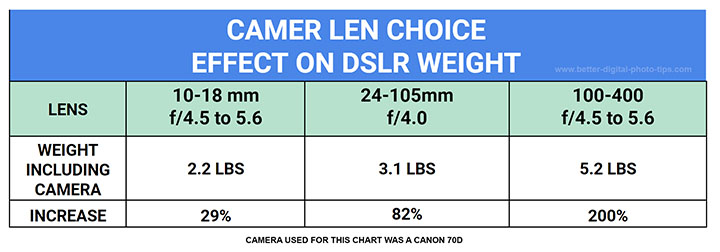
A DSLR with a lens usually weighs 1.5 to 3 pounds, but the total can be much higher with a telephoto lens.
Here are common examples:
| Setup | Lens weight range | Total setup estimate |
|---|---|---|
| Small DSLR with 18–55mm kit lens | 200–250 g | 550–800 g |
| Mid-range DSLR with 18–135mm lens | 400–550 g | 1,000–1,300 g |
| Full-frame DSLR with 24–105mm lens | 600–800 g | 1.4–1.8 kg |
| DSLR with 70–200mm f/2.8 lens | 1,400–1,600 g | 2.2–3.0 kg |
| DSLR with 100–400mm telephoto lens | 1,300–1,700 g | 2.0–3.0 kg |
A standard kit lens is often the best way to keep a DSLR light. A fast zoom lens, such as a 24–70mm f/2.8 or 70–200mm f/2.8, uses more glass and usually has a larger barrel. That extra optical range and brightness come with a major weight increase.
To estimate your own setup:
Total camera weight = camera body + lens + battery + memory card + strap + accessories
For example:
- Camera body: 700 g
- Standard zoom lens: 500 g
- Battery and card: 100 g
- Strap: 100 g
Estimated total: 1,400 g, or about 3.1 pounds.
This calculation is hypothetical. Check the specifications for your exact camera and lens for a closer result.

How to convert DSLR weight from grams to pounds
Camera specifications often use grams, while many U.S. shoppers think in ounces and pounds.
Use these conversions:
- 1 ounce = 28.35 grams
- 1 pound = 453.6 grams
- 1 kilogram = 2.205 pounds
A simple formula is:
Pounds = grams ÷ 453.6
Examples:
- 400 g ÷ 453.6 = 0.88 lb
- 700 g ÷ 453.6 = 1.54 lb
- 1,000 g ÷ 453.6 = 2.20 lb
- 1,500 g ÷ 453.6 = 3.31 lb
For quick estimates:
| Grams | Approximate pounds |
|---|---|
| 350 g | 0.8 lb |
| 500 g | 1.1 lb |
| 750 g | 1.7 lb |
| 1,000 g | 2.2 lb |
| 1,500 g | 3.3 lb |
| 2,000 g | 4.4 lb |
Do not confuse ounces by weight with fluid ounces. Camera specifications use ounces as a measure of mass.
What is a comfortable DSLR weight for travel?
For travel in the United States, a camera body between 1 and 1.7 pounds is often easier to carry all day. With a small zoom lens, the full kit may weigh about 2 pounds.
Your comfort depends on more than the number on the scale. A well-shaped grip, padded strap, and balanced lens can make a heavier camera feel easier to carry. A poorly balanced kit can feel tiring even when it weighs less.
Consider these setups:
- Light travel setup: Small APS-C DSLR plus 18–55mm lens, about 1.5–2 pounds
- Flexible travel setup: Mid-range DSLR plus 18–135mm lens, about 2.5–3 pounds
- Full-frame travel setup: Full-frame DSLR plus standard zoom, about 3–4 pounds
- Wildlife setup: DSLR plus telephoto lens, often 5 pounds or more
A shoulder strap or backpack may be more comfortable than a thin neck strap. For long walks, place the camera in a padded bag when you are not actively shooting. The goal is not only to reduce weight but also to spread the load.

Does a heavier DSLR take better photos?
No. Camera weight does not directly determine image quality.
A heavier DSLR may include features that help in certain situations, such as:
- A larger battery
- More physical controls
- A stronger body
- Better weather resistance
- A larger optical viewfinder
- Faster continuous shooting
- A more robust shutter system
However, image quality also depends on the lens, lighting, focus, exposure, camera settings, and the photographer’s technique. A lighter camera that you carry and use often may produce better real-world results than a heavier camera that stays at home.
Weight can affect stability, too. A heavy camera may be steadier with a long lens, but it can also cause arm fatigue and camera shake during a long handheld session. A tripod or monopod may help more than buying a heavier body.

How to choose the right DSLR weight
Choose based on how you will carry and use the camera, not on body weight alone.
For beginners
A DSLR body around 1 pound is often easier to learn with and carry. An APS-C camera with a basic 18–55mm lens provides a practical starting setup without excessive bulk.
For travel and family photos
Look for a compact body and a small zoom lens. A total kit weight near 2 pounds is easier to keep in a day bag or carry through a museum, park, or city.
For portraits and events
A mid-range or full-frame body may be useful, but the lens often matters more. A bright portrait lens can add weight while improving low-light performance and background blur.
For wildlife and sports
The lens usually dominates the weight. A long telephoto lens can weigh more than the DSLR body. Plan for a suitable strap, monopod, or backpack rather than judging the camera body by itself.
For hiking
Think about the full load. Include extra batteries, water protection, a tripod, filters, and spare lenses. A body that seems light in a store can become tiring when combined with outdoor gear.

Common mistakes when comparing DSLR weight
Comparing body-only weight with kit weight
A listing may show the camera body without a lens. Another listing may show a camera kit that includes a lens. These numbers describe different things.
Check whether the stated weight includes the lens, battery, memory card, strap, or battery grip.
Ignoring the lens
The lens can equal or exceed the body weight. If you plan to use a 70–200mm or 100–400mm lens, calculate the complete setup before buying.
Forgetting accessories
A spare battery, flash, tripod plate, camera strap, protective filter, and memory cards all add weight. A full camera bag can weigh much more than the camera alone.
Assuming “weather sealed” means waterproof
Weather resistance does not make a DSLR safe to submerge or use without care in heavy rain. Follow the camera maker’s guidance and protect the camera when conditions are wet, dusty, or very cold.
Treating advertised weight as a personal measurement
Published specifications may use different conditions. If the exact load matters for a backpack, airline trip, or support system, weigh the assembled kit with a household luggage scale.

Key takeaways
- A DSLR body usually weighs 0.8 to 2.2 pounds.
- Entry-level APS-C DSLRs are often the lightest.
- Full-frame and professional DSLRs are usually heavier.
- A camera with a standard lens commonly weighs 1.5 to 3 pounds.
- Large telephoto lenses can push a complete setup above 5 pounds.
- Check whether the listed weight includes the battery, memory card, lens, and other parts.
- The lens often affects carrying comfort more than the camera body.
- A heavier DSLR does not automatically take better photos.
FAQs
Is a DSLR heavier than a mirrorless camera?
Often, yes, especially when comparing similar full-frame systems. A DSLR needs a mirror and optical viewfinder system, while a mirrorless camera uses an electronic viewfinder. However, the lens can erase the difference. A mirrorless camera with a large telephoto lens may weigh as much as or more than a DSLR kit.
How much does a Canon DSLR weigh?
Canon DSLR bodies range from roughly 1 pound for smaller Rebel models to more than 3 pounds for professional models. A typical mid-range Canon DSLR body weighs about 1.5 pounds with its battery and memory card.
How much does a Nikon DSLR weigh?
Nikon DSLR bodies range from about 0.8 pounds for compact entry-level models to more than 2 pounds for many full-frame models. Professional bodies with built-in vertical grips can weigh about 3 pounds or more.
How much does a DSLR camera weigh with a 50mm lens?
A DSLR with a small 50mm lens often weighs about 1.3 to 2.5 pounds, depending on the body and lens version. A compact 50mm f/1.8 lens is much lighter than a larger 50mm f/1.2 lens.
Can I take a DSLR in carry-on luggage?
A DSLR can usually travel in carry-on luggage, but airline rules differ by carrier, route, and bag size. Keep the camera and lenses in a padded bag, protect batteries from short circuits, and check the current airline policy before departure. Do not rely on a camera bag’s empty weight when checking your total cabin-bag weight.
Conclusion
A typical DSLR weighs around 1 to 2 pounds for the body and 2 to 3 pounds with a standard lens. Small APS-C models are easier to carry, while full-frame and professional cameras offer larger bodies and features at a higher weight.
The most useful figure is the weight of your complete working kit. Add the camera, lens, battery, card, strap, and support gear before deciding whether a DSLR will suit your travel, hiking, event, or everyday photography needs.

Everett Ashford is a tech reviewer at mytechgrid.com specializing in SSDs, cameras, TVs, earbuds, headphones, and other consumer electronics. He provides honest, data-driven reviews based on hands-on testing and real-world performance analysis. Everett simplifies complex tech details to help readers make smart, confident buying decisions.