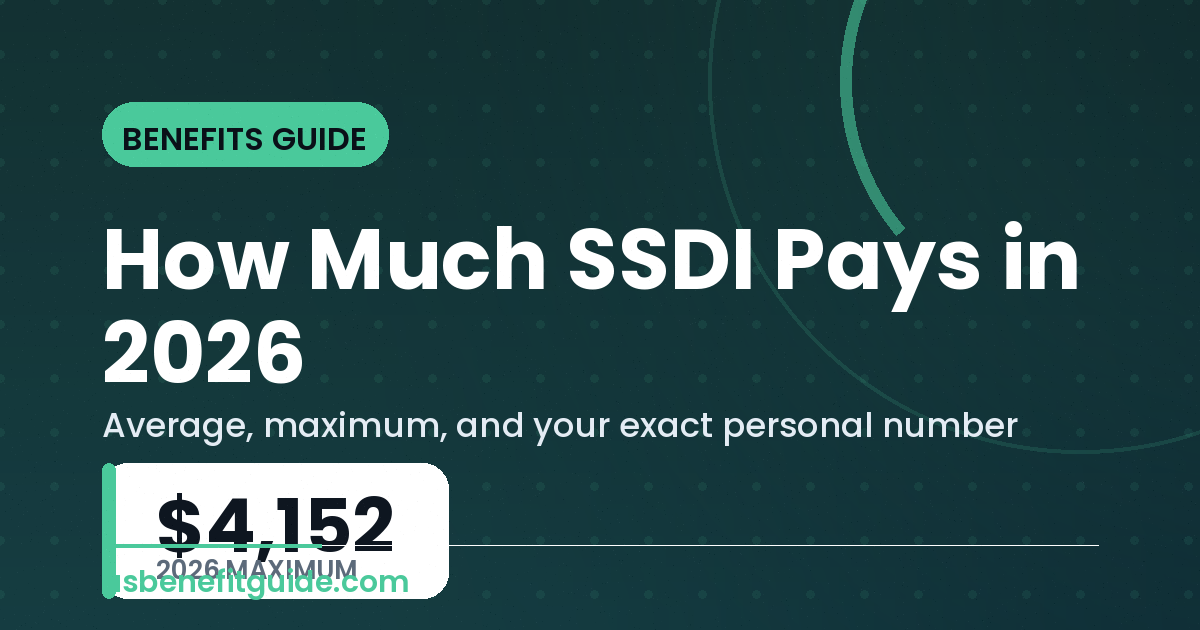
In the United States, Social Security Disability Insurance (SSDI) pays an average of about $1,580 per month in 2025 for a disabled worker. The actual amount can be much lower or higher because SSDI is based on your work history and past earnings. The maximum SSDI benefit for 2025 is $4,018 per month for a worker who qualifies for the maximum amount.
If you mean Supplemental Security Income (SSI) rather than SSDI, the 2025 federal maximum is $967 per month for one person or $1,450 for an eligible couple. Some states add a supplement.
Your exact payment depends on which program you qualify for, your average earnings, your work credits, household income, living situation, and other benefits.


SSDI and SSI Pay Different Amounts
The first step is to identify whether you are asking about SSDI or SSI. The programs serve different groups and use different payment rules.
| Program | Main eligibility rule | 2025 federal payment information |
|---|---|---|
| SSDI | You have a qualifying disability and enough recent work history | Average disabled-worker benefit: about $1,580 per month |
| SSI | You have a qualifying disability, low income, and limited resources | Maximum: $967 per month for one person |
| SSI for a couple | Both spouses meet SSI rules | Maximum: $1,450 per month |
| SSDI dependent benefits | Certain family members may qualify through your record | Amount varies by family member and family maximum |
What is SSDI?
Social Security Disability Insurance is an earned benefit. Workers pay Social Security taxes through payroll deductions. Those taxes help provide insurance coverage if a serious disability prevents substantial work.
Your SSDI payment is based mainly on your lifetime earnings covered by Social Security. It is not based on your current bank balance or whether you own a home.
What is SSI?
Supplemental Security Income is a needs-based program. It helps people who are disabled, blind, or age 65 or older and have limited income and resources.
SSI does not require a work history. However, other income can reduce your payment. Free or low-cost housing, help with food, and support from another person can also affect the amount in some cases.
Can you receive both?
Yes. Some people receive both SSDI and SSI. This may happen when a person qualifies for SSDI but has a relatively low SSDI payment and limited income or resources.


In that case, SSI may bring the person up to the applicable SSI amount. The total is not automatically the full SSDI payment plus the full SSI payment because SSDI generally counts as income for SSI.

How Much Does SSDI Pay Per Month?
The average disabled-worker SSDI benefit is about $1,580 per month in 2025. That figure is an average, not a guaranteed payment.
Your personal amount may be:
- Less than $1,000 per month
- Around the national average
- Several thousand dollars per month
- Up to the 2025 maximum of $4,018 for a qualifying worker
The maximum is uncommon. It generally requires many years of high earnings subject to Social Security taxes.
Why SSDI payments differ
Social Security calculates benefits from your earnings record. In simple terms, the agency:
- Reviews your covered earnings.
- Adjusts older earnings for wage growth.
- Calculates your average indexed monthly earnings.
- Applies a benefit formula.
- Adjusts the result for factors such as dependents or prior benefits.
The calculation is based on more than your most recent job. A person with a long work history and high taxable earnings may receive more than a person who worked fewer years or earned less.
A hypothetical example
Suppose two workers both become disabled at age 50:
- Worker A had lower covered earnings for much of their career.
- Worker B had higher covered earnings over many years.
Worker B may receive a larger SSDI payment even though both workers have the same disability and apply at the same time.
This is only a general example. The Social Security Administration must calculate each person’s benefit from its official earnings record.
How to find your exact SSDI estimate
The most reliable way to check your estimated SSDI payment is to use your my Social Security account at ssa.gov/myaccount.
Your account may show:
- Your reported earnings
- Your estimated disability benefit
- Your estimated retirement benefit
- Your estimated family benefits
- Your work history
- Your Social Security statement
Check the earnings record carefully. Missing or incorrect earnings can affect your estimate. Keep tax forms, W-2 forms, and other wage records that may help prove an error.

How Much Does SSI Pay?
The 2025 federal SSI maximum payment is:


- $967 per month for an eligible individual
- $1,450 per month for an eligible couple
- $484 per month for an essential person
These are federal maximums. Many SSI recipients receive less.
Why SSI payments may be lower
Social Security may reduce SSI when you have countable income. Examples include:
- Wages from work
- SSDI or retirement benefits
- Workers’ compensation
- Unemployment benefits
- Pensions
- Support from another person
- Some free or reduced-cost food or housing arrangements
Not every dollar is counted in the same way. SSI has exclusions and special rules for some income.
For example, wages do not always reduce SSI dollar for dollar. Social Security generally excludes certain amounts before counting part of earned income. The exact calculation depends on your income and circumstances.
SSI resource limits
SSI also has resource limits. In general, the countable resource limit is:
- $2,000 for one person
- $3,000 for a couple
Some property does not count. A primary home, one vehicle used for transportation, and certain household items may be excluded. Rules can be complex, so a person should not assume that owning any asset automatically ends SSI eligibility.
State SSI supplements
Some states add money to the federal SSI payment. The amount and rules vary by state and by living arrangement.
For an accurate estimate, check:
- Your state’s Social Security office
- Your state benefits agency
- Your SSI award notice
- Your local legal aid or benefits counseling service

What Determines Your SSDI Payment?
Your SSDI payment depends mostly on your Social Security earnings record, but several other factors can change the amount you receive.
1. Your covered earnings
Social Security taxes must have been paid on the earnings used in the benefit calculation. Cash wages that were not reported may not appear on your record and may not count.
2. Your work history
A longer work history often gives Social Security more earnings to review. However, the agency does not simply add up your lifetime wages and divide by the number of years worked.
The calculation uses a specific formula. The number of years used can vary based on your age when your disability began.
3. Your age when the disability began
Younger workers may qualify with fewer work credits than older workers. Social Security generally requires a person to have worked recently, but the exact credit requirement depends on age.
A person who became disabled at a young age may qualify with a shorter work history than someone who became disabled later.


4. Your family status
A spouse, former spouse, or child may qualify for benefits on your Social Security record. Family benefits can be subject to a family maximum, which limits the total amount payable on one worker’s record.
Your own SSDI benefit is not normally reduced simply because an eligible child receives a benefit. However, the total amount paid to the family may be limited.
5. Other disability benefits
Workers’ compensation and some public disability benefits may reduce SSDI under the government pension offset and workers’ compensation offset rules. The combined benefits generally cannot exceed a set percentage of your past average earnings.
Private disability insurance usually follows different rules. Review the insurance policy before assuming that private benefits will reduce SSDI.

How the SSDI Benefit Formula Works
Social Security uses a formula based on your average indexed monthly earnings, often called AIME, and your primary insurance amount, or PIA.
These terms sound technical, but the basic process is straightforward:
- Social Security reviews your earnings.
- It adjusts older earnings to account for wage changes.
- It identifies the earnings used in the disability calculation.
- It applies the PIA formula.
- It makes any required adjustments.
The PIA is the base amount used for several Social Security benefits. SSDI is not calculated by using a simple percentage of your last paycheck.
Why an online calculator may differ from your award
An online estimate may not match your final SSDI payment because:
- Your earnings record may be incomplete.
- Your disability onset date may differ from your estimate.
- Social Security may use a different earnings period.
- Your application may involve workers’ compensation.
- The calculator may use old benefit formulas.
- The estimate may be for retirement rather than disability benefits.
Treat online tools as estimates. Your award letter and official Social Security record control the actual payment.

How Much Can Dependents Receive?
Certain family members may qualify for benefits based on your SSDI record. Potential family beneficiaries can include:
- A child under age 18
- A child who became disabled before age 22
- A spouse caring for your child
- A spouse age 62 or older
- In some cases, a former spouse
Family benefits do not apply automatically. Each person must meet Social Security’s eligibility rules.
The family maximum limits the total benefits payable on one worker’s record. If the total reaches that limit, dependent benefits may be reduced. The disabled worker’s own SSDI payment is generally paid in full while other family benefits are adjusted.
Ask Social Security to review your family record if you are approved for SSDI. Some eligible relatives may not know they can apply.


When Does SSDI Start Paying?
SSDI usually has a five-month waiting period after the date Social Security determines that your disability began. This is not always five months after you submit the application.
For example, if Social Security establishes a disability onset date of January 10, the waiting period generally covers the required months after that onset date. Payment may begin after the waiting period if you remain eligible.
There are special rules for some conditions. For example, the waiting period does not apply in the same way to certain people with amyotrophic lateral sclerosis, commonly called ALS.
How long does an SSDI application take?
The time varies. Delays may occur because:
- Medical records arrive slowly
- Social Security needs more evidence
- A medical examination is required
- The application is denied and appealed
- The case goes to a hearing
- The disability is difficult to document
A person should respond to Social Security requests by the deadline. Missing a deadline can delay the decision or harm the claim.
Can SSDI include back pay?
It can. Back pay may cover an eligible period before approval, subject to waiting-period rules and other limits.
The amount depends on:
- The established disability onset date
- The application date
- The waiting period
- Whether you received other disability benefits
- Whether you qualified for SSI during part of the period
Do not assume that the amount shown in a back-pay notice is the same as the total benefit available to every family member.
Is SSDI Taxable?
Some people pay federal income tax on part of their SSDI benefits. Others do not.
Tax treatment depends mainly on:
- Your total income
- Your filing status
- Whether you have other household income
- Whether you file a joint return
The IRS generally uses combined income to determine whether Social Security benefits are taxable. Combined income commonly includes adjusted gross income, tax-exempt interest, and half of your Social Security benefits.
A person with SSDI and no meaningful income from other sources may owe no federal tax on the benefit. A household with wages, investment income, a pension, or a spouse’s income may owe tax on part of the benefit.
State tax rules differ. For current guidance, review IRS Publication 915 or speak with a qualified tax professional.

Does Working Reduce SSDI?
Working may affect SSDI, but Social Security provides work incentives that allow beneficiaries to test their ability to work.
Important rules include:
- Trial Work Period: You may test work for a limited number of months while continuing to receive SSDI, if you meet the program rules.
- Extended Period of Eligibility: After the trial period, benefits may continue during a longer period when your earnings remain below the applicable limit.
- Impairment-related work expenses: Certain disability-related costs may affect how Social Security counts earnings.
- Expedited reinstatement: In some cases, benefits may restart if benefits ended because of work and you cannot continue working due to the same or a related medical condition.
Work rules can change each year. Report work activity to Social Security and keep proof of your wages, hours, and expenses.
Do not stop working or turn down a job based only on a general online explanation. Ask Social Security or a benefits counselor how the specific job and wage level may affect your benefits.

How Annual COLA Increases Affect SSDI
Social Security benefits usually receive an annual cost-of-living adjustment, known as COLA. The adjustment is intended to help benefits keep pace with inflation.
For 2025, Social Security benefits received a 2.5% COLA. The increase applies to eligible Social Security and SSI payments under the agency’s timing rules.
A COLA does not make every recipient’s payment equal. It increases each person’s existing benefit by the applicable percentage.
Hypothetical COLA example
If a person received $1,500 per month before a 2.5% increase:
- $1,500 × 0.025 = $37.50
- New monthly amount: $1,537.50
Actual payments may differ because of Medicare premiums, tax withholding, overpayments, or other deductions.
Why Your Bank Deposit May Be Lower Than Your SSDI Award
The amount in your award notice may not match the amount deposited into your bank account.
Common reasons include:
- Medicare Part B premiums
- Federal tax withholding
- A past overpayment
- Workers’ compensation offsets
- Voluntary deductions
- Representative payee arrangements
- State or federal debt collection in limited cases
If the deposit is lower than expected, compare your bank statement with your Social Security notice. Look for a payment explanation or deduction code.
If the difference is unclear, contact Social Security through its official number, 1-800-772-1213, or use your online account. Do not give your Social Security number or banking information to an unsolicited caller.
How to Estimate Your Monthly SSDI Payment
Use this process to get the most reliable estimate:
- Create or sign in to your my Social Security account.
- Review your earnings history.
- Look for the disability benefit estimate.
- Check whether the estimate is current.
- Compare the estimate with your award letter if you are already approved.
- Ask Social Security to correct missing or incorrect earnings.
- Check for Medicare premiums, offsets, or other deductions.
You can also contact Social Security directly. Have your claim number or Social Security information available when using an official channel.
Avoid relying on a website that asks for payment to reveal a basic benefit estimate. The official Social Security website provides free account access and benefit information.
Common Mistakes About SSDI Payments
Mistake 1: Assuming everyone receives the average
The average benefit is not a promised amount. Your earnings history controls your payment.
Mistake 2: Confusing SSDI with SSI
SSDI is based mainly on work history. SSI is based mainly on financial need. The payment rules are different.
Mistake 3: Thinking SSDI equals a percentage of your last paycheck
Social Security uses a formula based on your indexed earnings record. Your last paycheck alone does not determine the benefit.
Mistake 4: Ignoring the earnings record
A missing year of wages can lower your estimate. Review the record before filing an appeal or making major financial decisions.
Mistake 5: Forgetting dependent benefits
Children and some spouses may qualify for benefits on your record. Ask Social Security to check the family’s eligibility.
Mistake 6: Treating the maximum as typical
The maximum SSDI payment requires a long history of high earnings. Most recipients receive less.
Mistake 7: Using outdated benefit figures
Federal benefit rates, COLAs, work-income limits, and Medicare premiums can change. Check the year before relying on a number.
Key Takeaways
- The average SSDI payment is about $1,580 per month in 2025.
- The maximum SSDI payment is $4,018 per month in 2025.
- Your payment depends mainly on your Social Security earnings record.
- The maximum federal SSI payment is $967 per month for one person in 2025.
- Some eligible spouses and children may receive benefits on your record.
- Workers’ compensation, taxes, Medicare premiums, and other deductions may reduce the amount deposited.
- Your my Social Security account is the best place to find your personal estimate.
Frequently Asked Questions
How much does SSD pay for a child?
A child may receive a benefit based on a parent’s SSDI record if the child meets Social Security’s rules. The amount depends on the parent’s benefit and the family maximum. A child’s benefit is not automatically the same as the parent’s payment.
Can I get SSDI if I have never worked?
You may qualify for SSI if you have little income and limited resources. SSDI generally requires enough work credits, although a person who became disabled at a young age may qualify with fewer credits. An adult disabled before age 22 may also qualify for benefits based on a parent’s record in certain situations.
Does marriage affect SSDI?
Marriage usually does not reduce your own SSDI benefit. However, marriage can affect SSI eligibility, spouse benefits, and the income or resources used in a needs-based review.
Can I receive SSDI and retirement benefits at the same time?
You generally cannot receive full SSDI and full Social Security retirement benefits for the same period. SSDI converts to retirement benefits when you reach full retirement age, usually without a reduction caused by that conversion.
Where can I check my exact SSDI payment?
Use your official my Social Security account or contact the Social Security Administration. Your earnings record, award notice, and payment history provide more reliable information than a general online calculator.
Conclusion
How much SSD pays depends on the program and your personal record. For 2025, the average disabled-worker SSDI benefit is about $1,580 per month, while the maximum is $4,018. SSI uses separate income and resource rules, with a federal maximum of $967 per month for one eligible individual.
Your next step should be to review your earnings history and benefit estimate through your official Social Security account. If your medical, work, family, or income situation is complicated, contact Social Security or a qualified benefits counselor before making a decision.

Everett Ashford is a tech reviewer at mytechgrid.com specializing in SSDs, cameras, TVs, earbuds, headphones, and other consumer electronics. He provides honest, data-driven reviews based on hands-on testing and real-world performance analysis. Everett simplifies complex tech details to help readers make smart, confident buying decisions.