For people in the United States, artificial intelligence (AI) now appears in many common tools: search engines, banking apps, medical systems, customer service chats, cars, schools, and workplaces. But not all AI works in the same way. Some systems follow fixed rules, while others learn from data, create text or images, or help make decisions.
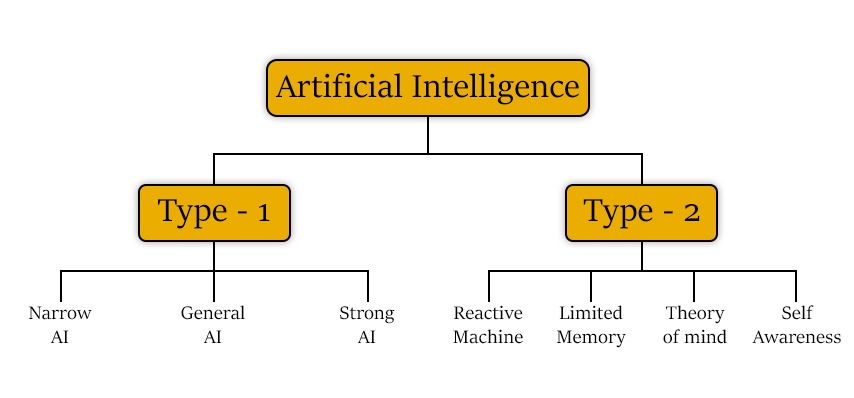
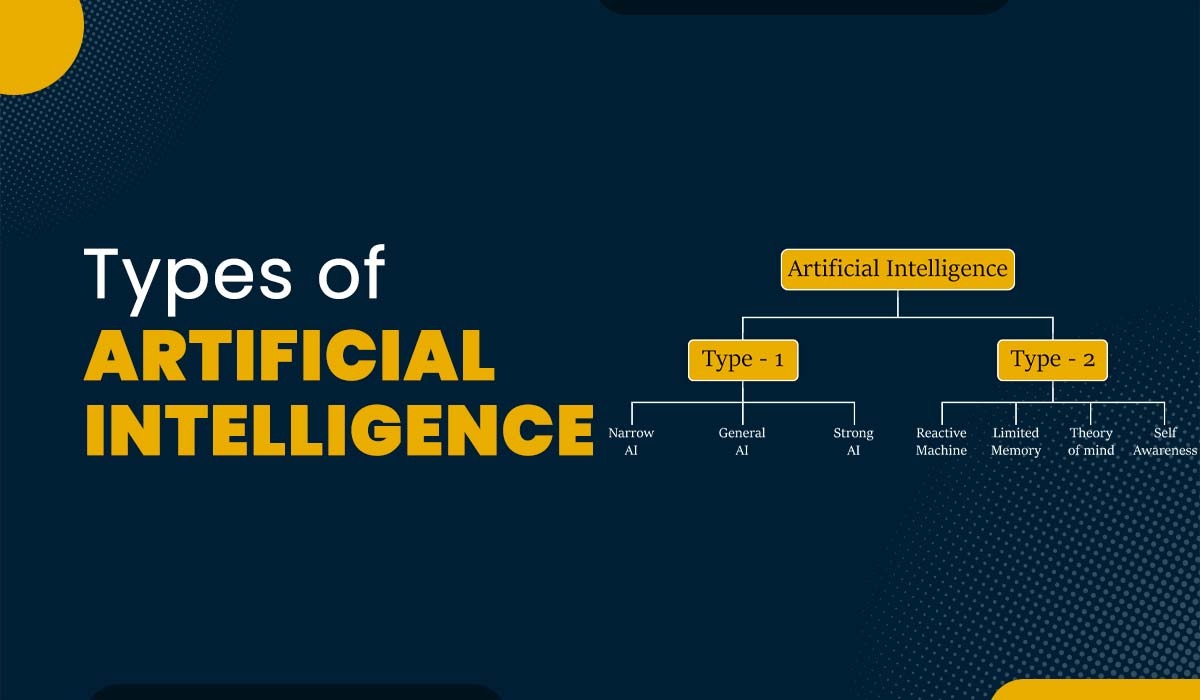
The main types of AI are grouped in two ways:
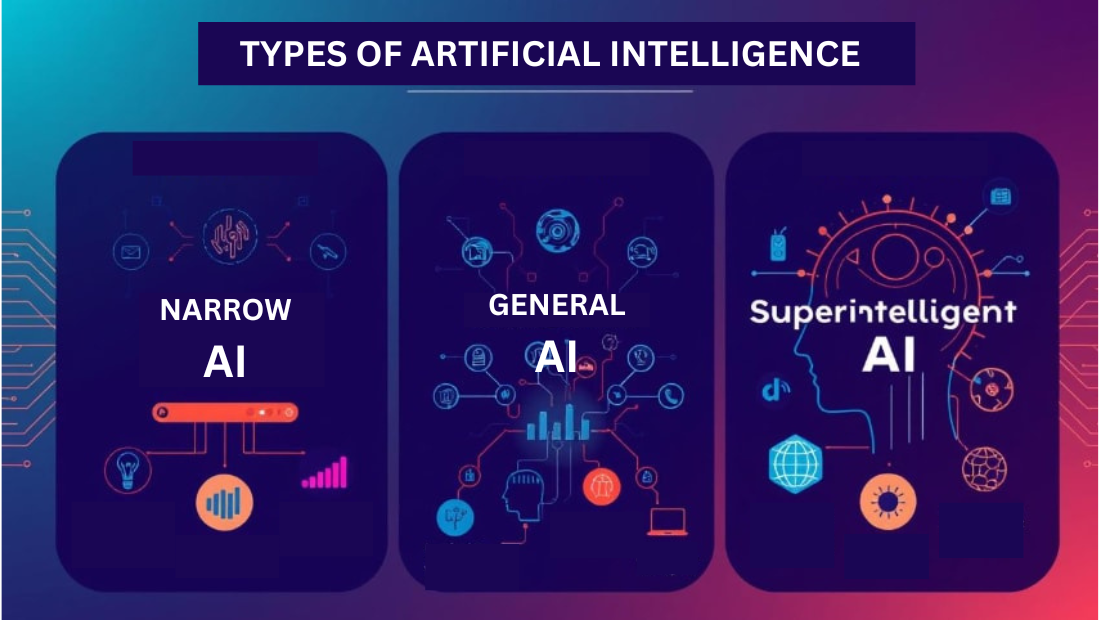
- By capability: narrow AI, artificial general intelligence, and artificial superintelligence.
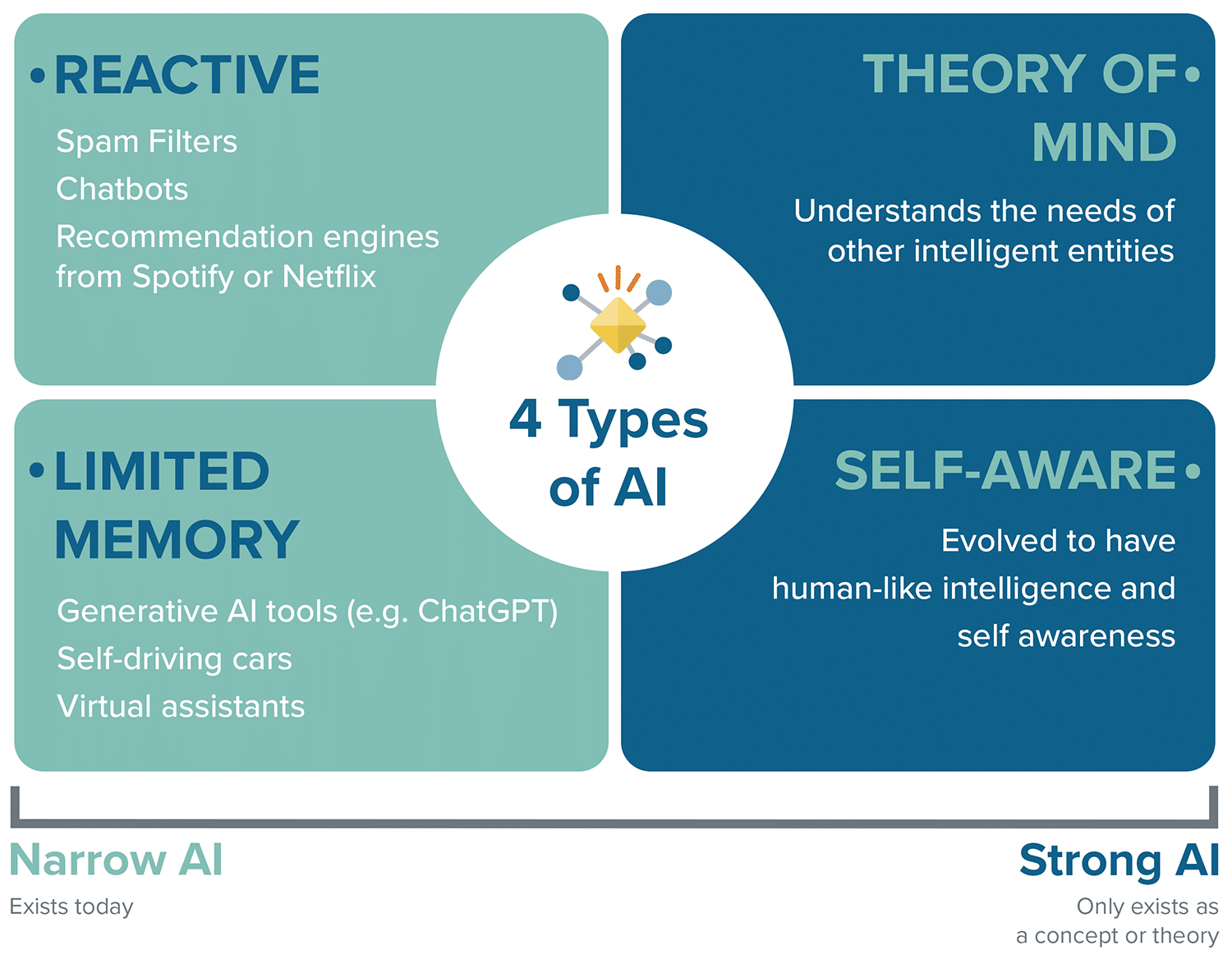
- By function: reactive machines, limited-memory AI, theory-of-mind AI, and self-aware AI.
Most AI used in the United States today is narrow AI and limited-memory AI. Generative AI is a major type of narrow AI that can create text, images, audio, video, and computer code.

What is artificial intelligence?
Artificial intelligence is technology that enables a computer system to perform tasks that usually require human intelligence. These tasks may include:
- Recognizing speech or images
- Finding patterns in data
- Understanding language
- Making predictions
- Solving problems
- Recommending content
- Creating new material
- Taking action based on rules or learned patterns
The National Institute of Standards and Technology (NIST) describes AI as a machine-based system that can make predictions, recommendations, or decisions for human-defined goals. This definition is useful because it includes both simple rule-based programs and advanced machine-learning systems.
AI does not always “think” like a person. In many cases, it calculates probabilities from data. For example, an email filter may estimate whether a message is spam based on words, links, sender details, and past examples.
The result may look intelligent, but the system may not understand the world in the human sense.
The two main ways to classify AI
There is no single universal list of AI types. Researchers, businesses, and educators often classify AI using different criteria.
Classification by capability
This method asks:
How broad is the system’s intelligence?
It includes:
- Narrow AI
- Artificial general intelligence
- Artificial superintelligence
Classification by functionality
This method asks:
How does the system use information and respond to its environment?
It includes:
- Reactive machines
- Limited-memory AI
- Theory-of-mind AI
- Self-aware AI
These systems can overlap. For example, a modern language model may be both narrow AI by capability and limited-memory AI by functionality.
What are the types of AI by capability?
AI by capability describes the range of tasks a system can perform. It does not necessarily describe how the system is built.
1. Narrow AI
Narrow AI, also called weak AI, is designed to perform a limited task or a related group of tasks.
Examples include:
- Voice assistants
- Face-recognition tools
- Fraud detection systems
- Product recommendation engines
- Navigation apps
- Medical image analysis tools
- Chatbots
- Translation software
- Generative AI tools
A narrow AI system may perform its assigned task very well. However, it cannot automatically transfer its skill to every other area.
For example, an AI trained to detect credit card fraud may be useful for finding unusual transactions. It cannot diagnose a disease, write a legal contract, or drive a car unless it has been built and trained for those tasks.
Strengths of narrow AI
- It can be highly accurate within a defined task.
- It can process large amounts of data quickly.
- It can automate repeated work.
- It can support human decisions.
- It is already used in many commercial products.
Limits of narrow AI
- It may fail when conditions change.
- It may reflect errors or bias in its training data.
- It may not explain its output clearly.
- It cannot reliably perform tasks outside its design.
- It may produce confident but incorrect results.
Nearly every practical AI tool available to U.S. consumers and organizations today belongs to this category.
2. Artificial general intelligence
Artificial general intelligence (AGI) refers to a hypothetical AI system that could learn and perform a wide range of intellectual tasks at a level comparable to humans.
An AGI system would need to do more than answer questions. It would need to transfer knowledge between fields, learn new skills, understand unfamiliar situations, plan over time, and adapt without being rebuilt for each task.
For example, a true AGI might be able to:
- Learn a new language
- Understand a scientific paper
- Plan a business project
- Repair a machine
- Teach a student
- Write and test software
- Apply knowledge from one task to another
No agreed technical test proves that a system is AGI. Researchers also disagree about how much reasoning, learning, memory, physical ability, or independence such a system would need.
Today’s advanced AI tools can perform many different tasks, but broad performance alone does not establish that they possess human-like general intelligence. Their results may depend on training data, system design, tools, prompts, and human review.
3. Artificial superintelligence
Artificial superintelligence (ASI) is a theoretical form of AI that would exceed human abilities across nearly all important intellectual areas.
An ASI system is often described as outperforming humans in:
- Scientific discovery
- Strategic planning
- Engineering
- Mathematics
- Learning speed
- Creativity
- Decision-making
ASI does not currently exist as a verified technology. It is mainly discussed in research, philosophy, policy, and AI safety debates.
The key point is simple: AGI and ASI describe possible future capabilities, not ordinary categories of AI products available today.
Capability comparison
| Type | What it means | Current status | Example |
|---|---|---|---|
| Narrow AI | Performs a limited task or task group | Widely used | Spam filter |
| AGI | Handles many intellectual tasks with broad flexibility | Not established | Hypothetical general-purpose system |
| ASI | Exceeds human ability across most intellectual fields | Theoretical | Hypothetical superintelligent system |
What are the types of AI by functionality?
Functional classifications focus on memory, awareness, and interaction with the environment.
1. Reactive machines
Reactive machines respond to current input but do not store memories or use past experiences to guide future responses.
A basic chess program is a common example. It evaluates the current board and selects a move based on its programming. It does not remember a personal history of previous games in the way a person does.
Other examples may include simple rule-based systems that:
- Detect a specific condition
- Respond with a fixed action
- Follow a decision tree
- Classify input using current information only
Reactive systems can be fast and predictable. Their main weakness is that they cannot use past events to improve their response unless an external system gives them that information.
2. Limited-memory AI
Limited-memory AI uses stored data or recent observations to produce an answer or decision.
Most modern AI systems fit this category. They may use:
- Historical training data
- Recent user input
- Sensor readings
- Past transactions
- Earlier turns in a conversation
- Labeled examples
- Feedback from a controlled process
Self-driving vehicle systems, for example, can use recent information about road signs, nearby objects, speed, and lane position. A fraud detection model can compare a new transaction with patterns found in past transactions.
Generative AI systems also rely on learned patterns from large training datasets. During a conversation, a system may use the current chat context, but that does not necessarily mean it has long-term personal memory.
“Limited memory” does not mean the system has memory like a human. It means the system uses a restricted set of stored information or recent observations to improve its output.
3. Theory-of-mind AI
Theory-of-mind AI would understand that people have different beliefs, goals, emotions, intentions, and knowledge.
A system with this ability might recognize that:
- A child has misunderstood a lesson.
- A customer is frustrated but remains polite.
- Two people have different information about the same event.
- A person’s stated request does not fully express their real goal.
Some current systems can identify emotional language or predict likely intent. That is not the same as proving that they understand emotions or beliefs.
For this reason, theory-of-mind AI remains a research concept rather than a confirmed type of widely available AI.
4. Self-aware AI
Self-aware AI would possess a conscious understanding of itself, its internal states, and its place in the world.
A self-aware system might understand:
- That it exists
- What it knows and does not know
- Its own goals
- Its internal experiences
- How its actions affect others
No current AI system has been reliably shown to be self-aware or conscious. A chatbot may use phrases such as “I think” or “I feel,” but language output alone does not prove subjective experience.
Functional comparison
| Type | Uses past information? | Understands human mental states? | Current status |
|---|---|---|---|
| Reactive machines | No or very little | No | Exists in simple systems |
| Limited-memory AI | Yes, within defined limits | Not in a human sense | Common today |
| Theory-of-mind AI | Expected to use context and beliefs | Intended capability | Research concept |
| Self-aware AI | Expected to understand itself | Expected to have consciousness | Theoretical |

What is machine learning?
Machine learning (ML) is a major method used to build AI systems. Instead of writing every rule by hand, developers train a model to find patterns in data.
A simple machine-learning process includes:
- Collecting data
- Preparing and labeling the data
- Training a model
- Testing its performance
- Deploying the model
- Monitoring results and updating it when needed
For example, a bank may train a model with past transaction data. The model can learn patterns linked with fraudulent activity. It then gives a risk score to new transactions.
Machine learning can be divided into several common types.
Supervised learning
Supervised learning uses data that includes the correct answer, or label.
Examples include:
- Photos labeled as “cat” or “dog”
- Transactions labeled as “fraud” or “legitimate”
- Homes labeled with sale prices
- Medical images labeled by trained professionals
The model learns to connect input data with the known outcome.
Supervised learning works well when reliable labeled data is available. Its performance depends on the quality and coverage of those labels.
Unsupervised learning
Unsupervised learning looks for patterns in data without using predefined answers.
It may help identify:
- Customer groups
- Unusual behavior
- Similar documents
- Hidden data patterns
- Common product combinations
A retail company might use unsupervised learning to group shoppers with similar buying habits. The system finds the groups; a human must decide what those groups mean and how to use them.
Semi-supervised learning
Semi-supervised learning combines a small amount of labeled data with a larger amount of unlabeled data.
This approach can help when labeling is costly or requires specialists. For example, a company may have thousands of medical images but only a smaller set reviewed by qualified clinicians.
Reinforcement learning
Reinforcement learning trains an agent to choose actions in an environment. The system receives rewards for useful actions and penalties for poor ones.
It can be used for:
- Game-playing systems
- Robotics
- Resource management
- Industrial control
- Route planning
- Recommendation experiments
The system does not receive a correct answer for every step. Instead, it learns which actions are more likely to produce a desired result over time.

What is deep learning?
Deep learning is a form of machine learning that uses layered neural networks to process complex patterns.
Deep-learning models can work with:
- Text
- Images
- Audio
- Video
- Sensor data
- Biological data
They are especially useful when the relationships in the data are too complex to describe with simple rules.
A deep-learning model may recognize objects in an image, transcribe speech, translate text, or predict the next part of a sentence. However, it may require large datasets, significant computing power, and careful testing.
Deep learning can also be difficult to interpret. A model may produce a useful result without offering a simple human-readable explanation of every step.
What is generative AI?
Generative AI creates new content based on patterns learned from existing data.
It can generate:
- Text
- Images
- Audio
- Video
- Software code
- Synthetic data
- Summaries
- Designs
Large language models are generative AI systems that work mainly with text. They estimate likely sequences of words or tokens based on the input and the patterns learned during training.
Generative AI can help draft an email, explain a concept, summarize a document, or create a first version of computer code. It can also make errors, invent sources, miss context, or reproduce bias.
Generative AI is not the same as AGI
These terms describe different ideas:
- Generative AI describes what a system can produce.
- AGI describes a proposed level of broad intelligence.
- Machine learning describes a method used to train AI.
- Deep learning describes a family of machine-learning techniques.
A generative AI tool can be powerful while still being narrow AI. Creating many types of content does not prove that the system understands the world or can perform every intellectual task reliably.
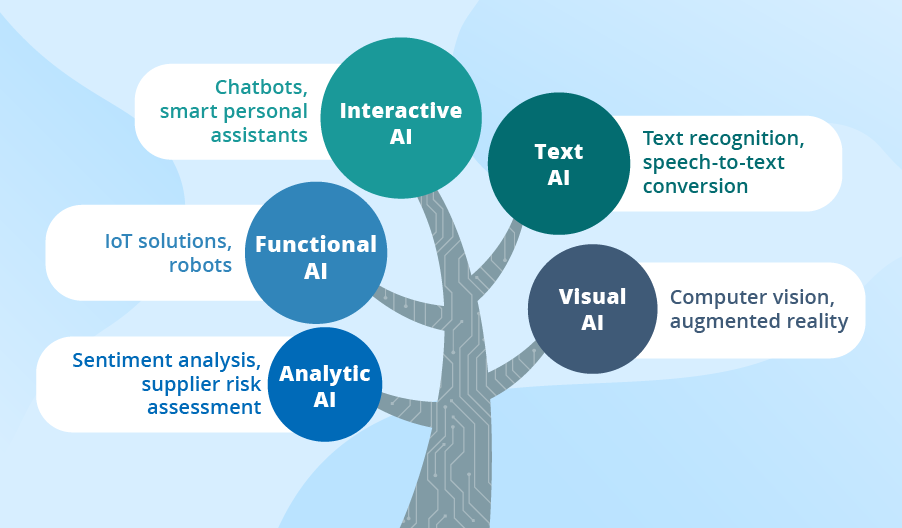
Other useful types of AI
Some AI categories describe the application rather than the system’s intelligence level.
Conversational AI
Conversational AI interacts with people through text or speech.
Examples include:
- Customer service chatbots
- Voice assistants
- Support agents
- Educational tutors
- Appointment systems
The main risks include misunderstanding, incorrect answers, poor escalation, and failure to protect private information.
Computer vision
Computer vision enables computers to interpret images and video.
Uses include:
- Object detection
- Quality inspection
- Document scanning
- Medical image analysis
- Traffic monitoring
- Identity verification
Computer vision systems can fail because of poor lighting, unusual angles, missing data, image quality, or differences between the training data and real-world conditions.
Natural language processing
Natural language processing (NLP) helps computers work with human language.
It includes:
- Translation
- Speech recognition
- Text classification
- Search
- Sentiment analysis
- Summarization
- Question answering
Language is affected by context, culture, tone, slang, and ambiguity. A system may process grammar correctly while still missing the intended meaning.
Robotics and autonomous systems
Robotics combines AI with physical machines. A robot may sense its environment, plan a movement, and take action.
Examples include:
- Warehouse robots
- Surgical assistance systems
- Agricultural machines
- Delivery robots
- Industrial arms
- Autonomous vehicles
Physical AI needs extra safety checks because mistakes can affect people, equipment, and property.
Expert systems
Expert systems use rules and a knowledge base to solve problems in a narrow field.
A rule might look like this:
If condition A and condition B are present, recommend action C.
Expert systems can be clear and predictable when their rules are correct. They may struggle with uncertain, changing, or unfamiliar situations.

Which type of AI is best for a specific task?
The best AI type depends on the task, data, risk, and need for human control. There is no single best type for every situation.
| Task | Likely AI approach | Main question to ask |
|---|---|---|
| Detect spam | Supervised machine learning | Are the labels accurate and current? |
| Recommend products | Machine learning | Does the system over-personalize or narrow choices? |
| Create a draft article | Generative AI | Who checks facts and sources? |
| Inspect factory parts | Computer vision | How does it handle defects not seen in training? |
| Answer support questions | Conversational AI | When does it transfer the case to a person? |
| Control a robot | Reinforcement learning and robotics | What happens when the environment changes? |
| Flag possible fraud | Anomaly detection or supervised learning | How are false alarms handled? |
A useful selection process is:
- Define the outcome. Decide what the system must do.
- Check the data. Ask whether the data is accurate, relevant, lawful to use, and representative.
- Set the risk level. A wrong movie recommendation is not equal to a wrong medical or financial decision.
- Choose the simplest suitable method. A clear rule may be better than a complex model when the task is simple.
- Keep human review where needed. People should be able to question, correct, or override important decisions.
- Monitor performance. Accuracy can change when users, data, or conditions change.
What are the limits and risks of different AI types?
Every AI system has limits. The risks depend on the system, its data, its users, and the consequences of failure.
Common risks
- Incorrect or fabricated information
- Biased results
- Privacy loss
- Security attacks
- Lack of transparency
- Overreliance on automated decisions
- Outdated information
- Poor performance for underrepresented groups
- Copyright or data-use concerns
- Unsafe actions in physical environments
Questions to ask before using AI
- What data did the system use?
- Is the data current and relevant?
- Can a person review the result?
- What happens when the system is uncertain?
- Is sensitive information being entered?
- Can the output be checked against a trusted source?
- Who is responsible if the system is wrong?
- Does the system meet the rules for the industry and location?
For high-impact uses, such as health care, employment, housing, education, insurance, or credit, organizations should apply stronger testing and oversight. In the United States, applicable federal, state, and local laws may differ by use and location.
Do not treat an AI answer as a medical diagnosis, legal opinion, financial recommendation, or emergency instruction. Use qualified professionals and official sources when the consequences are serious.

Common misconceptions about AI types
“All AI learns by itself”
Many systems are trained before deployment and do not continuously learn from every interaction. Some systems update on a schedule. Others use a fixed model with separate databases or rules.
“A human-like conversation proves intelligence”
Fluent language can create the impression of understanding. It does not prove consciousness, reliable reasoning, or accurate knowledge.
“More advanced means better for every task”
A complex model may cost more, run more slowly, or be harder to audit. A simple system may be safer and easier to explain for a well-defined task.
“AI is always objective”
AI systems learn from data and design choices made by people. If the data reflects unequal treatment or missing groups, the output may repeat those problems.
“AI replaces human judgment in every field”
AI can automate some tasks and support others. Responsibility, context, values, and accountability often still require people.
Frequently asked questions
What is the most common type of AI today?
Narrow AI is the most common type. Many tools also use limited-memory methods because they rely on past training data, recent input, or stored records.
Is ChatGPT narrow AI or AGI?
ChatGPT is generally classified as narrow AI because it performs a broad set of language tasks without being a proven human-level general intelligence. Its ability to handle many subjects does not establish AGI.
Is generative AI a separate type of AI?
Generative AI is a functional category based on output. It can overlap with narrow AI, machine learning, deep learning, and limited-memory AI.
Are theory-of-mind and self-aware AI real?
They are mainly theoretical categories. Current systems can imitate empathy, discuss beliefs, and use self-referential language, but those behaviors do not prove human-like mental understanding or consciousness.
What is the difference between AI and machine learning?
AI is the broader field of systems that perform tasks associated with intelligence. Machine learning is one method for creating AI by allowing systems to learn patterns from data.
Key takeaways
- Narrow AI performs specific tasks and is the main type used today.
- AGI would perform a broad range of intellectual tasks, but it has not been established as a current technology.
- ASI is a theoretical system that would exceed human intelligence across most fields.
- Reactive machines respond to current input with little or no memory.
- Limited-memory AI uses stored data or recent observations and is common today.
- Theory-of-mind and self-aware AI remain research and philosophical concepts.
- Machine learning, deep learning, generative AI, computer vision, and NLP describe methods or applications that can overlap with the broader AI categories.
- The right AI system depends on the task, data quality, risk, cost, and need for human review.
Conclusion
The different types of AI are easier to understand when you separate capability from function. Capability asks how broadly a system can work. Function asks how it uses data, memory, and interaction.
For practical purposes, most people in the United States are using narrow, limited-memory AI. Machine learning and deep learning power many of these systems, while generative AI creates new content. AGI, theory-of-mind AI, self-aware AI, and ASI describe possible or theoretical abilities rather than proven everyday technologies.
Before using any AI tool, start with the task, assess the risks, protect sensitive data, and keep human review where an error could cause harm.

Everett Ashford is a tech reviewer at mytechgrid.com specializing in SSDs, cameras, TVs, earbuds, headphones, and other consumer electronics. He provides honest, data-driven reviews based on hands-on testing and real-world performance analysis. Everett simplifies complex tech details to help readers make smart, confident buying decisions.