
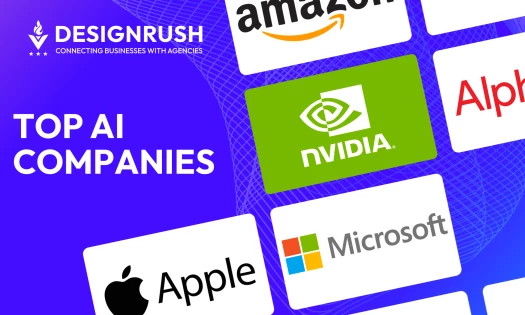
The top AI companies in the United States include NVIDIA, Microsoft, OpenAI, Google, Amazon, Meta, Anthropic, IBM, and Tesla. They lead different parts of the AI market, from computer chips and cloud systems to chatbots, research, self-driving technology, and business software.
There is no single “best” AI company. The right name depends on what you value:
- AI chips: NVIDIA
- AI software and cloud tools: Microsoft and Google
- Generative AI models: OpenAI, Google DeepMind, Anthropic, and Meta
- Cloud AI services: Amazon Web Services, Microsoft Azure, and Google Cloud
- Open AI models: Meta
- Business AI: Microsoft, IBM, Salesforce, and Google
- Autonomous vehicles and robotics: Tesla
This guide compares the leading U.S. AI companies by role, technology, reach, and business impact. Public information available through June 2024 forms the basis of the comparison. AI models, prices, products, and partnerships change often, so check each company’s current documentation before making a purchase or investment decision.

How to Identify the Top AI Companies
The top AI companies are not ranked by one number. A useful review should look at several factors.
1. AI research
Research shows how well a company develops new AI methods. Important areas include:
- Large language models
- Image and video generation
- Speech recognition
- Robotics
- Computer vision
- AI safety
- Scientific discovery
Research alone does not prove that a product is useful. Still, it can show long-term technical strength.
2. AI products
A company may publish strong research but offer few useful products. Leading firms turn AI research into tools that people and businesses can use.
Examples include:
- Chatbots
- Coding assistants
- Search tools
- Cloud APIs
- AI design software
- Customer service systems
- Data analysis tools
3. Computing power
Modern AI needs large amounts of computing power. This includes:
- Graphics processing units, or GPUs
- Data centers
- Cloud networks
- AI software libraries
- High-speed data systems
NVIDIA is especially important because its chips and software support much of the AI industry.
4. Business reach
A strong AI company can reach many users through cloud platforms, mobile devices, search engines, office tools, or social networks.
Microsoft, Google, Amazon, Apple, and Meta have a major advantage here. They already serve millions of people and many large businesses.
5. Trust, safety, and control
AI can create false information, expose private data, or produce harmful content. A serious comparison should review how a company handles:
- Privacy
- Security
- Copyright
- Model testing
- Human oversight
- Content controls
- Public transparency
No company has solved all of these issues.

The Top AI Companies in the U.S.
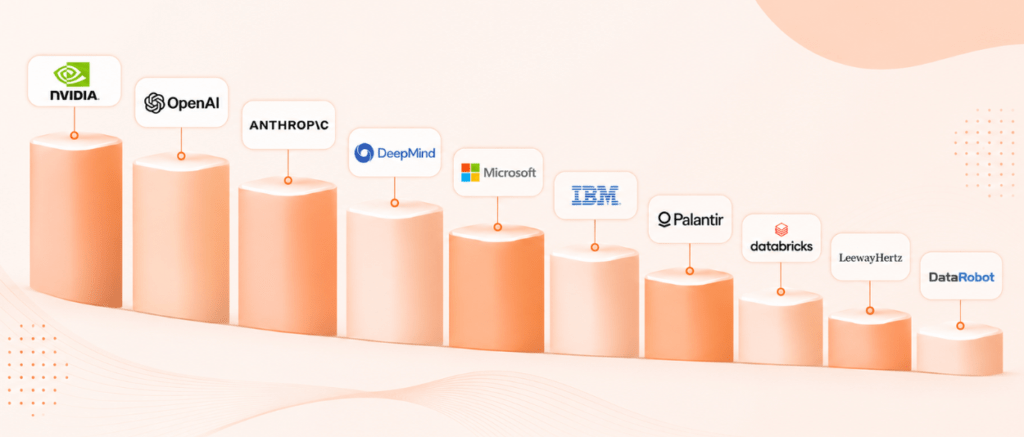
The following companies are leading the U.S. AI market in different ways. The list is not a strict ranking from one to nine.
NVIDIA: The leading AI chip company
NVIDIA is the most important infrastructure company in modern AI. Its graphics processing units power the training and operation of many large AI models.
NVIDIA sells more than chips. Its AI platform also includes:
- CUDA software
- AI development tools
- Data center systems
- Networking products
- Enterprise AI software
- Robotics platforms
The company’s data center business grew rapidly as cloud firms and AI labs expanded their computing capacity. Its H100 and related data center GPUs became widely used for advanced AI workloads.
Best known for: AI chips and data center systems.
Why it leads: NVIDIA combines high-performance hardware with a large software ecosystem. That makes it difficult for organizations to replace its tools quickly.
Main limitation: Its success depends on continued demand for expensive data center hardware. It also faces competition from AMD, Google, Amazon, and custom chips made by large cloud providers.
Read more from NVIDIA’s official AI platform.
Microsoft: The broadest enterprise AI platform
Microsoft is one of the largest AI companies because it combines software, cloud services, and a major partnership with OpenAI.
Microsoft offers AI through:
- Azure AI
- Microsoft Copilot
- GitHub Copilot
- Microsoft 365 Copilot
- Security Copilot
- AI tools for developers
- Custom model services
Azure gives businesses access to AI models, data tools, computing power, and security controls. Microsoft also adds AI features to products such as Word, Excel, Teams, Windows, and GitHub.
Best known for: Enterprise AI and cloud-based AI tools.
Why it leads: Microsoft can place AI inside software that businesses already use. Its enterprise relationships also make adoption easier.
Main limitation: Copilot features may vary by product, license, region, and business setup. Organizations must review data controls and costs before deployment.
See Microsoft Azure AI and Microsoft Copilot.
OpenAI: A major generative AI company
OpenAI created ChatGPT and developed the GPT family of language models. It helped bring generative AI into public use at a large scale.
OpenAI’s products include:
- ChatGPT
- GPT models
- Image generation tools
- Speech tools
- Developer APIs
- Custom business features
OpenAI focuses on models that can work with text, images, audio, and code. Its products are used for writing, research, software development, customer service, education, and data work.
Best known for: Chatbots and general-purpose generative AI.
Why it leads: ChatGPT made AI assistants familiar to a large public audience. OpenAI also offers models through an API for developers.
Main limitation: AI output can be wrong, incomplete, or based on weak reasoning. Users should check important facts. Model access, limits, and features can change over time.
Visit OpenAI for current product and API details.
Google and Google DeepMind: Leading AI research and products
Google has worked on AI for decades. Its AI research groups helped advance fields such as machine learning, speech recognition, search, and reinforcement learning.
Google DeepMind created systems such as AlphaGo and AlphaFold. Google also developed the Gemini model family for text, images, code, and other forms of data.
Google applies AI to:
- Search
- Android
- Google Cloud
- Gmail
- Workspace
- YouTube
- Advertising
- Health and science research
Best known for: AI research, search, cloud services, and multimodal models.
Why it leads: Google has strong research teams, large data systems, custom AI chips, and many consumer products.
Main limitation: AI features may be spread across several products. Users must check which model and feature are available in their country and subscription plan.
Learn more at Google DeepMind and Google Cloud AI.
Amazon: A major cloud AI provider
Amazon is a top AI company through Amazon Web Services, or AWS. AWS provides infrastructure and software for companies that want to build or run AI systems.
Its AI services include:
- Amazon Bedrock
- Amazon SageMaker
- AI chips
- Data storage
- Machine learning tools
- Contact center AI
- Recommendation systems
Amazon Bedrock lets businesses use models from several AI providers through AWS. This can help companies compare models without building all infrastructure from scratch.
Amazon also uses AI in its shopping systems, logistics network, advertising tools, Alexa products, and retail operations.
Best known for: Cloud AI infrastructure and business applications.
Why it leads: AWS has a large global customer base and many cloud services that support AI projects.
Main limitation: Cloud AI costs can be hard to predict. Charges may include model use, storage, data transfer, and computing time.
See AWS AI services.
Meta: A leading open-model AI company
Meta develops AI for Facebook, Instagram, WhatsApp, Messenger, advertising, recommendation systems, and virtual reality products.
Its Llama family of large language models became one of the best-known openly available model families. Developers can use Llama under its license, subject to the model’s terms and restrictions.
Meta also researches:
- Computer vision
- Speech
- Recommendation systems
- AI assistants
- Virtual and augmented reality
- Content ranking
Best known for: Open model development and social media AI.
Why it leads: Meta can release AI models to a large developer community and use AI across several high-traffic platforms.
Main limitation: “Open” does not always mean fully open source. Users should read the license and check whether the model fits their commercial, technical, and legal needs.
Read more at Meta AI.
Anthropic: A safety-focused generative AI company
Anthropic develops the Claude family of AI models. The company focuses on language models, model reliability, and AI safety.
Claude is used for:
- Writing
- Coding
- Document analysis
- Research
- Customer support
- Business workflows
Anthropic also provides API access and works with major cloud partners, including Amazon and Google.
Best known for: Business language models and AI safety research.
Why it leads: Claude has become a major alternative to ChatGPT for writing, analysis, and coding tasks.
Main limitation: Model performance depends on the task, prompt, context length, and version. Users should test the exact workflow rather than rely on general reputation.
Visit Anthropic for current model information.
IBM: Enterprise AI with a focus on governance
IBM has provided business computing and AI tools for many years. Its current AI work includes the watsonx platform and enterprise consulting services.
IBM focuses on:
- Business automation
- Data governance
- Hybrid cloud
- Industry-specific AI
- AI assistants
- Model management
- Security and compliance
IBM often works with large organizations that need control over data, access, and deployment.
Best known for: Enterprise AI, consulting, and governance.
Why it leads: IBM targets organizations with complex systems and strict business requirements.
Main limitation: IBM may be less visible to consumers than ChatGPT, Gemini, or Meta AI. Its products are usually designed for business use rather than casual chat.
See IBM watsonx.
Tesla: AI for vehicles and robotics
Tesla uses AI for driver assistance, vehicle perception, robotics, and automated decision systems. Its work includes neural networks, computer vision, and custom computing hardware.
Tesla’s AI-related projects include:
- Autopilot
- Full Self-Driving features
- Dojo computing systems
- Vehicle vision systems
- Humanoid robot research
Best known for: Automotive AI and robotics.
Why it leads: Tesla collects driving data from its vehicle fleet and builds AI systems for real-world movement.
Main limitation: Driver assistance is not the same as fully autonomous driving. Drivers must follow current instructions, laws, and safety requirements. Product names should not be treated as proof that a vehicle can operate without human attention.
Read Tesla’s current safety information at Tesla Support.
Top AI Companies by Category
This table helps match an AI company to a specific need.
| AI category | Leading U.S. companies | Main reason |
|---|---|---|
| AI chips | NVIDIA, AMD, Google, Amazon | Hardware for training and running models |
| AI cloud services | Microsoft, Amazon, Google | Compute, data, APIs, and model tools |
| General AI assistants | OpenAI, Google, Anthropic, Microsoft | Text, code, image, and research tasks |
| Open AI models | Meta, Google, Mistral AI | Model access for developers and researchers |
| Enterprise AI | Microsoft, IBM, Google, Amazon | Business software, governance, and cloud systems |
| AI search | Google, Microsoft, OpenAI | Search, answers, and web information tools |
| Social media AI | Meta, Google, Microsoft | Recommendations, moderation, and content tools |
| Autonomous vehicles | Tesla, Waymo | Vehicle perception and driving systems |
| AI research | Google DeepMind, OpenAI, Anthropic, Meta | New models and machine learning methods |
The main lesson is simple: the leading company changes with the job. NVIDIA may be the strongest choice for infrastructure, while Microsoft may fit a company already using Microsoft 365. A developer may prefer OpenAI, Anthropic, Google, or Meta after testing the exact model and price.

Which AI Company Is Best for Businesses?
The best AI company for a business depends on its existing systems, data rules, staff, and budget.
Choose Microsoft when your company uses Microsoft tools
Microsoft may fit organizations that already rely on:
- Microsoft 365
- Azure
- Teams
- GitHub
- Windows
- Active Directory
The main benefit is integration. The main risk is that costs and licensing can become complex.
Choose Amazon when cloud flexibility matters
AWS may fit companies that already use Amazon’s cloud infrastructure. It offers many models and services through one cloud environment.
The main benefit is flexibility. The main challenge is managing cloud complexity.
Choose Google when search, data, or research matters
Google may fit teams that need:
- Data analysis
- Search tools
- Cloud AI
- Workspace integration
- Multimodal models
- Scientific research tools
The company has strong research depth, but its products can change quickly.
Choose OpenAI or Anthropic when model quality is the main concern
OpenAI and Anthropic may suit teams that want a general AI model for writing, analysis, coding, or support.
Before choosing one, test:
- Accuracy
- Response speed
- Cost
- Context limits
- Privacy controls
- API stability
- Output format
- Safety filters
Choose IBM when governance is central
IBM may be a better fit for organizations that need strong oversight, consulting, hybrid cloud support, or industry-specific systems.
What Should You Check Before Choosing an AI Company?
Do not choose a provider based only on a public leaderboard or a short demo. Test the system with your real work.
Review these areas:
- Task performance: Does it solve the problem accurately?
- Data handling: How does the provider store and use your data?
- Security: Does it support access controls, logs, and secure connections?
- Price: What is the full cost, including usage and setup?
- Reliability: Does the service meet your uptime and speed needs?
- Integration: Can it connect to your software and data?
- Human review: Can a person check important results?
- Exit plan: Can you move your data and workflow to another provider?
For a simple comparison, create a small test set of real tasks. Score each result for accuracy, time saved, cost, and risk. This is more useful than choosing the company with the most publicity.
AI output should receive human review when it affects health, employment, credit, legal rights, safety, or personal finances.

Common Mistakes When Comparing AI Companies
Mistaking a popular chatbot for the whole AI market
Chatbots are only one part of AI. Chips, data centers, robotics, search, healthcare, and business software also matter.
Treating benchmark scores as final proof
Benchmarks can help compare models under set conditions. They may not match your own tasks, data, or users.
Ignoring total cost
A low API price may not mean a low project cost. You may also pay for:
- Data preparation
- Cloud computing
- Storage
- Security
- Software development
- Human review
- Support
- Model monitoring
Assuming AI answers are always correct
Large language models can produce confident errors. A fluent answer is not the same as a verified answer.
Overlooking licensing rules
Model licenses differ. Review the terms before using an AI model in a commercial product or redistributing its output.
Sending private data without review
Do not paste confidential customer, employee, medical, legal, or financial data into an AI service until your organization approves the provider and settings.

Frequently Asked Questions
Who is the biggest AI company?
There is no single answer. NVIDIA is a leading AI hardware company. Microsoft, Google, and Amazon are major AI cloud providers. OpenAI, Anthropic, Google DeepMind, and Meta are leading generative AI developers.
Is NVIDIA an AI company or a chip company?
NVIDIA is both. Its GPUs provide the computing power used by many AI systems, while its CUDA software and AI platforms help developers build and run those systems.
Is OpenAI the best AI company?
OpenAI is one of the leading generative AI companies, but “best” depends on the task. Other providers may offer better pricing, different privacy controls, stronger business integration, or better results for a specific workflow.
Which AI company is best for small businesses?
Microsoft, Google, OpenAI, Anthropic, and Amazon can all suit small businesses. The best option depends on the tools the business already uses, the size of its data, and its need for support and security.
Which AI companies make their models available to developers?
OpenAI, Anthropic, Google, Meta, Microsoft, and Amazon all provide developer tools or model access in different forms. Access, pricing, licenses, and usage limits vary by model and service.
Key Takeaways
- NVIDIA leads AI chips and data center hardware.
- Microsoft is a major choice for enterprise AI and workplace software.
- OpenAI is a leading provider of general-purpose generative AI.
- Google DeepMind combines strong research with search, cloud, and consumer products.
- Amazon is a major cloud AI provider through AWS.
- Meta is important for open model development and social platform AI.
- Anthropic focuses on language models and AI safety.
- IBM targets governed, enterprise-focused AI systems.
- Tesla focuses on vehicle AI, autonomy, and robotics.
- The best company depends on your task, data, budget, risk, and existing technology.
Conclusion
The top AI companies in the United States lead different parts of the field. NVIDIA builds much of the hardware. Microsoft, Amazon, and Google provide cloud systems. OpenAI, Anthropic, Meta, and Google develop major AI models. IBM focuses on enterprise control, while Tesla applies AI to vehicles and robotics.
For a practical choice, start with your use case. Define the task, test two or three providers with the same data, check the full cost, and review privacy and safety controls. That process will produce a better answer than any universal ranking.

Everett Ashford is a tech reviewer at mytechgrid.com specializing in SSDs, cameras, TVs, earbuds, headphones, and other consumer electronics. He provides honest, data-driven reviews based on hands-on testing and real-world performance analysis. Everett simplifies complex tech details to help readers make smart, confident buying decisions.