Introduction
High-fidelity headphones, often called hi-fi headphones, are designed to reproduce music with a high level of accuracy. For listeners in the United States, that may mean hearing a lossless stream from Apple Music, a vinyl record through a home stereo, a movie soundtrack, or a carefully mixed track with as little unwanted change as possible.
The term does not mean “most expensive” or “best for everyone.” A high-fidelity model may use an open-back design, a wired connection, a balanced driver, or another feature that supports detailed sound. Yet comfort, fit, source quality, room noise, and personal taste also shape what you hear.
In simple terms, high-fidelity headphones aim to make the sound from a recording resemble the original audio signal as closely as practical.

What Does “High Fidelity” Mean?
“High fidelity” means high accuracy in sound reproduction. The headphones receive an audio signal and turn it into sound waves. A hi-fi design tries to add as little unwanted change as possible while still giving the listener a clear and enjoyable result.
No headphone is perfectly neutral. Every model has a sound signature. One may add bass, another may make vocals stand out, and another may sound bright in the treble range. High fidelity describes the goal of accurate reproduction, not a single sound profile.
The term is also not a legal grade or a universal certification. A company can use “hi-fi” in product marketing without meeting one fixed worldwide standard. You should judge the full design, measurements, build, comfort, and use case rather than the label alone.
High fidelity compared with ordinary headphones
All headphones reproduce sound. High-fidelity headphones usually place more focus on:
- Low distortion
- Clear detail
- A balanced or intentional frequency response
- Good channel matching
- Consistent driver performance
- Strong build quality
- Accurate stereo imaging
- A source and amplifier that suit the headphone
This does not mean basic headphones always sound bad. Many affordable models sound clear and enjoyable. A high-fidelity model simply aims to preserve more of the recording and give the listener more control over the final sound.
How Do High-Fidelity Headphones Work?
High-fidelity headphones use small speaker drivers to convert an electrical signal into movement. That movement creates pressure changes in the air, which your ears hear as music, speech, or other sound.
Most headphones use dynamic drivers. These contain a diaphragm, voice coil, and magnet. The electrical signal moves the coil, and the coil moves the diaphragm. This design can produce strong bass and works in many price ranges.
Other headphones use different driver types:
| Driver type | How it works | Common strengths | Possible limits |
|---|---|---|---|
| Dynamic | A coil moves a diaphragm in a magnetic field | Strong bass, broad availability, efficient designs | Performance varies widely by model |
| Planar magnetic | A thin diaphragm moves between magnetic fields | Fast response, low distortion in some designs, even sound | Can be heavier and may need more power |
| Electrostatic | A charged diaphragm moves between stators | Very fine detail and low moving mass | Requires special amplification and can cost more |
| Balanced armature | A small armature moves a diaphragm | Efficient, compact, common in in-ear monitors | May need multiple drivers for full-range sound |
Driver type alone does not prove that one headphone is better. Tuning, design, fit, electronics, and quality control matter just as much.
The signal path matters
The sound you hear depends on more than the headphones. The signal path may include:
- The recording or audio file
- A streaming service, music player, or computer
- A digital-to-analog converter, or DAC
- A headphone amplifier
- The headphone cable or wireless system
- The drivers and ear cups
- Your ears and the fit around them
A high-end headphone cannot restore detail that was removed from a poor recording. It also cannot overcome a poor seal, a noisy room, or a bad connection.

What Features Should You Look For?
The most useful features depend on how and where you listen. A home listener may value an open-back design and a comfortable cable. A commuter in Chicago, Los Angeles, or New York may need strong noise cancellation and a secure fit instead.
Frequency response
Frequency response describes how loudly a headphone reproduces different frequencies. These frequencies are often measured in hertz, or Hz.
- Bass covers low frequencies, such as kick drums and deep effects.
- Midrange carries much of the human voice, guitars, and piano.
- Treble covers higher details, such as cymbals and breath sounds.
A graph can show where a model plays louder or softer. However, a frequency-response graph does not tell the whole story. It does not fully show comfort, distortion, soundstage, build quality, or how the headphone sounds with your ears.
A smooth response is not automatically better for every listener. Some people prefer extra bass. Others prefer a more neutral response for mixing or close listening.
Distortion
Total harmonic distortion, often shown as THD, measures unwanted tones added by the headphone. Lower distortion can help preserve clean sound, especially during loud or demanding passages.
A low distortion figure does not guarantee a great listening experience. If the headphone has an uneven response or poor fit, you may still dislike its sound. Use distortion data as one part of the assessment, not as a single score.
Impedance and sensitivity
Impedance is electrical resistance, measured in ohms. Sensitivity indicates how much sound a headphone can produce from a given amount of power.
In practice:
- Low-impedance headphones are often easier to power from phones, tablets, and laptops.
- High-impedance headphones may need more voltage from a headphone amplifier.
- Low sensitivity can also make a headphone harder to drive.
- Impedance alone does not tell you whether an amplifier is necessary.
A headphone that plays loudly enough from a laptop may still benefit from a better amplifier, but volume is not proof of better sound. If the output is clean and powerful enough, adding an amplifier may provide little audible improvement.
Open-back and closed-back designs
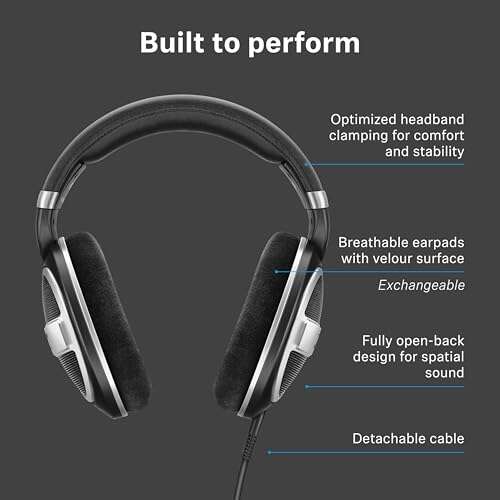
Open-back headphones have vents that allow air and sound to pass through the ear cups.
They often provide:
- A more open presentation
- More natural airflow
- Less pressure from trapped sound
- Sound that can feel wider or more spacious
They also leak sound and let outside noise in. They are usually better for quiet rooms than for offices, airplanes, libraries, or shared homes.
Closed-back headphones seal the rear of the driver.
They can offer:
- Better isolation
- Less sound leakage
- Stronger bass impact in some designs
- Better use in shared or noisy spaces
Closed-back models may feel warmer or less spacious. The seal can also change the bass response.
Wired and wireless connections
Wired headphones send the audio signal through a cable. This can avoid battery limits and wireless compression, depending on the source and connection.
Wireless headphones use Bluetooth or another radio link. They add convenience, but the sound passes through built-in electronics and a codec. A codec compresses and sends the audio data over the wireless connection.
Common Bluetooth codec names include SBC, AAC, aptX variants, and LDAC. Support varies by headphone, phone, computer, and operating system. Both devices must support a codec for it to work.
A wireless headphone can still sound excellent. “Wireless” does not automatically mean “low fidelity.” It does mean that battery life, codec support, connection quality, and onboard processing become part of the design.
Active noise cancellation
Active noise cancellation, or ANC, uses microphones and electronic processing to reduce outside sound. It works best against steady low-frequency noise, such as airplane engines or bus rumble.
ANC is not the same as high fidelity. It can improve the listening experience in a noisy place, but the processing may change the sound. Some headphones let you turn ANC off or select a different listening mode.

Are High-Fidelity Headphones Worth It?
High-fidelity headphones can be worth the cost when you listen often, notice differences in sound, and choose a model that fits your equipment and environment.
They may be a good choice for:
- Focused music listening
- Home stereo systems
- Audio editing and mixing
- Learning an instrument
- Hearing small details in familiar recordings
- Film and game sound in a quiet room
- Listeners who want a replaceable cable or repairable parts
They may not be the best choice when:
- You mainly listen in loud public places
- You need a microphone for frequent calls
- You want a small, light travel set
- You dislike cable management
- You prefer a strong bass boost or other colored sound
- Your current headphones already meet your needs
The biggest improvement often comes from a better fit and better tuning, not from spending more money. A comfortable, well-sealed headphone that matches your taste may sound better to you than a costly model with an unsuitable design.
High fidelity versus a “fun” sound
Some listeners use “high fidelity” to mean a neutral sound. Others use it to mean detailed, clean, and well made, even when the headphone has extra bass or treble.
A neutral headphone may be useful for editing because it does not strongly favor one part of the range. A bass-enhanced headphone may be more enjoyable for hip-hop, electronic music, or action films.
Neither choice is wrong. The deciding question is whether you want the headphones to reveal the recording as it is or shape it toward your preferred sound.

How to Choose High-Fidelity Headphones
Start with your listening situation. Do not begin with price or driver type.
Step 1: Choose the setting
Ask where you will use the headphones most:
- Quiet room: Consider open-back or comfortable closed-back models.
- Shared home: Closed-back headphones reduce leakage.
- Travel: Look for isolation, ANC, low weight, and long battery life.
- Studio work: Prioritize consistent response, comfort, and a reliable cable.
- Gaming: Consider imaging, comfort, microphone quality, and platform support.
- Phone use: Check impedance, sensitivity, cable controls, and connector type.
Step 2: Decide between wired and wireless
Choose wired if you want:
- No battery charging
- A simple analog signal path
- Easy use with a DAC or amplifier
- A removable cable on many models
Choose wireless if you want:
- Freedom from cables
- Easy use with a phone
- ANC or transparency modes
- Built-in controls and microphones
Some headphones offer both. That can be useful if you want wireless convenience for travel and a wired connection at home.
Step 3: Check device compatibility
Before buying, check:
- The headphone connector
- Whether your phone needs a USB-C or Lightning adapter
- The headphone’s impedance and sensitivity
- Bluetooth codec support
- Whether the microphone works with your computer or phone
- Whether the model needs a special amplifier
- Whether replacement pads and cables are available
A 6.35-millimeter plug may need an adapter for a smaller 3.5-millimeter jack. An adapter changes the connector size; it does not automatically improve sound.
Step 4: Evaluate comfort and fit
Comfort affects sound because fit changes the seal and the seal changes the response.
Check the:
- Headband pressure
- Ear pad material
- Ear cup size
- Weight
- Clamp force
- Heat buildup
- Cable position
- Adjustment range
For in-ear models, the ear tip size can change both comfort and bass. Try different tips if the design allows it.
Step 5: Read measurements carefully
Look for measurements from a reliable, independent test source. Pay attention to:
- Frequency response
- Distortion
- Channel balance
- Output level
- Noise cancellation performance
- Battery results under stated conditions
Do not compare graphs from different systems as if they were identical. Measurement rigs, software, fit, and test settings can change the result.
High-Fidelity Headphones and High-Resolution Audio
High-resolution audio usually refers to digital audio with more detail than standard compact-disc specifications, such as a higher sample rate or bit depth. A high-resolution file can contain more stored information, but that does not automatically make it sound better.
The final result depends on:
- The quality of the original recording
- The mastering
- The playback device
- The DAC and amplifier
- The headphone response
- The listener’s hearing
- The listening level
- The quality of the connection
A lossless file preserves the encoded data without lossy compression. It does not guarantee a better recording. A carefully mastered compressed file may sound better than a poorly mastered high-resolution file.
For most listeners, a good recording, a suitable headphone, and a comfortable fit matter more than chasing the highest file specification.

Do You Need a Headphone Amplifier?
You may need a headphone amplifier when your current device cannot provide enough clean power or when it lacks a suitable headphone output.
Signs that an amplifier may help include:
- The headphone is too quiet at a safe listening level.
- The sound becomes harsh or distorted when you raise the volume.
- The device has a weak or noisy headphone output.
- The headphone manufacturer lists a specific power requirement.
- You use a model with high impedance or low sensitivity.
You may not need one if your laptop, phone adapter, or audio interface already drives the headphones to a comfortable level without noise or distortion.
Do not use extreme volume to test equipment. Hearing damage can result from loud sound over time. The National Institute on Deafness and Other Communication Disorders advises keeping listening levels moderate and taking breaks. If you notice ringing, muffled hearing, pain, or a change in hearing, stop listening and seek medical advice.

Common Mistakes to Avoid
Assuming a higher price means higher fidelity
Price can pay for better materials, research, comfort, support, or manufacturing. It does not guarantee a better match for your ears or music.
Treating “lossless” as a quality guarantee
Lossless describes how data is stored or transmitted. It does not rate the recording, mastering, or headphone.
Ignoring the room
Open-back headphones may sound excellent in a quiet room but work poorly beside a television, office conversation, or air conditioner.
Buying by driver type alone
Planar, dynamic, electrostatic, and balanced-armature drivers can all produce strong results. The driver label is not a complete performance test.
Using the wrong ear pad seal
A loose seal can reduce bass and make the headphone sound thin. Glasses, hair, jaw movement, and ear shape can all affect the seal.
Listening too loudly
More volume can make music seem more detailed for a short time. It also raises hearing risk. Compare headphones at similar, moderate levels.
Confusing detail with accuracy
A sharp treble peak can make small sounds stand out. That may feel detailed but can also make music tiring. Detail and neutrality are related, but they are not the same thing.

Key Takeaways
- High-fidelity headphones aim to reproduce recorded sound with high accuracy.
- “Hi-fi” is not one fixed certification or guarantee.
- Fit, tuning, comfort, and listening conditions matter as much as technical specifications.
- Open-back models suit quiet rooms; closed-back models provide more isolation.
- Wireless headphones can sound very good, but codec and battery limits matter.
- A headphone amplifier is useful only when the source cannot drive the headphones cleanly.
- High-resolution audio does not guarantee better sound.
- Protect your hearing by keeping volume moderate and taking breaks.
FAQs
What is the difference between high-fidelity and regular headphones?
High-fidelity headphones place more emphasis on accurate sound, low distortion, detail, and consistent reproduction. Regular headphones may focus more on price, convenience, bass impact, style, or portability. The categories overlap, and an affordable headphone can still sound very good.
Are high-fidelity headphones good for gaming?
They can be. Many provide clear imaging that helps you place sounds in a game. However, gaming performance also depends on comfort, microphone quality, platform compatibility, and whether the headphone works well with your console or computer.
Are wireless headphones high fidelity?
Yes. Wireless headphones can deliver detailed and balanced sound. Their performance depends on the drivers, tuning, codec, wireless connection, battery state, and built-in processing. Wired headphones offer a simpler signal path, but wireless does not automatically mean poor quality.
Are high-fidelity headphones safe for your ears?
The headphones themselves are not the main risk. Excessive volume and long listening sessions can damage hearing. Keep the level moderate, take regular breaks, and stop if you notice ringing, pain, or muffled hearing.
Do high-fidelity headphones need special music files?
No. They work with ordinary music files, streaming services, CDs, records, and high-resolution audio. Better headphones may reveal more of a recording, but the source still needs to be well recorded and well mastered.
Conclusion
High-fidelity headphones are headphones built to reproduce audio with as little unwanted change as practical. Their value comes from the full system: tuning, drivers, fit, comfort, source quality, amplification, and listening environment.
For a quiet U.S. home setup, an open-back wired model may offer an enjoyable and spacious presentation. For travel or shared spaces, a closed-back wireless model with ANC may be more useful. The best choice is not the model with the biggest specification list. It is the one that matches your ears, equipment, music, and daily use.

Everett Ashford is a tech reviewer at mytechgrid.com specializing in SSDs, cameras, TVs, earbuds, headphones, and other consumer electronics. He provides honest, data-driven reviews based on hands-on testing and real-world performance analysis. Everett simplifies complex tech details to help readers make smart, confident buying decisions.