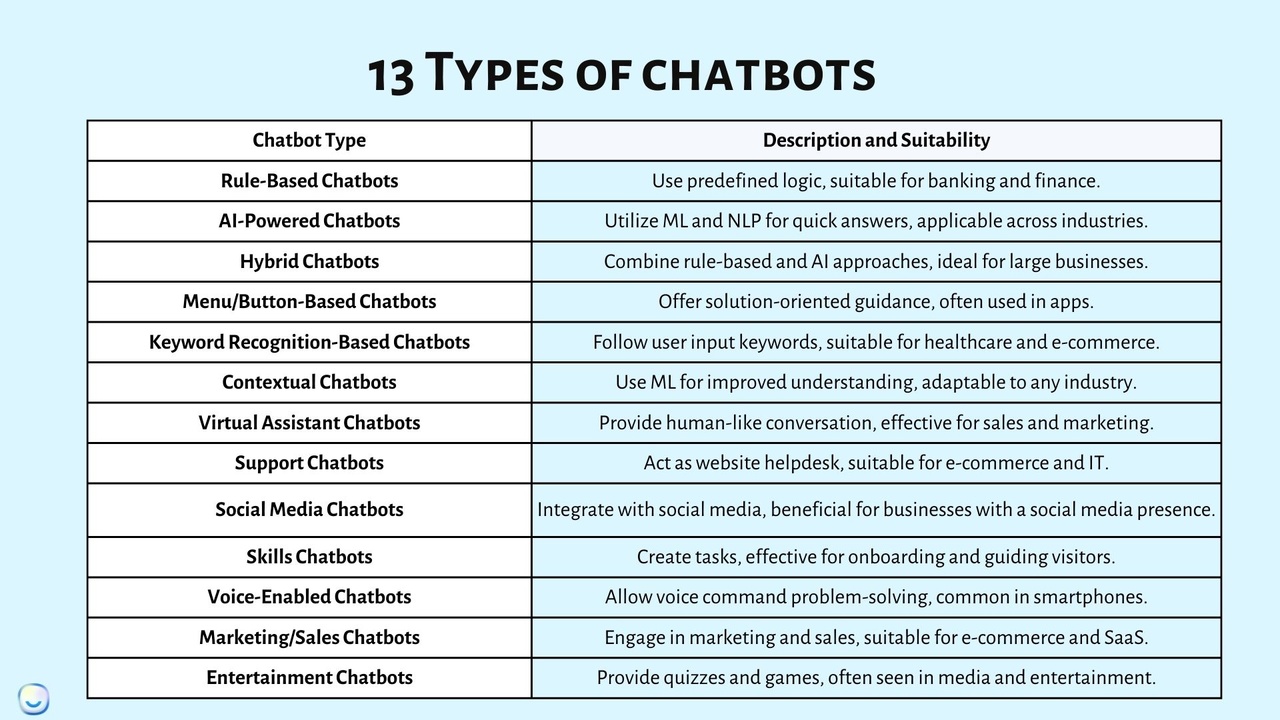
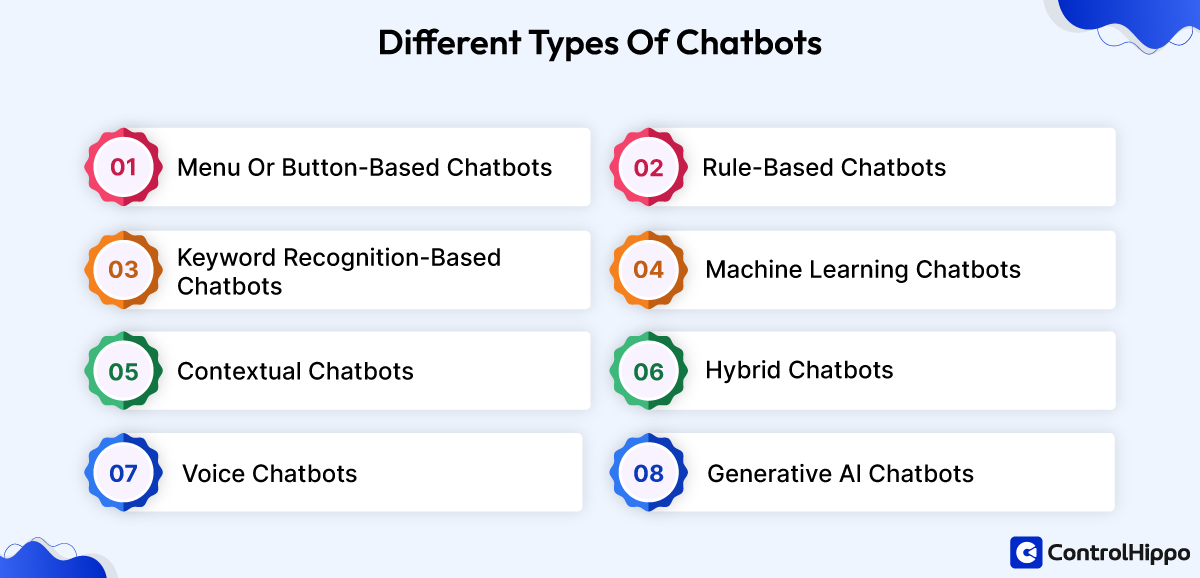
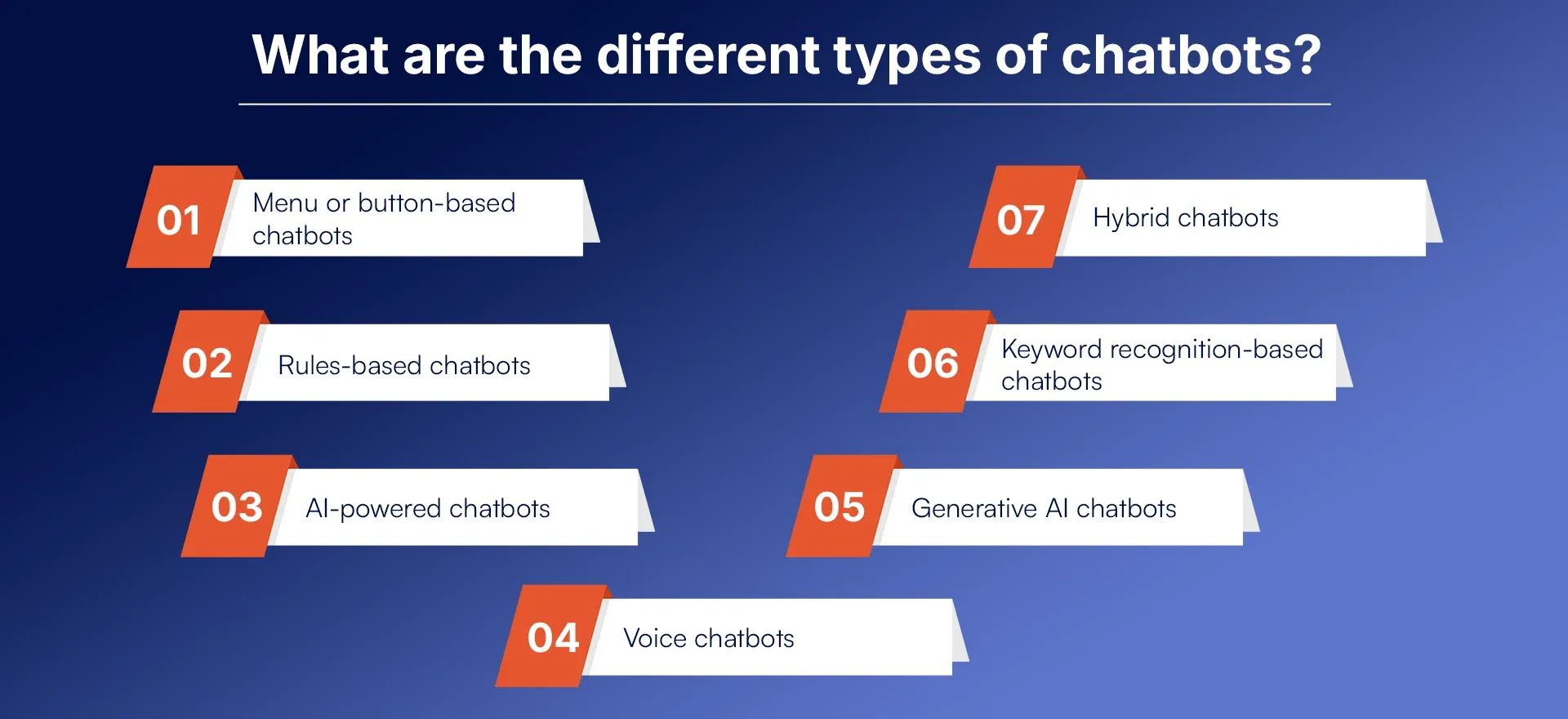
In the United States, chatbots help people check an order, book an appointment, answer a bank question, or get support from a government or business website. The main types are rule-based chatbots, AI chatbots, hybrid chatbots, retrieval-based chatbots, generative AI chatbots, voice chatbots, and task-oriented chatbots. These types can overlap because one chatbot may use several methods at once.
The best chatbot type depends on the job, the risk level, the data it must use, and how much freedom it needs when forming answers. A bot for store hours needs less control than one that helps a patient find care or a customer dispute a charge.
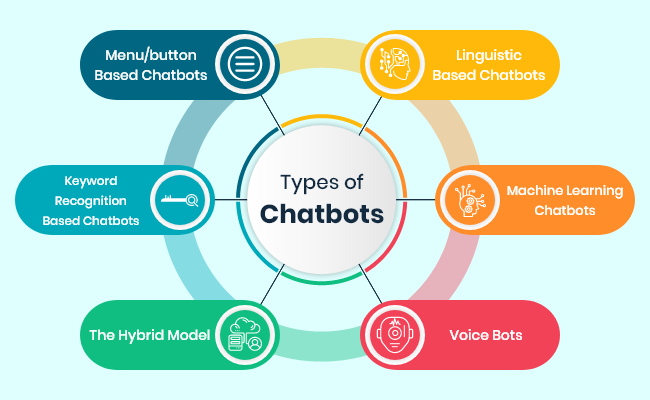
The Main Types of Chatbots at a Glance
Chatbots are software systems that communicate with people through text, voice, or another digital interface. Some follow fixed rules. Others use artificial intelligence (AI) to understand language, search approved information, or create a new reply.
| Chatbot type | How it works | Best for | Main limit |
|---|---|---|---|
| Rule-based chatbot | Follows set rules, menus, and decision trees | Simple, repeatable questions | Struggles with new wording |
| AI or NLP chatbot | Uses natural language processing to identify user intent | Flexible customer questions | Can misunderstand unclear requests |
| Retrieval-based chatbot | Selects an answer from approved content | Accurate support and knowledge bases | Cannot freely create new answers |
| Generative AI chatbot | Creates replies with a language model | Drafting, research, conversation, and broad help | May produce false or unsupported claims |
| Hybrid chatbot | Combines rules, search, AI, and human handoff | Complex support journeys | Needs more design and testing |
| Voice chatbot | Uses speech recognition and text-to-speech | Phone calls and hands-free use | Noise and accents can affect accuracy |
| Task-oriented chatbot | Completes a specific action or workflow | Booking, payments, returns, and account help | Usually has a narrow scope |
| Social or conversational chatbot | Focuses on open-ended conversation | Engagement and basic companionship | May lack reliable task control |
These categories describe different parts of a chatbot. For example, a bank may use a hybrid, voice-enabled, task-oriented chatbot that retrieves answers from approved content and uses rules for account security.

1. Rule-Based Chatbots
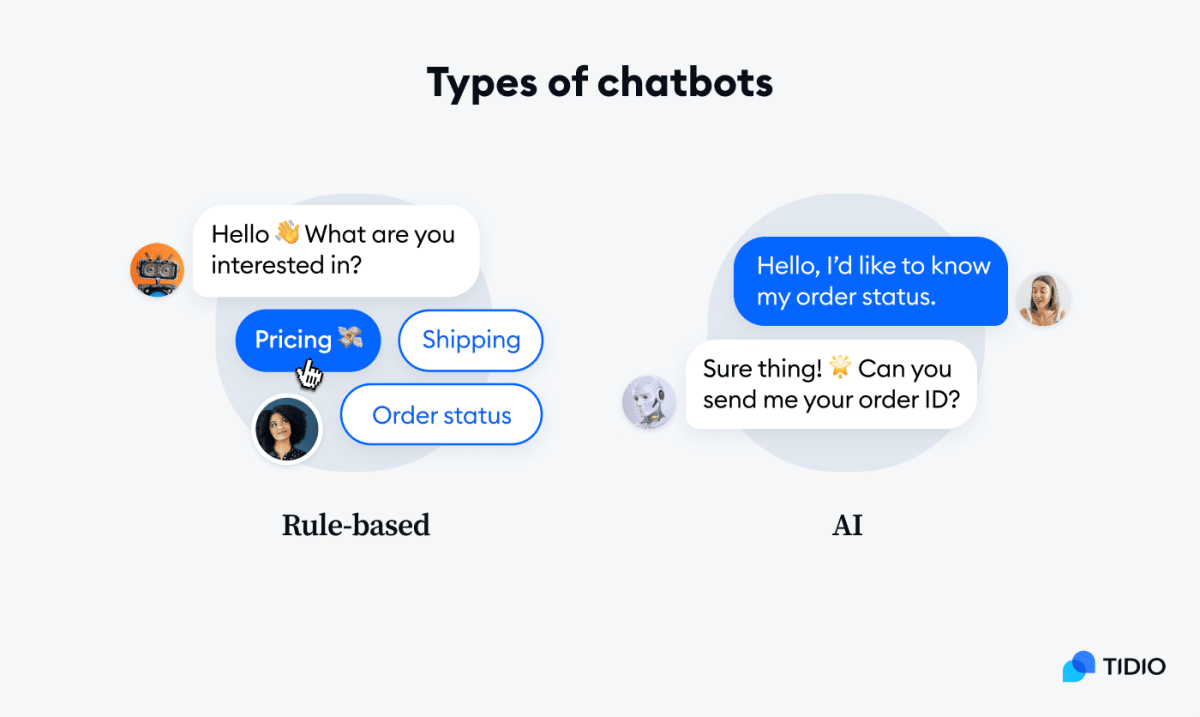
Rule-based chatbots use instructions written by people. They guide users through menus, buttons, keywords, and decision trees. The bot does not need to understand every sentence in a deep way. It checks the user’s input against a known path and gives the matching response.
A simple rule-based chatbot may ask:
- “What do you need help with?”
- “Choose an option: shipping, returns, or billing.”
- “Select your order number.”
- “Your order is scheduled to arrive on Friday.”
Where rule-based chatbots work well
Rule-based bots fit tasks with clear steps and limited choices, such as:
- Checking store hours
- Finding a return policy
- Tracking an order
- Collecting contact details
- Routing a support request
- Answering common questions
- Guiding users to a form or webpage
They are often easier to review because the business can see the exact paths and replies. This control matters in settings where an incorrect answer could cause harm or create a legal problem.
Limits of rule-based bots
A rule-based bot may fail when a user changes the wording. For example, a bot built for “Where is my package?” may not understand “Can you tell me when my delivery will get here?” unless both phrases are included in its rules.
These bots can also frustrate users when they force a long menu path. A good design should offer a clear escape route, such as “talk to a person,” “start over,” or “show all options.”
2. AI and Natural Language Processing Chatbots
AI chatbots use natural language processing (NLP) to interpret what a person means. NLP is the technology that helps software work with human language. Instead of matching only one exact phrase, the chatbot tries to identify the user’s intent and key details.
For example, these requests may share one intent:
- “I need to change my flight.”
- “Can I move my trip to next week?”
- “How do I reschedule my ticket?”
The chatbot may identify the intent as change reservation and extract details such as the booking number, date, or destination.
What AI chatbots can do
An AI chatbot may:
- Recognize different ways to ask the same question
- Ask follow-up questions
- Detect names, dates, locations, or order numbers
- Classify a support request
- Remember details within a conversation
- Route the user to the correct department
- Connect with business software through an application programming interface (API)
The bot’s performance depends on its training data, language model, system design, and testing. “AI-powered” does not automatically mean accurate or useful.
The main trade-off
AI chatbots are more flexible than fixed menu bots, but flexibility can create uncertainty. The bot may misunderstand a short or vague message. It may also assign the wrong intent when two requests sound alike.
For higher-risk tasks, businesses often combine AI language understanding with rules. The AI can understand the user, while rules control what the system is allowed to do.

3. Retrieval-Based Chatbots
Retrieval-based chatbots find information in a set of approved documents and use it to answer the user. The documents may include a company help center, product manuals, policy pages, or internal guides.
A retrieval-based bot does not need to invent an answer from scratch. It searches for relevant content and presents a reply based on that material. Some systems use a method called retrieval-augmented generation (RAG). RAG first retrieves relevant information and then asks a language model to turn it into a readable answer.
Why retrieval-based chatbots are useful
This type works well when the answer should come from a known source, such as:
- Employee policies
- Insurance plan documents
- Product instructions
- University rules
- Shipping and return policies
- Technical support articles
- Public agency information
Retrieval can make answers more grounded than a chatbot that relies only on a general language model. It also allows the content owner to update the source documents without retraining the entire model.
What retrieval does not guarantee
Retrieval is not the same as proof of accuracy. The bot may find the wrong document, use outdated content, or misread a passage. It may also fail when the needed answer is not in the source library.
Businesses should set rules for source updates, access control, document versions, and citations. Users should still verify important details, such as deadlines, fees, coverage terms, and eligibility rules, with the official source.

4. Generative AI Chatbots
Generative AI chatbots create new text in response to a prompt. They use a large language model to predict and assemble a reply based on patterns learned from data and the information supplied during the conversation.
Popular uses include:
- Explaining a complex topic
- Drafting an email
- Summarizing text
- Brainstorming ideas
- Translating content
- Writing code
- Answering broad questions
- Helping staff prepare a first draft
A generative chatbot can handle many topics, which makes it feel more natural than a narrow menu bot.
The risk of hallucinations
A generative chatbot can produce a statement that sounds confident but is false. This is often called a hallucination. The risk rises when the question asks for obscure facts, current information, personal advice, or details outside the model’s reliable knowledge.
The National Institute of Standards and Technology (NIST) identifies reliability, privacy, security, and accountability as important parts of managing AI risk. A business should not treat fluent writing as evidence that an answer is correct.
How to use generative chatbots with care
For important work:
- Give the bot trusted source material.
- Ask it to say when it lacks enough information.
- Limit access to sensitive systems.
- Review output before sending it to a customer.
- Avoid entering private data unless the service and policy allow it.
- Keep a human involved in high-impact decisions.
A generative chatbot is often strongest as a writing or support aid. It needs tighter controls when it can approve, deny, charge, diagnose, or make decisions about a person.

5. Hybrid Chatbots
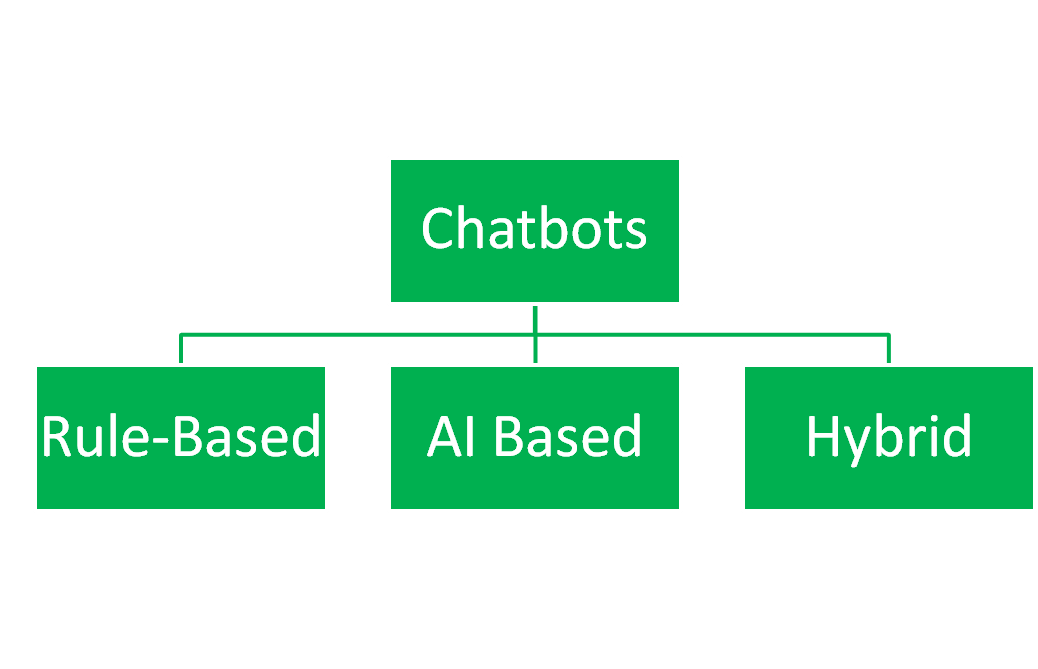
Hybrid chatbots combine two or more approaches. A single system may use rules for security, NLP for intent detection, retrieval for facts, generative AI for wording, and human support for unusual cases.
This design is common because no single chatbot type is best at every job.
Example of a hybrid support flow
A customer may type, “My laptop arrived damaged. What can I do?”
A hybrid chatbot might:
- Identify the request as a damaged-item return.
- Ask for the order number.
- Check the order system.
- Retrieve the company’s damage policy.
- Explain the next step.
- Create a return request.
- Send the case to a person if the order does not meet a rule.
The system uses AI to understand the message, business rules to control eligibility, and approved content to explain the policy.
Why companies choose hybrid systems
Hybrid chatbots offer a practical balance:
- Rules provide control.
- AI improves language understanding.
- Retrieval keeps answers tied to approved sources.
- Generative tools make replies easier to read.
- Human handoff covers edge cases.
The cost is complexity. More parts mean more testing, monitoring, access controls, and maintenance. A hybrid bot should have clear logs that show what source, rule, or system produced an answer.
6. Voice Chatbots and Conversational IVR
Voice chatbots communicate through spoken language. They usually combine:
- Automatic speech recognition, which turns speech into text
- Language understanding, which identifies meaning
- A dialogue system, which chooses the next step
- Text-to-speech, which reads the reply aloud
A phone-based voice bot may help someone check an account balance, schedule a service visit, or route a call.
Voice chatbot benefits
Voice systems can help users who:
- Prefer phone support
- Have limited access to a screen
- Need hands-free help
- Are driving or working with equipment
- Find typing difficult
They may also reduce wait time for simple requests. However, a voice system should not make it hard to reach a person.
Common voice chatbot problems
Voice bots can misunderstand:
- Background noise
- Names and unusual words
- Accents and dialects
- Fast speech
- Multiple people speaking
- Phone connection problems
- Numbers, dates, and addresses
A safe voice flow repeats critical details. For example, it should confirm a payment amount or appointment time before completing the action.

7. Task-Oriented Chatbots
Task-oriented chatbots are built to help a person complete a defined goal. They focus less on open conversation and more on getting a result.
Examples include:
- Booking a hotel room
- Scheduling a medical appointment
- Filing a service request
- Checking a delivery
- Starting a product return
- Resetting a password
- Paying a bill
- Updating an address
A task-oriented bot usually needs access to another system. It may need to check inventory, verify identity, read a calendar, or create a record.
What makes a task-oriented chatbot effective
A good task bot should:
- State what it can do.
- Ask only for needed information.
- Confirm key details before acting.
- Show the result clearly.
- Handle errors without losing the whole conversation.
- Offer a human handoff.
- Protect private account information.
For example, a booking chatbot should confirm the date, time, location, and price before placing a reservation. A vague “Done” message is not enough.
Task-oriented versus conversational chatbots
A conversational chatbot may discuss many topics. A task-oriented bot has a narrower goal. The narrower design is often better when accuracy and completion matter more than open-ended discussion.
8. Conversational and Social Chatbots
Conversational chatbots are designed to maintain a natural dialogue. They may answer questions, brainstorm, provide entertainment, or support engagement on a website or messaging platform.
Some are called social chatbots because they focus on interaction rather than a business transaction. A brand may use one to welcome visitors, explain a service, or start a product conversation.
These bots can make digital support feel less rigid. Still, a friendly tone does not mean the system understands emotions or has human judgment. Users should not assume that a chatbot is a person, a licensed professional, or a confidential counselor.
For mental health, medical, legal, or financial concerns, a chatbot should provide clear limits and direct users to qualified help when the situation calls for it.

How Chatbot Types Differ
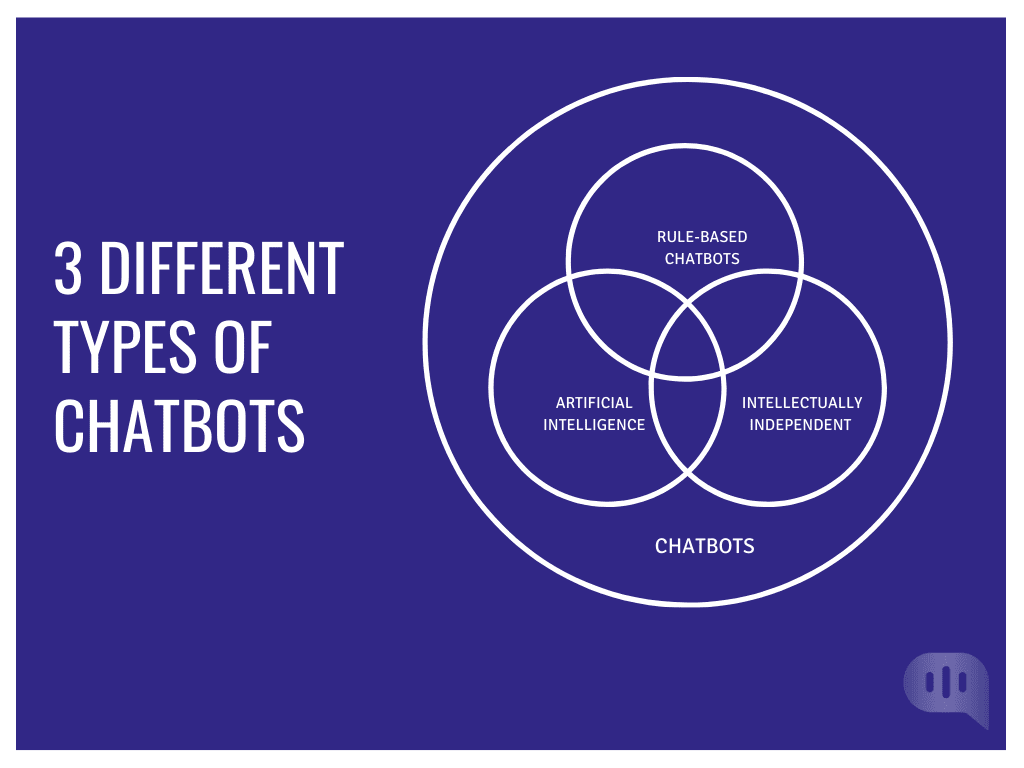
The word “type” can refer to several features. A useful classification looks at the chatbot’s control, knowledge source, communication channel, and purpose.
By control
- Scripted: Uses fixed replies and paths.
- AI-assisted: Interprets language but follows defined actions.
- Generative: Creates flexible responses.
- Human-supported: Escalates to a person when needed.
By knowledge source
- Closed-domain: Uses information about one business, product, or service.
- Open-domain: Handles a broad range of topics.
- Retrieval-based: Finds answers in approved sources.
- Model-based: Relies mainly on information learned during model training.
- Connected: Uses live business systems or external tools.
By channel
- Website chat
- Mobile app chat
- SMS
- Social messaging
- Voice or phone
- Smart speakers
- Workplace tools
By purpose
- Customer support
- Sales and product guidance
- Lead collection
- Employee help
- Education and training
- Scheduling
- Transactions
- Entertainment
- Accessibility support
These labels can overlap. A chatbot may be closed-domain, retrieval-based, hybrid, task-oriented, and available by phone and website.
Which Type of Chatbot Should You Choose?
Choose the simplest chatbot that can complete the job safely and well. A more advanced model is not always a better fit.
| If your main need is… | Start with… | Add when needed… |
|---|---|---|
| A few common questions | Rule-based chatbot | Search and human handoff |
| Many ways to ask the same thing | NLP chatbot | Intent testing and fallback rules |
| Answers tied to company documents | Retrieval-based chatbot | Source citations and update controls |
| Drafts and broad conversation | Generative AI chatbot | Human review and data limits |
| A mix of support and transactions | Hybrid chatbot | System integrations and monitoring |
| Phone-based help | Voice chatbot | Confirmation steps and call transfer |
| A booking or account action | Task-oriented chatbot | Identity checks and error recovery |
Before selecting a platform or model, answer these questions:
- What should the chatbot do?
- What information will it need?
- Can a wrong answer cause financial, legal, health, or safety harm?
- Does it need live data?
- Should it complete actions or only provide information?
- When must a human take over?
- What personal data will it collect?
- How will the business test and monitor it?
The riskier the task, the more the design should favor approved sources, clear rules, confirmation steps, access controls, and human review.
Common Chatbot Mistakes
Choosing generative AI for a simple menu
A large language model may be unnecessary for store hours, return links, or basic routing. A rule-based bot can be easier to control and less costly to maintain.
Treating a chatbot as a search box
A chatbot may summarize information incorrectly or miss an important condition. Users need a way to view the original policy or source when the detail matters.
Hiding the human handoff
A chatbot should not trap a user in repeated failed replies. Offer a clear path to a person, especially for billing disputes, account access, complaints, and urgent needs.
Giving the bot too much access
A chatbot should receive only the permissions required for its task. Separate reading information from changing records, issuing refunds, or sending payments.
Failing to test real wording
Test short messages, spelling errors, slang, accents, incomplete details, angry users, and questions outside the bot’s scope. Test both success and failure paths.
Ignoring privacy
Do not collect sensitive information unless it is needed and properly protected. Tell users what data the chatbot collects and how it is used. Businesses should also review applicable U.S. privacy, consumer protection, accessibility, and sector-specific requirements.

How to Evaluate a Chatbot
A chatbot evaluation should measure more than how natural the conversation sounds.
Track:
- Answer accuracy: Does the reply match the approved source?
- Task completion: Did the user finish the intended action?
- Fallback rate: How often does the bot fail or transfer the case?
- Escalation quality: Does it send the case to the right person?
- Response time: How quickly does it reply under normal demand?
- User effort: How many turns or steps does the task require?
- Safety performance: Does it avoid unsafe or unauthorized actions?
- Privacy controls: Does it limit data collection and access?
- Accessibility: Can people with different abilities use it?
- Maintenance effort: How often must content, rules, or integrations be updated?
A high completion rate can hide problems if the bot gives wrong answers or blocks users from reaching support. Review conversation samples, error cases, and complaints instead of relying on one score.
Frequently Asked Questions
What is the most common type of chatbot?
Rule-based and hybrid chatbots are common in customer service because they handle repeat questions and can route complex cases. Many newer systems add AI language tools, search, or generative responses to those basic flows.
Are AI chatbots and generative AI chatbots the same?
No. AI chatbot is a broad term. It can include rule-assisted NLP systems, retrieval tools, predictive models, and generative AI. A generative AI chatbot specifically creates new responses with a language model.
What type of chatbot is best for customer service?
A hybrid chatbot is often a strong fit when support includes both simple questions and account actions. A rule-based bot may be enough for a small FAQ, while a retrieval-based bot can suit support that depends on detailed product or policy documents.
Can a chatbot use more than one type?
Yes. Chatbot categories describe different features, so they can overlap. A single system may be a website chatbot, a voice chatbot, a retrieval-based chatbot, and a task-oriented chatbot at the same time.
Are chatbots safe for private information?
Safety depends on the system, its data practices, and the task. Do not share sensitive information unless the service clearly explains how it protects that data and the interaction is necessary. For high-impact decisions, keep qualified human review in the process.
Key Takeaways
- Rule-based chatbots follow fixed paths and work well for simple, repeatable requests.
- AI and NLP chatbots understand more varied language and user intent.
- Retrieval-based chatbots answer from approved documents and knowledge sources.
- Generative AI chatbots create flexible replies but may produce false information.
- Hybrid chatbots combine rules, AI, retrieval, system tools, and human support.
- Voice chatbots handle spoken conversations over phones or voice devices.
- Task-oriented chatbots help users complete actions such as booking, tracking, or returning an item.
- The best choice depends on the task, risk, data, channel, and need for human control.
Conclusion
The types of chatbots differ mainly in how they understand language, find information, create replies, and complete tasks. Start with the user’s goal rather than the newest technology. Use a simple, controlled design for simple work, and add AI, retrieval, integrations, or human review only when they solve a real need.
For most U.S. businesses, the practical path is to define a narrow use case, connect the bot to trusted information, protect user data, test failure cases, and make human help easy to reach.

Everett Ashford is a tech reviewer at mytechgrid.com specializing in SSDs, cameras, TVs, earbuds, headphones, and other consumer electronics. He provides honest, data-driven reviews based on hands-on testing and real-world performance analysis. Everett simplifies complex tech details to help readers make smart, confident buying decisions.