Introduction
A software framework for AI is a set of reusable tools, rules, and building blocks that helps developers create, train, test, and run artificial intelligence systems. For a team in the United States, an AI framework can reduce the time needed to move from a data set to a working model, whether the goal is fraud detection, document search, image analysis, or a customer service tool.
Instead of writing every function from scratch, developers use a framework to handle common tasks such as data processing, model training, optimization, testing, and deployment. The framework does not decide what the AI should do. It provides the structure needed to build and operate that system.
How an AI framework works
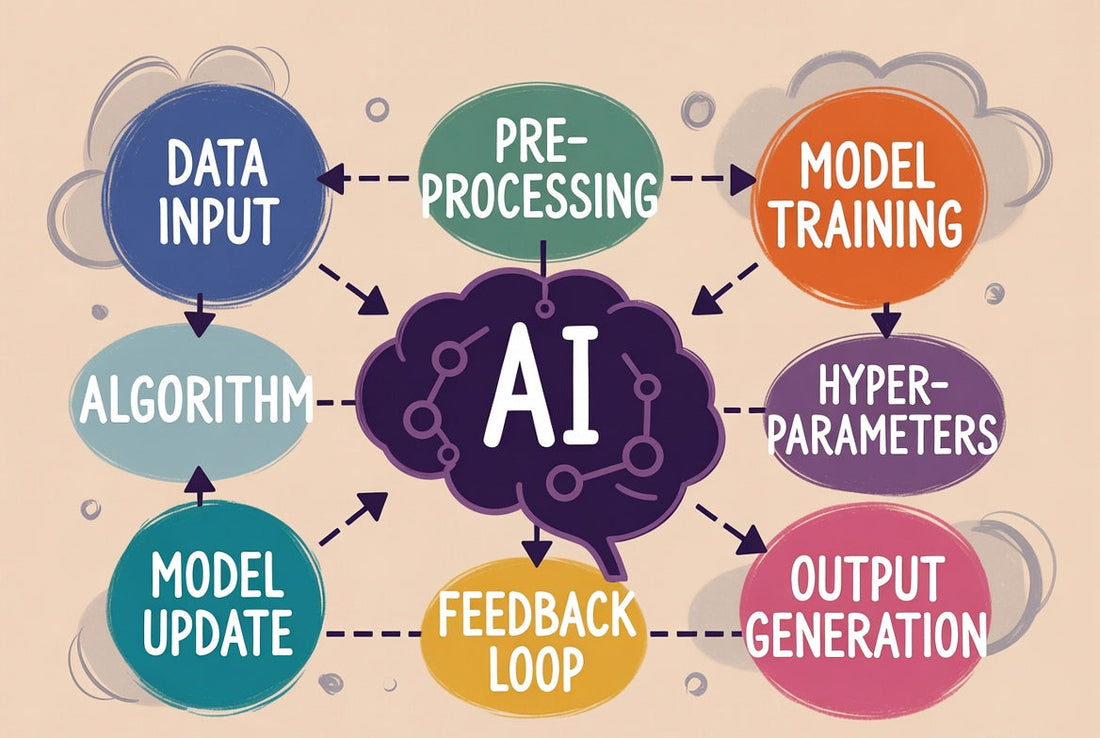
An AI framework connects several parts of the development process. These parts usually include data input, model design, training, evaluation, and use in a real application.


A typical workflow looks like this:
- Prepare data. The developer loads, cleans, labels, and divides data into useful sets.
- Define a model. The model describes how the system will find patterns or produce results.
- Train the model. The framework adjusts model settings by using examples.
- Evaluate results. The developer checks accuracy, errors, speed, and fairness.
- Deploy the model. The trained model is placed in an app, website, device, or cloud service.
- Monitor performance. The team watches for errors, drift, security risks, and changes in data.
The framework supplies many of the low-level operations behind these steps. It may manage mathematical operations, hardware use, memory, automatic differentiation, parallel processing, and saved model files.
A simple example
Suppose a US credit union wants to flag unusual card activity. A developer could build the system without a framework, but that would require writing code for many standard tasks.
With a machine learning framework, the developer can:
- Load transaction records.
- Convert data into numbers.
- Choose a classification or anomaly detection model.
- Train the model on past transactions.
- Measure false alarms and missed fraud cases.
- Export the model for use in a banking application.
The framework does not prove that the system is fair, secure, or accurate enough for real customers. Those decisions still require careful testing, human review, and compliance work.
What is the difference between an AI framework and an AI library?
An AI framework offers a broader structure for building an application. An AI library usually provides a narrower set of functions that the developer calls when needed.


The distinction is useful, but the terms can overlap. Some tools are called libraries in one context and frameworks in another.
| Tool type | Main role | Example |
|---|---|---|
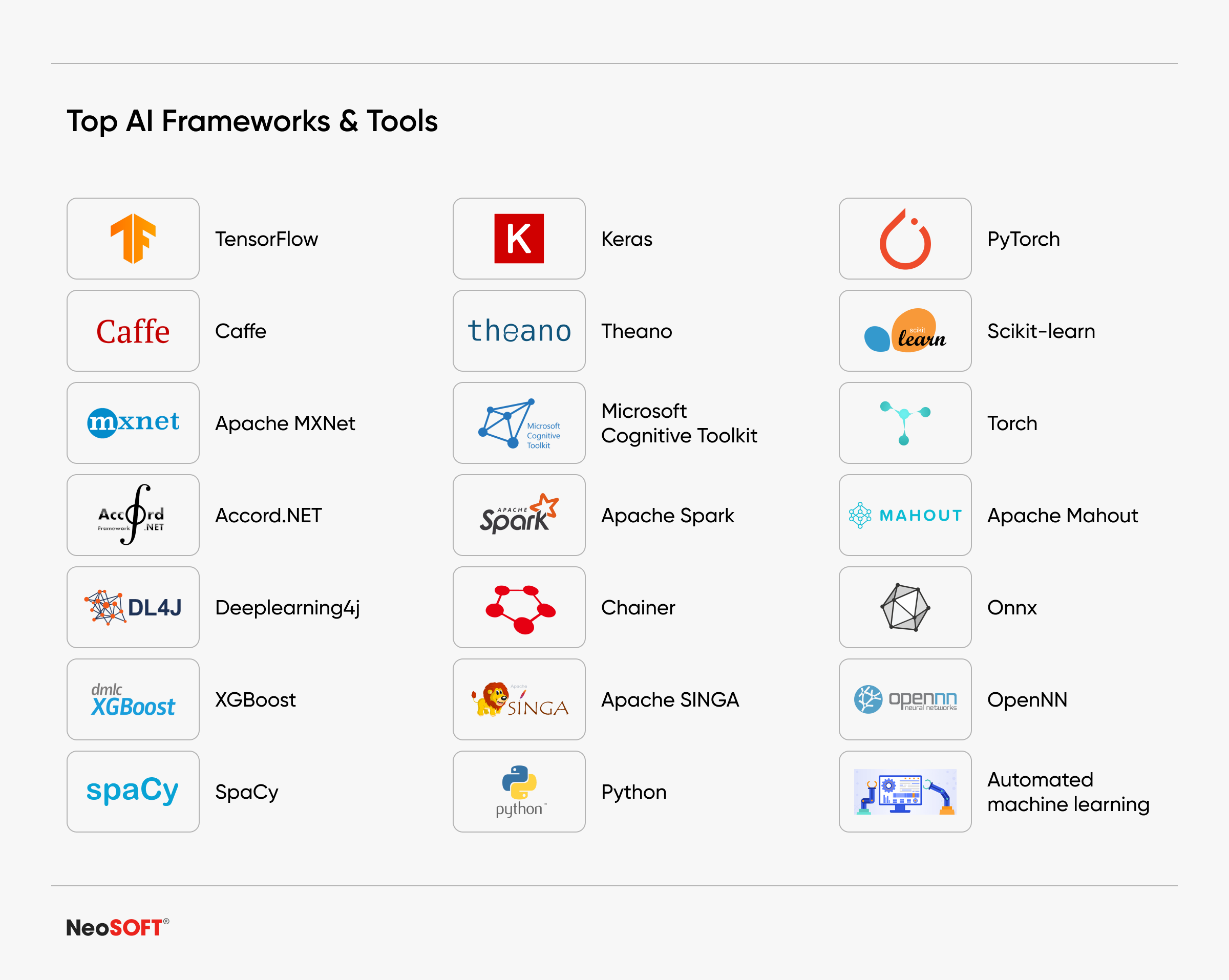
| AI framework | Organizes model development and execution | TensorFlow, PyTorch |
| Machine learning library | Provides algorithms and data tools | scikit-learn |
| Neural network API | Simplifies model creation | Keras |
| Model hub | Shares trained models and data sets | Hugging Face Hub |
| Application framework | Connects AI to an app or service | FastAPI, Ray |
| Cloud AI platform | Adds managed training and deployment | A cloud provider’s machine learning service |
A library often follows the developer’s code. A framework may control more of the application flow. In practice, an AI project may use several layers at once.
For example, a team might use Python for the application, pandas for data work, scikit-learn for a baseline model, PyTorch for a neural network, and FastAPI to expose the model through a web service.
What does an AI framework include?
Most AI frameworks include several common functions. The exact features depend on the framework and the type of AI project.
Model-building tools
A framework may provide ready-made parts for:
- Linear and logistic models
- Decision trees
- Neural networks
- Convolutional networks for images
- Transformer models for text and other sequences
- Recommender systems
- Clustering and anomaly detection
These parts let developers test different designs without implementing every mathematical operation by hand.
Training and optimization
Training tools help a model learn from examples. They may include:
- Loss functions
- Optimizers
- Automatic gradient calculation
- Batch processing
- Learning-rate controls
- Checkpoints
- Distributed training
A loss function measures how far a model’s result is from the desired result. An optimizer then changes the model to reduce that loss.
Hardware support
Modern AI can require large amounts of computation. Frameworks may use:
- Central processing units, or CPUs
- Graphics processing units, or GPUs
- Specialized AI chips
- Cloud clusters
- Multiple machines
Hardware support can improve speed, but it can also increase cost. A framework that runs well on a developer’s laptop may need different settings in a US cloud region or in an edge device.
Evaluation and monitoring
A useful framework helps developers measure more than one score. Depending on the task, the team may need to track:
- Accuracy
- Precision
- Recall
- F1 score
- Mean absolute error
- Response time
- Memory use
- Cost per request
- Error rates across user groups
A high accuracy score can hide serious problems. For example, a fraud model may appear accurate if fraud is rare, even while missing many real fraud cases.
Deployment tools
Some frameworks support the move from a trained model to a working product. Deployment features may include:
- Model export
- Version control
- Batch prediction
- Real-time prediction
- Mobile or browser execution
- Container support
- API integration
- Hardware-specific optimization
The best training framework is not always the best deployment tool. A team should check both needs before it starts.


Common software frameworks for AI
The right framework depends on the AI task, team skills, hardware, and deployment plan. No single tool is best for every project.
TensorFlow
TensorFlow is an open-source platform for machine learning. It supports model creation, training, evaluation, and deployment. Its wider ecosystem includes tools for serving models, mobile use, and browser-based applications.
TensorFlow may suit teams that want a broad production ecosystem and support for several deployment targets. Its learning curve can be higher when a project uses advanced features.
Official documentation: TensorFlow
PyTorch
PyTorch is an open-source machine learning framework widely used for deep learning. It supports tensor operations, automatic differentiation, neural network building, and GPU computing.
PyTorch can be a strong fit for research, experimentation, and custom deep learning systems. Teams should still review its deployment path, hardware needs, and long-term maintenance plan.
Official documentation: PyTorch
scikit-learn
scikit-learn is a Python machine learning library. It includes tools for classification, regression, clustering, preprocessing, model selection, and evaluation.
It is often a good starting point for structured data, such as sales records, customer attributes, sensor readings, and transaction data. It is not designed as the main tool for training large language models or large neural networks.
Official documentation: scikit-learn
Keras
Keras is a high-level deep learning API that makes it easier to create and train neural networks. It can work with supported backends and provides a simpler interface for many common tasks.
Keras may help beginners and teams that want readable model code. Developers should confirm which backend and deployment options fit their project.
Official documentation: Keras
Hugging Face Transformers
Transformers is a library and ecosystem for using many pretrained models for text, images, audio, and related tasks. It can help teams start with an existing model and adapt it instead of training one from nothing.
A pretrained model can save time and computing resources, but it still needs testing. Its license, training data, bias, security, and commercial use terms must fit the intended application.


Official documentation: Hugging Face Transformers
How to choose an AI framework
Choose an AI framework by starting with the task, not the brand name. A small prediction system has different needs from a large language model or a real-time vision system.
Use these questions to narrow the choice:
-
What type of data will the system use?
Text, images, audio, video, tables, and sensor data may favor different tools. -
Will you train a model or use a pretrained model?
Training from the start needs more data and computing power. A pretrained model may need fine-tuning, testing, or careful prompting. -
Where will the model run?
Consider a US cloud service, private data center, laptop, phone, browser, vehicle, or industrial device. -
What does the team already know?
A familiar framework may reduce errors and training time. -
What are the data and privacy limits?
Sensitive health, financial, student, or customer data may require strict controls. Check where data is stored, who can access it, and whether the service uses it for other purposes. -
How will you measure success?
Define the target before selecting a tool. Speed, cost, recall, reliability, and explainability may matter more than a single accuracy score. -
Can the team maintain it?
Check documentation, release practices, dependency updates, support options, and the ease of moving models to a new version.
A practical decision table
| Project need | A reasonable starting point | Main caution |
|---|---|---|
| Basic prediction from rows and columns | scikit-learn | Data quality may matter more than model complexity |
| Custom image or deep learning model | PyTorch or TensorFlow | GPU cost and model monitoring can grow quickly |
| Simple neural network workflow | Keras | Confirm backend and deployment needs |
| Text generation or classification with a pretrained model | Transformers | Review model license, bias, and security |
| Small model on a phone or browser | A framework with supported export tools | Test memory, speed, and battery use |
| Enterprise production system | A framework that fits the existing cloud and operations stack | Avoid choosing only by popularity |
These are starting points, not universal recommendations. A short prototype can use one tool, while a production system may use several.
What is the difference between an AI framework and an AI platform?
An AI framework is mainly a development tool. An AI platform usually includes managed services around that tool.
A platform may provide:
- Data storage
- Managed notebooks
- Training jobs
- Model registries
- Access controls
- Deployment endpoints
- Monitoring
- Billing controls
- Team collaboration
For example, a company may use PyTorch as the model framework and a cloud machine learning platform to run training jobs and host the model.


A framework gives developers more direct control. A platform can reduce operational work but may create service costs, account dependencies, and migration challenges. The best choice depends on the team’s need for control, speed, compliance, and portability.
What an AI framework does not solve
An AI framework cannot fix poor data, unclear goals, or unsafe product design. It can make a system easier to build, but it cannot guarantee that the result is correct.
Watch for these limits:
- Bad data: A model may learn errors or bias in its training data.
- Data leakage: Information from the answer set may accidentally enter the training data.
- Overfitting: A model may perform well on known examples but fail on new cases.
- Model drift: Real-world data may change after deployment.
- Security attacks: Inputs can be designed to confuse or manipulate a model.
- Hallucinated output: Generative AI can produce confident but false text.
- Unclear ownership: Training data and model licenses may limit use.
- Hidden cost: Large models can require costly storage, hardware, and API calls.
- Weak human review: High-risk decisions should not rely on an untested automated result.
For US organizations, legal and compliance needs can vary by industry and state. A framework does not provide legal compliance by itself. Teams should involve qualified privacy, security, and legal staff when the system affects employment, lending, housing, health care, education, safety, or access to services.
Common mistakes when selecting an AI framework
Choosing the most popular tool
Popularity does not prove that a framework fits your task. Compare it with the data type, deployment target, team skills, and maintenance plan.
Starting with a large model
A large model may be unnecessary for a small classification task. Start with a simple baseline. Add complexity only when testing shows a clear benefit.
Ignoring deployment
A model that trains well may be too slow or large for its target device. Test the full path early, including input handling and response time.
Measuring only accuracy
Use metrics that reflect the real cost of errors. In fraud detection, for example, false alarms can frustrate customers while missed fraud can create financial loss.
Failing to record versions
Save the framework version, model version, data version, settings, and evaluation results. Without this record, reproducing a result can be difficult.
Treating a framework as a safety system
Security, privacy, human oversight, access control, and incident response need their own design. They do not appear automatically when a team imports an AI package.

Key takeaways
- A software framework for AI provides reusable tools for building, training, evaluating, and deploying AI models.
- Common examples include TensorFlow, PyTorch, scikit-learn, Keras, and Hugging Face Transformers.
- A framework is broader than a single algorithm, but it is not the same as a full cloud AI platform.
- The best choice depends on the task, data, hardware, deployment location, team skills, cost, and maintenance needs.
- A framework cannot guarantee accuracy, fairness, privacy, security, or legal compliance.
- Start with a small, measurable use case and test the complete system before expanding it.
FAQs
Is Python required to use an AI framework?
No, but Python is common because many major AI tools support it well. Other languages may work better for mobile apps, browsers, high-speed services, or existing enterprise systems.
Is ChatGPT an AI framework?
ChatGPT is an AI application and service, not a general-purpose software framework. Developers can use an AI service through an API, while a framework helps them build, train, connect, or deploy AI systems.
Can I build AI without a framework?
Yes. You can write algorithms and numerical operations from scratch. In practice, frameworks save time, reduce repeated work, and provide tested tools for common tasks.
Which AI framework is best for beginners?
The answer depends on the goal. scikit-learn is often approachable for basic machine learning with structured data. Keras can simplify many neural network tasks. PyTorch and TensorFlow are useful when the project needs deeper control or broader deep learning features.
Do AI frameworks cost money?
Many popular frameworks are open source and can be used without a software license fee. You may still pay for computing, cloud storage, data transfer, commercial support, monitoring, and model API usage. Always review the framework and model license before commercial use.
Conclusion
A software framework for AI is the working foundation behind many machine learning systems. It gives developers reusable code for data handling, model training, testing, hardware use, and deployment.
To choose one, define the task first. Then compare the framework’s data support, learning curve, hardware needs, deployment options, license, cost, and maintenance path. A sensible next step is to build a small baseline with a clear success metric before committing to a larger AI stack.

Everett Ashford is a tech reviewer at mytechgrid.com specializing in SSDs, cameras, TVs, earbuds, headphones, and other consumer electronics. He provides honest, data-driven reviews based on hands-on testing and real-world performance analysis. Everett simplifies complex tech details to help readers make smart, confident buying decisions.