Introduction
For people in the United States, AI now helps sort email, suggest products, detect fraud, read medical images, and power tools such as chatbots. But AI does not learn in the same way a person does. It does not form beliefs or understand every example like a human teacher.
AI learns from data by finding patterns, measuring its mistakes, and changing its internal settings to make better predictions. This process is called machine learning. A model sees examples, compares its output with the correct answer or a useful signal, and adjusts its parameters again and again.
The quality of the data matters as much as the learning method. Poor, biased, outdated, or mislabeled data can produce a model that makes poor decisions with great confidence.
What does it mean for AI to “learn”?
AI learning means that a computer model changes its parameters based on data. These parameters are values inside the model that control how it turns an input into an output.
For example, a spam filter may receive:
- An email’s words
- The sender’s address
- The number of links
- The message format
- A label such as “spam” or “not spam”
At first, the filter may make many wrong guesses. During training, it compares each guess with the known label. It then changes its parameters so that similar emails are more likely to receive the right result later.
The model does not usually store a simple rule for every example. Instead, it seeks patterns that can work on new data. In this way, machine learning is closer to pattern finding than to memorizing a list of answers.
AI learning has three key parts
Most machine learning systems include:
- Data: The examples used to find patterns.
- A model: A mathematical system that maps inputs to outputs.
- An optimization process: A method for reducing errors by changing model parameters.
A model may predict a house price, classify a photo, translate text, or produce a response. The task changes, but the basic loop stays similar:
Input data → prediction → error measurement → parameter update → better prediction
This explanation follows the standard machine learning framework described in resources such as Google’s Machine Learning Crash Course and the U.S. National Institute of Standards and Technology’s AI Risk Management Framework.

How does machine learning work step by step?
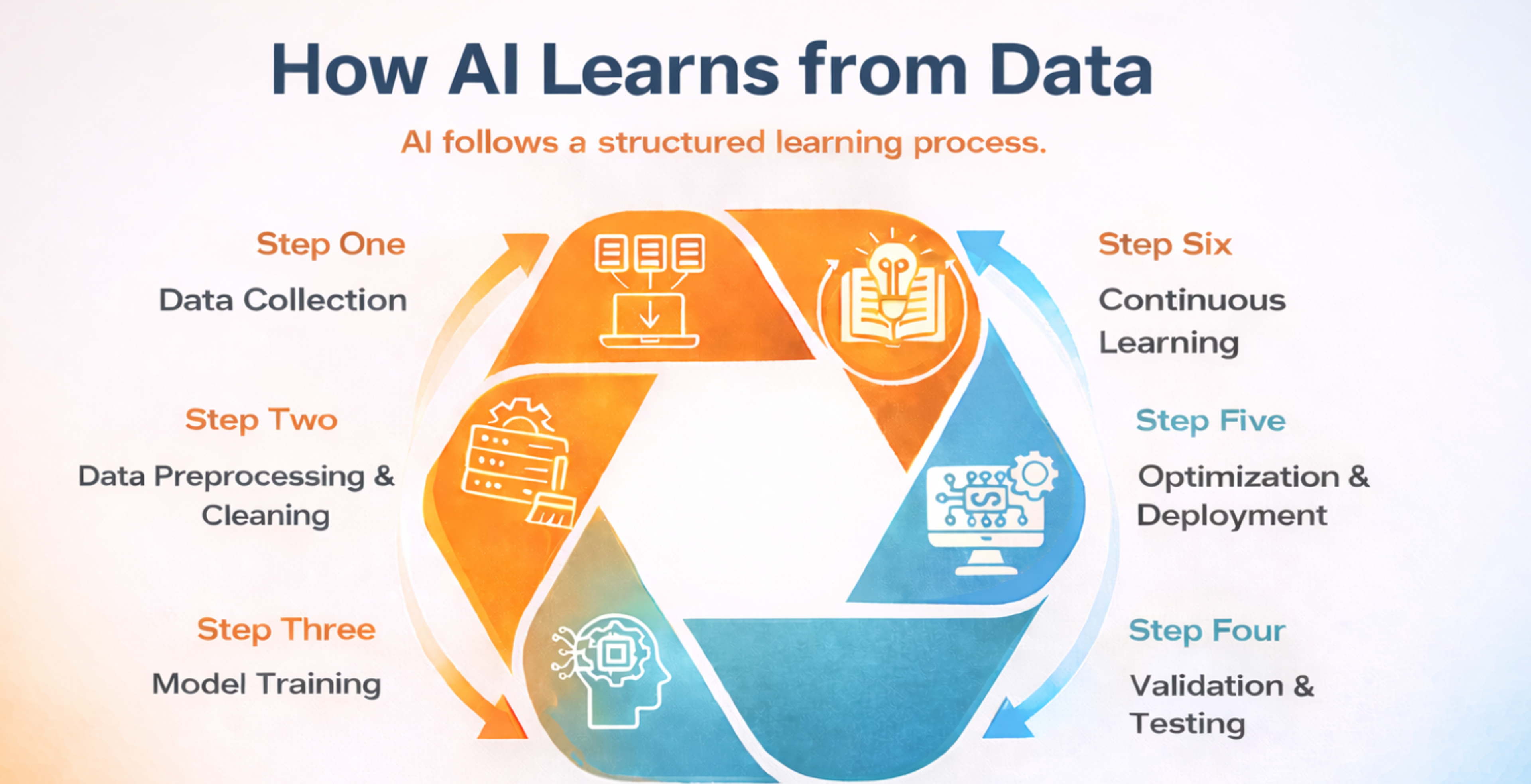
AI learns through a training process. The exact method differs by model type, but the main steps are consistent.
1. Collect data
The first step is to gather examples that relate to the task.
For a model that predicts home prices, the data might include:
- Square footage
- Location
- Number of bedrooms
- Property age
- Sale price
- Sale date
For a model that identifies cats in photos, the data may include many images and labels that identify what each image contains.
Data can come from:
- Business records
- Sensors
- Websites
- Mobile apps
- Public datasets
- Human-created examples
- User activity
- Documents, images, audio, or video
The data must match the real task. A model trained on old housing prices may perform poorly when market conditions change. A speech model trained mostly on one type of accent may struggle with other speakers.
2. Prepare and clean the data
Raw data often contains errors. It may have missing values, duplicate records, incorrect labels, or unusual entries.
Data preparation can include:
- Removing duplicate examples
- Fixing incorrect formats
- Handling missing values
- Checking labels
- Converting text, images, or sound into usable forms
- Removing data that should not be used
- Balancing groups when one group is underrepresented
This step can take more time than model training. A powerful algorithm cannot fully repair data that does not represent the task.
For example, suppose a fraud model uses past transactions. If investigators only labeled a small set of fraud cases, the model may learn that most fraud looks like those cases. It may miss new fraud patterns.
3. Split the data
Teams usually divide data into separate sets:
| Data set | Main purpose |
|---|---|
| Training set | Teaches the model patterns |
| Validation set | Helps choose settings and compare model versions |
| Test set | Measures performance on data kept separate from training |
A common mistake is to test a model on examples it has already seen. That can make the model look better than it is.
The test set should represent the data the model will face after launch. If the model will process future transactions, a time-based split may be more useful than a random split. This can reveal whether the model works as conditions change.
4. Make a prediction
The model receives an input and produces an output.
A simple model may estimate a number. A classification model may assign a category. A language model may predict the next token, which is a small unit of text such as a word or part of a word.
For instance, a model may receive this sentence:
“The package arrived late.”
It may predict the next token based on patterns found in its training data. A language model does not need to store the sentence as a complete rule. It uses learned relationships between words, phrases, and other features.
5. Measure the error
The system needs a way to judge its prediction. This measure is called a loss function or objective function.
A loss function turns an error into a number. A larger number usually means a worse prediction.
For a numeric prediction, a simple loss may be the squared error:
[
\text{Loss} = (\text{Predicted value} – \text{Actual value})^2
]
If a model predicts a home will sell for $400,000 and the actual price is $420,000, the error is $20,000. The loss function converts that difference into a value the training system can use.
Different tasks use different loss functions. A model that predicts categories needs a different measure from one that predicts prices.
6. Adjust the parameters
The model uses the error to change its parameters. An optimization method calculates which changes may reduce future loss.
A common method is gradient descent. It works like walking downhill in fog:
- Check the current level of error.
- Estimate which direction reduces the error.
- Take a small step in that direction.
- Repeat the process.
The size of each step is controlled by the learning rate. If the learning rate is too large, training may jump past a useful solution. If it is too small, training may take too long or get stuck.
7. Repeat the training cycle
The model repeats the prediction, error, and update cycle over many examples.
One complete pass through the training data is called an epoch. Large systems may train for many epochs, although more training is not always better. After a point, a model may begin to memorize training examples instead of learning patterns that apply to new data.
8. Test the model on new data
After training, the model is evaluated on data it did not use to change its parameters.
Useful measures depend on the task:
- Accuracy: The share of predictions that are correct.
- Precision: How often positive predictions are correct.
- Recall: How many actual positive cases the model finds.
- F1 score: A balance between precision and recall.
- Mean absolute error: The average size of numeric errors.
- Calibration: Whether predicted probabilities match real outcomes.
No single metric tells the whole story. A fraud model may need high recall so it catches more fraud, but too many false alerts can frustrate customers and staff.

How do neural networks learn from data?
Neural networks learn by adjusting numerical weights between connected units. These units are often arranged in layers.
A basic neural network may include:
- An input layer
- One or more hidden layers
- An output layer
Each connection has a weight. The network combines input values with these weights, passes the result through mathematical functions, and produces an output.
During training, the network compares its output with the target answer. It then uses backpropagation to send information about the error back through the layers. An optimizer updates the weights to reduce the error.
A simplified cycle looks like this:
- Data enters the network.
- The network produces an output.
- A loss function measures the error.
- Backpropagation calculates how each weight affected the error.
- The optimizer changes the weights.
- The network tries again.
Deep learning uses neural networks with many layers. These layers can learn increasingly complex features. In an image task, early layers may detect edges, while later layers may combine those edges into shapes and objects.
The network does not receive a human explanation for every feature. It often discovers useful internal patterns through training. That can make deep models powerful but difficult to interpret.

What are the main ways AI learns from data?
The learning method depends on the type of feedback available.
Supervised learning
In supervised learning, people or other trusted systems provide target answers called labels.
Examples include:
- Photos labeled by object type
- Transactions labeled as fraudulent or legitimate
- Messages labeled as spam or normal
- Medical records labeled with a known diagnosis
The model learns a relationship between inputs and labels. Supervised learning is useful when accurate examples exist, but creating labels can cost time and money.
Unsupervised learning
In unsupervised learning, the data has no assigned answer for each example. The system looks for structure on its own.
Common tasks include:
- Grouping similar customers
- Finding unusual activity
- Reducing the number of data dimensions
- Discovering patterns in documents
A method called clustering may place similar records into groups. The groups can be useful, but a human still needs to decide what they mean.
Self-supervised learning
Self-supervised learning creates a training signal from the data itself.
For example, a language model may hide part of a sentence and learn to predict the missing text. An image system may learn by comparing different views of the same image.
This method can use large amounts of unlabeled data. It is common in modern language and vision systems. However, the model can still learn errors, bias, or unwanted patterns present in its data.
Reinforcement learning
In reinforcement learning, an agent takes actions and receives rewards or penalties.
Examples may include:
- A robot choosing how to move
- A program learning to play a game
- A system choosing actions in a simulated environment
The agent tries to find actions that lead to higher total reward. The reward does not need to explain why an action was good. That can make reward design difficult.
If the reward measures the wrong thing, the system may find a way to increase its score while failing the real goal. This is sometimes called reward hacking.

What happens after AI finishes training?
Training is only one part of an AI system. After training, the model enters inference, which means using the learned parameters to produce an output.
For example:
- Training teaches a model to recognize suspicious transactions.
- Inference uses the trained model to score a new transaction.
Training may use large computers and many examples. Inference may need to happen quickly on a phone, website, vehicle, or company server.
A deployed system also needs monitoring. Its performance can change when the real world changes. This is known as data drift or concept drift.
Examples include:
- New slang changes how a moderation model reads text.
- Criminals change fraud tactics.
- A camera is used in lighting that was rare in training.
- Customer behavior shifts after a new product launch.
A model may need new data, fresh labels, retraining, or a revised decision rule. A model that worked well during testing is not automatically reliable forever.

Why does data quality matter so much?
Data quality affects what the model can learn. The model can only learn patterns that its data shows, and it may learn patterns that should not guide decisions.
Bias in the data
Bias can enter through:
- Missing groups
- Unequal data collection
- Historical discrimination
- Inconsistent labels
- Different error rates across groups
- Proxies for sensitive traits
Removing a sensitive field does not always remove bias. Other fields may act as proxies. A ZIP code, for example, may correlate with race, income, or access to services.
Label errors
Labels are not always objective. Two people may classify the same image or document differently. If label quality is weak, the model may learn disagreement rather than a clear rule.
Teams can improve labels by:
- Writing clear labeling rules
- Using more than one reviewer
- Measuring reviewer agreement
- Auditing difficult examples
- Recording uncertainty when no clear answer exists
Data leakage
Data leakage occurs when training includes information that would not be available at the time of a real prediction.
For example, a hospital model meant to predict a future diagnosis may accidentally use a field entered after the diagnosis. The test score may look strong, but the model cannot use that information in practice.
Privacy and security
Data used for AI may contain personal or sensitive information. Organizations should limit collection, protect stored data, control access, and follow applicable laws and policies.
The NIST Privacy Framework and the NIST AI Risk Management Framework provide U.S. resources for managing privacy and AI risks. The right controls depend on the use case, data type, organization, and applicable law.

How can you tell whether an AI model learned well?
A model learned well when it performs reliably on new, relevant data and meets the real goal of the task.
Use this checklist:
- Check the test design. Was the test data kept separate from training?
- Compare with a simple baseline. A complex model should improve on a reasonable simpler method.
- Review more than one metric. Accuracy alone may hide important errors.
- Test important groups and conditions. Check location, device, language, age range, or other relevant factors.
- Inspect false positives and false negatives. The type of error may matter more than the total count.
- Test unusual cases. Real data often includes rare but costly events.
- Check calibration. A prediction of 80% should be correct about 80% of the time in a suitable group.
- Monitor performance after launch. Success during training does not prove long-term success.
Overfitting and underfitting
Overfitting happens when a model learns the training data too closely. It performs well on familiar examples but poorly on new ones.
Signs of overfitting include:
- Very high training performance
- Much lower validation or test performance
- Large errors on new conditions
Possible fixes include:
- More representative data
- A simpler model
- Regularization
- Early stopping
- Data augmentation
- Better validation methods
Underfitting happens when the model is too simple or has not learned enough. It performs poorly on both training and new data.
Possible fixes include:
- Better features
- A more suitable model
- More training
- Improved labels
- A clearer task definition

A simple example: teaching AI to recognize spam
Imagine building a spam filter for an American email service.
The input
Each message may include:
- Words and phrases
- Sender information
- Link count
- Message length
- Attachment type
- User feedback
The target
Each message receives a label:
- Spam
- Not spam
The training process
The model makes a prediction for each training message. It compares that prediction with the label, calculates the loss, and updates its parameters.
Over many examples, it may learn that certain combinations of signals often appear in spam. It should not rely on one word alone, because normal messages can contain the same word.
The evaluation
The team tests the model on newer messages that it did not use during training. It checks:
- How much spam it catches
- How many normal messages it blocks
- Whether performance differs across languages or email types
- Whether users can correct mistakes
A good spam filter must balance two costs. Missing spam is bad, but sending an important message to the spam folder can also cause harm.
Common misunderstandings about how AI learns
“AI understands data like a person”
Usually, it does not. A model processes numerical representations and statistical relationships. Some systems can produce fluent text or realistic images, but fluent output does not prove human-like understanding.
“More data always makes AI better”
More data can help when it is relevant, accurate, and varied. More low-quality data can reinforce errors and bias.
“A high accuracy score means the model is safe”
A score can hide poor performance on rare cases or specific groups. Safety depends on the task, the consequences of errors, human oversight, and monitoring.
“The model learns each time a user asks a question”
Often, it does not. Many systems use a fixed trained model during normal use. A separate process may collect feedback and retrain the model later. The exact behavior depends on the system.
“AI can explain every decision”
Some models provide explanations, but an explanation may be an approximation rather than a complete record of the model’s internal process. High-impact decisions may require additional review and documentation.

Frequently asked questions
Does AI learn without human help?
Sometimes, but human choices still shape the process. People select the task, collect data, choose labels or rewards, set evaluation rules, and decide when a model is acceptable.
Can AI learn from mistakes?
Yes. During training, a model uses measured errors to update its parameters. After deployment, user feedback may support later retraining. A model does not always change immediately after making a mistake.
How much data does AI need?
There is no single amount. The need depends on the task, model, data quality, number of categories, and acceptable error rate. A simple task may need fewer examples than a complex task with many conditions.
Can AI learn from private data?
It can be trained or configured to use private data, but privacy, access control, retention, security, and legal requirements must be addressed. Sensitive data should not be shared with an AI system unless the user has the right to do so and the system is approved for that use.
What is the difference between AI training and AI inference?
Training changes the model’s parameters by using data and feedback. Inference uses those learned parameters to create a prediction or response from new input.
Can AI learn something that is false?
Yes. If training data contains false claims, poor labels, bias, or misleading patterns, the model may reproduce them. Testing, source review, human checks, and monitoring can reduce—but not eliminate—this risk.
Key takeaways
- AI learns from data by adjusting model parameters to reduce prediction errors.
- Training usually includes data collection, preparation, prediction, error measurement, optimization, and testing.
- Supervised, unsupervised, self-supervised, and reinforcement learning use different kinds of feedback.
- A model can memorize training data instead of learning useful patterns.
- Data quality, labels, privacy, bias, and drift strongly affect results.
- A high test score does not prove that an AI system is fair, safe, or reliable in every setting.
- After launch, monitoring and updates remain part of responsible AI work.
Conclusion
AI learns from data through repeated measurement and adjustment. It sees examples, produces an output, measures how far that output is from the target, and changes its internal parameters. With enough useful data and careful testing, this process can produce strong predictions.
The practical lesson is simple: the model is only one part of the system. Data quality, task design, evaluation, privacy, human review, and monitoring all shape what the AI learns and how it behaves.
For a first step, define the task in one sentence, collect representative examples, choose a clear success measure, and keep a separate test set. That process will reveal far more than a model’s marketing label or a single accuracy number.

Everett Ashford is a tech reviewer at mytechgrid.com specializing in SSDs, cameras, TVs, earbuds, headphones, and other consumer electronics. He provides honest, data-driven reviews based on hands-on testing and real-world performance analysis. Everett simplifies complex tech details to help readers make smart, confident buying decisions.