Yes. Several types of AI can answer medical questions, explain health terms, help you prepare for a doctor visit, and suggest what kind of care may fit your symptoms.
But an AI health tool is not a doctor. It may miss key details, give a wrong answer, or fail to spot an emergency. In the United States, use medical AI as a guide for information and preparation—not as a replacement for a licensed health professional.
Introduction: How Americans Can Use AI for Health Questions
People in the United States can use AI to ask questions such as:
- “What can cause a sore throat?”
- “What does this lab result mean?”
- “What questions should I ask my doctor about high blood pressure?”
- “Could this medicine interact with another medicine?”
- “When should I seek urgent care?”
The safest use is to ask for plain-language information, possible explanations, and next steps. The AI should help you think clearly before you call a doctor, visit urgent care, or use the emergency department.
For severe or sudden symptoms, do not wait for an AI answer. Call 911 in the U.S. for signs such as trouble breathing, chest pain, severe bleeding, sudden weakness, a major allergic reaction, or a possible stroke.
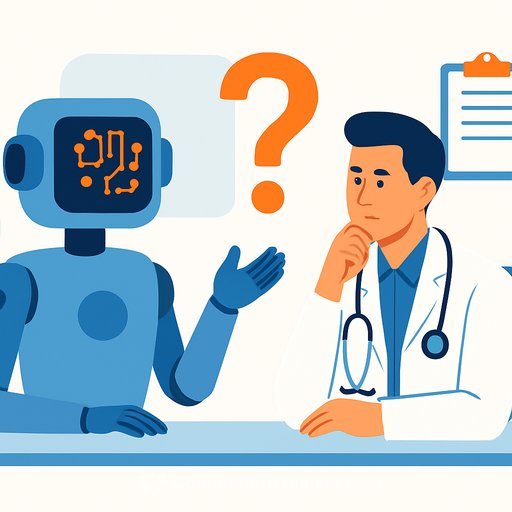
What Kind of AI Answers Medical Questions?
Medical AI is not one single product. It includes several tools with different uses, risks, and levels of oversight.
1. General AI chatbots
General chatbots can explain health terms, summarize information, and help you write questions for a clinician. They may know common medical facts, but they are not automatically connected to your medical record or a licensed care team.
Their answers can sound sure even when they are wrong. Treat them as educational tools.
2. Symptom checkers
Symptom checkers ask about symptoms and may list possible causes or care options. Some are built into health systems, insurance websites, or telehealth services.
A symptom checker may help you decide whether to seek:
- Emergency care
- Same-day care
- A routine appointment
- Home care and monitoring
It cannot safely rule out every serious condition. The result depends on the symptoms you enter and the questions the tool asks.
3. Medical information search tools
Some AI tools search medical sources and provide answers with links. These can be useful when you want to read about a condition, treatment, or test.
Check whether the answer names its sources. Prefer information from organizations such as:
- The National Institutes of Health
- The Centers for Disease Control and Prevention
- The U.S. Food and Drug Administration
- The MedlinePlus service from the National Library of Medicine
- Major hospitals, universities, and professional medical groups
4. Clinical AI used by health professionals
Doctors, nurses, pharmacists, and hospitals may use AI to review records, summarize notes, support imaging work, or assist with clinical decisions.
This does not mean the AI makes the final decision. A qualified health professional must review the information, consider your history, and use clinical judgment.
The FDA keeps a list of some AI-enabled medical devices authorized for marketing in the United States. Authorization applies to a specific device and use. It does not prove that every AI health product is accurate or safe for every purpose.
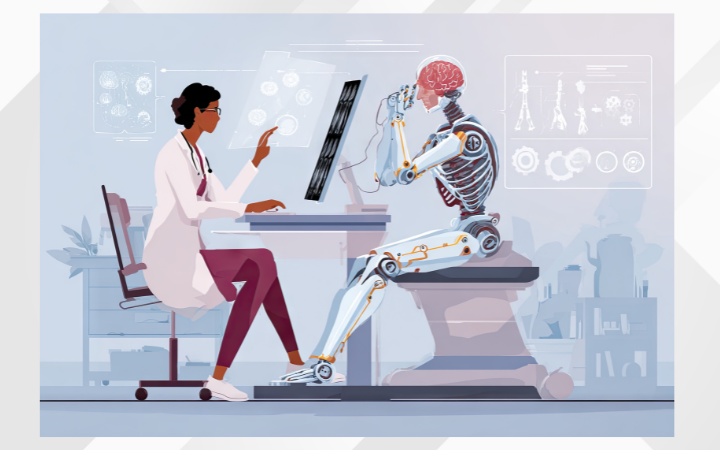
What Can AI Do Well With Medical Questions?
AI can be useful when the goal is education, planning, or communication.
Explain medical words
You can ask AI to explain terms such as “A1C,” “benign,” “hypertension,” or “MRI contrast” in simple language.
A useful prompt is:
Explain this medical term in plain English. Tell me what it usually means, why a clinician may use it, and what follow-up questions I can ask.
Turn a medical report into questions
AI can help you prepare for an appointment by turning a report into a short list of questions.
For example:
Help me create questions for my doctor about this ultrasound report. Do not diagnose me. Group the questions by meaning, treatment, risks, and follow-up.
Remove names, birth dates, addresses, medical record numbers, and other identifying details first.
Organize symptoms
AI can help you make a symptom log. Include:
- When the symptom began
- Where it occurs
- How severe it feels
- What makes it better or worse
- Other symptoms
- Medicines and supplements
- Recent illness, travel, injury, or exposure
A clear record can help a clinician understand the problem faster.
Compare general treatment options
AI may explain how two treatments differ. Ask it to cover benefits, common side effects, serious risks, cost questions, and who may need to avoid each option.
The answer still needs review by a doctor or pharmacist. Your age, pregnancy status, allergies, kidney function, other medicines, and health history can change the recommendation.
Translate or simplify health instructions
AI can rewrite instructions in plain English or another language. Have a clinician or pharmacist confirm any important dose, timing, or safety detail.

What Can AI Not Do Reliably?
AI cannot examine you, measure your vital signs, see your full medical record, or understand every part of your situation. This creates limits that a fluent answer can hide.
It may give a wrong diagnosis
Many conditions share the same symptoms. Fatigue, nausea, pain, or dizziness can have many causes. AI may list a common cause while missing a serious one.
Do not use an AI answer to confirm that you have—or do not have—a disease.
It may miss important context
An AI answer may change when you add:
- Your age
- Pregnancy or recent childbirth
- A weak immune system
- Cancer treatment
- Blood-thinning medicine
- A serious allergy
- A recent operation
- A chronic heart, lung, liver, or kidney condition
Without this context, the answer may not fit you.
It may provide outdated information
Medical guidance, drug labels, recalls, and screening advice can change. Ask for the date and source of important information. Confirm drug and treatment details with a pharmacist or clinician.
It may invent sources or facts
Some AI systems produce made-up citations, studies, or quotations. Open the source links and check that they support the claim.
A source from a real website does not prove that the AI summarized it correctly.
It may create privacy risks
Do not enter private health information into an AI tool unless you understand how the service stores and uses it. Consumer AI tools may not provide the same protections as a health care provider covered by the Health Insurance Portability and Accountability Act, commonly called HIPAA.
The U.S. Department of Health and Human Services explains that HIPAA applies to covered entities and business associates in specific situations. It does not automatically apply to every health app or consumer chatbot.

How to Ask an AI a Medical Question More Safely
A clear prompt produces a more useful answer, but it cannot remove medical risk.
Step 1: State the goal
Say what you want the tool to do.
Good example:
I want general information about possible causes of a mild cough. I do not want a diagnosis.
Step 2: Add useful, non-identifying context
You may include:
- Age range
- Sex, when relevant
- Pregnancy status, when relevant
- Main symptoms
- Start date
- Severity
- Known conditions
- Medicines and supplements
- Recent travel or illness
Do not include your full name, address, phone number, insurance number, or medical record number.
Step 3: Ask for uncertainty
Use a prompt such as:
List common explanations first, then less common but serious causes. Explain which symptoms would need urgent care. Tell me what information is missing.
This can reduce false certainty.
Step 4: Ask for sources
Try:
Use current U.S. sources when possible. Name the source and date for treatment, medicine, or safety claims.
Still verify the sources yourself.
Step 5: Check the answer with a qualified person
Contact a doctor, nurse, or pharmacist when the answer affects treatment, medicine use, pregnancy, a child, an older adult, or a serious condition.
Example of a safer prompt
I am an adult in the United States with a new sore throat that began yesterday. I have no trouble breathing and no severe swelling. Please give general information about common causes, warning signs, and questions to ask a clinician. Do not diagnose me or tell me to start or stop medicine.
The lack of breathing trouble does not prove that the condition is minor. It only gives the tool one piece of context.
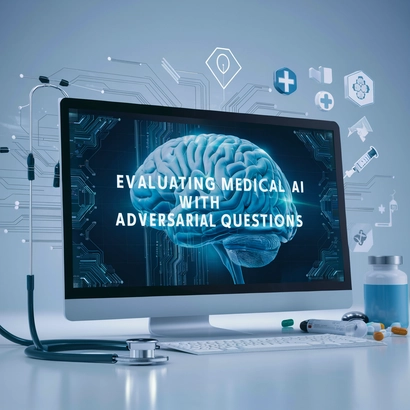
Which AI Medical Tool Should You Use?
The best tool depends on your task. No single AI is best for every medical question.
| Your goal | Tool that may help | Main limit |
|---|---|---|
| Understand a medical word | General AI or MedlinePlus | May simplify too much |
| Review symptoms | A reputable symptom checker or telehealth service | Cannot examine you |
| Understand a medicine | Pharmacist, official drug label, or trusted drug database | Personal interactions need review |
| Prepare for an appointment | General AI with private details removed | Cannot replace the visit |
| Review a lab result | Your clinician or patient portal | The number needs medical context |
| Find urgent care guidance | Official health system or emergency service | AI should not delay emergency care |
| Research a condition | NIH, CDC, FDA, medical society, or major hospital | Sources may differ in scope |
| Make a treatment decision | Your licensed clinician | Requires personal history and examination |
For medicine questions, a pharmacist is often the most direct professional resource. Ask about dose, timing, side effects, interactions, missed doses, and what to do if you take too much.

When Should You Avoid AI and Get Medical Help?
Do not use an AI chatbot as the first step when symptoms may be life-threatening.
Call 911 in the United States for signs such as:
- Trouble breathing or blue lips
- Chest pressure or severe chest pain
- Sudden weakness, numbness, confusion, or trouble speaking
- Fainting or a seizure
- Severe bleeding that will not stop
- A serious allergic reaction with swelling or breathing trouble
- A possible overdose
- Severe burns or major injuries
- Immediate danger from self-harm or harm to another person
For urgent but non-life-threatening problems, contact a health care provider, urgent care center, or nurse advice line. For poison exposure in the United States, contact Poison Control at 1-800-222-1222.
Children, pregnant people, older adults, and people with serious chronic illness may need prompt professional advice even when symptoms seem mild.

How to Check Whether an AI Medical Answer Is Trustworthy
Use a short safety check before acting on an answer.
- Look for a clear limit. Does the tool say that it cannot diagnose or replace medical care?
- Check the source. Does it link to a government agency, medical organization, hospital, or drug label?
- Check the date. Is the information current enough for the question?
- Look for missing context. Would age, pregnancy, medicine, or a chronic condition change the answer?
- Watch for certainty. Be cautious with words such as “definitely,” “always,” or “no need to see a doctor.”
- Confirm action steps. Check medicine changes and urgent-care decisions with a qualified professional.
- Compare only reliable sources. Do not treat several AI answers as independent proof. They may repeat the same error.
A useful answer helps you decide what to ask next. It should not pressure you to make a high-risk decision alone.
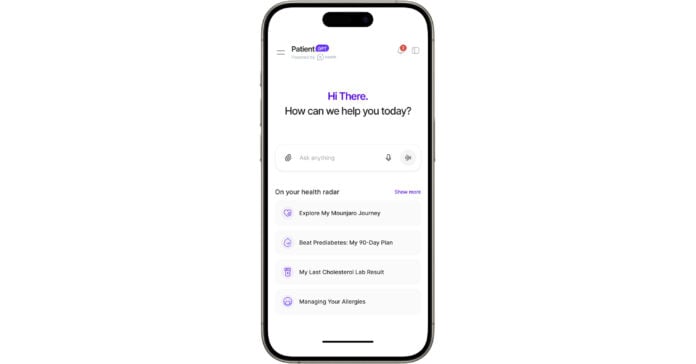
Common Mistakes People Make With Medical AI
The most common mistake is treating a possible explanation as a diagnosis.
Other mistakes include:
- Entering private patient information
- Asking the same question repeatedly until the answer becomes reassuring
- Ignoring a symptom because an AI called it “common”
- Starting, stopping, or changing a medicine without professional advice
- Using an old answer for a new symptom
- Trusting an answer with no source
- Giving too little context
- Using AI during an emergency instead of calling 911
- Assuming that FDA authorization for one medical device applies to all AI tools
AI can support a health decision, but accountability remains with the person and professional making the decision.
Frequently Asked Questions
Is there a free AI that can answer medical questions?
Yes. Free general AI tools, symptom checkers, health-system tools, and government health websites can answer basic questions. Free does not mean accurate, private, or suitable for diagnosis. Check the tool’s privacy policy, sources, and limits.
Can AI diagnose my symptoms?
AI may suggest possible causes, but it should not be treated as a diagnosis. A diagnosis may require an exam, vital signs, lab tests, imaging, and a review of your medical history.
Can I upload a lab report to AI?
You can ask AI to explain general terms, but remove personal identifiers first. Do not make treatment decisions from a lab number alone. The ordering clinician can interpret the result with your symptoms and medical history.
Is it safe to ask AI about prescription drugs?
AI can provide general drug information, but confirm dose changes, interactions, pregnancy concerns, allergies, and missed-dose instructions with a pharmacist or prescriber.
Should I trust an AI symptom checker?
Use it as a starting point, not a final decision. Follow its emergency warnings only as one source of guidance, and seek professional care when symptoms are severe, worsening, unusual, or persistent.
Bottom Line
Yes, AI can answer many medical questions. It works best for plain-language explanations, symptom organization, source finding, and appointment preparation.
It does not replace a doctor, nurse, pharmacist, emergency service, or other licensed professional. Protect your privacy, verify important claims, and get human medical help when symptoms are urgent or the decision could affect your health.
If you have a current symptom, your next step should be based on its severity: call 911 for an emergency, contact a clinician or pharmacist for urgent advice, or use AI only to prepare informed questions for routine care.

Everett Ashford is a tech reviewer at mytechgrid.com specializing in SSDs, cameras, TVs, earbuds, headphones, and other consumer electronics. He provides honest, data-driven reviews based on hands-on testing and real-world performance analysis. Everett simplifies complex tech details to help readers make smart, confident buying decisions.