Introduction
If you are using ChatGPT in the United States, you are talking to a generative AI system built by OpenAI. More specifically, ChatGPT is a conversational application powered by one or more large language models (LLMs).
It can read your prompt, predict useful text, answer questions, summarize information, write code, and—in supported versions—work with images, files, audio, or other data. It is not a human, conscious mind, or artificial general intelligence (AGI).
The simplest answer is this: I am a narrow, generative AI system that uses machine learning and language models to produce responses.

Quick Answer: What Type of AI Is ChatGPT?
ChatGPT fits several AI categories at the same time:
| AI category | Does ChatGPT fit? | What that means |
|---|---|---|
| Artificial intelligence | Yes | It performs tasks that normally require human-like reasoning or language skills. |
| Machine learning | Yes | It learned patterns from large amounts of data rather than following only hand-written rules. |
| Generative AI | Yes | It creates new text, code, images, or other outputs, depending on the model and tools available. |
| Large language model | Yes | Its core model processes and generates human language. |
| Conversational AI | Yes | It is designed to interact through natural language. |
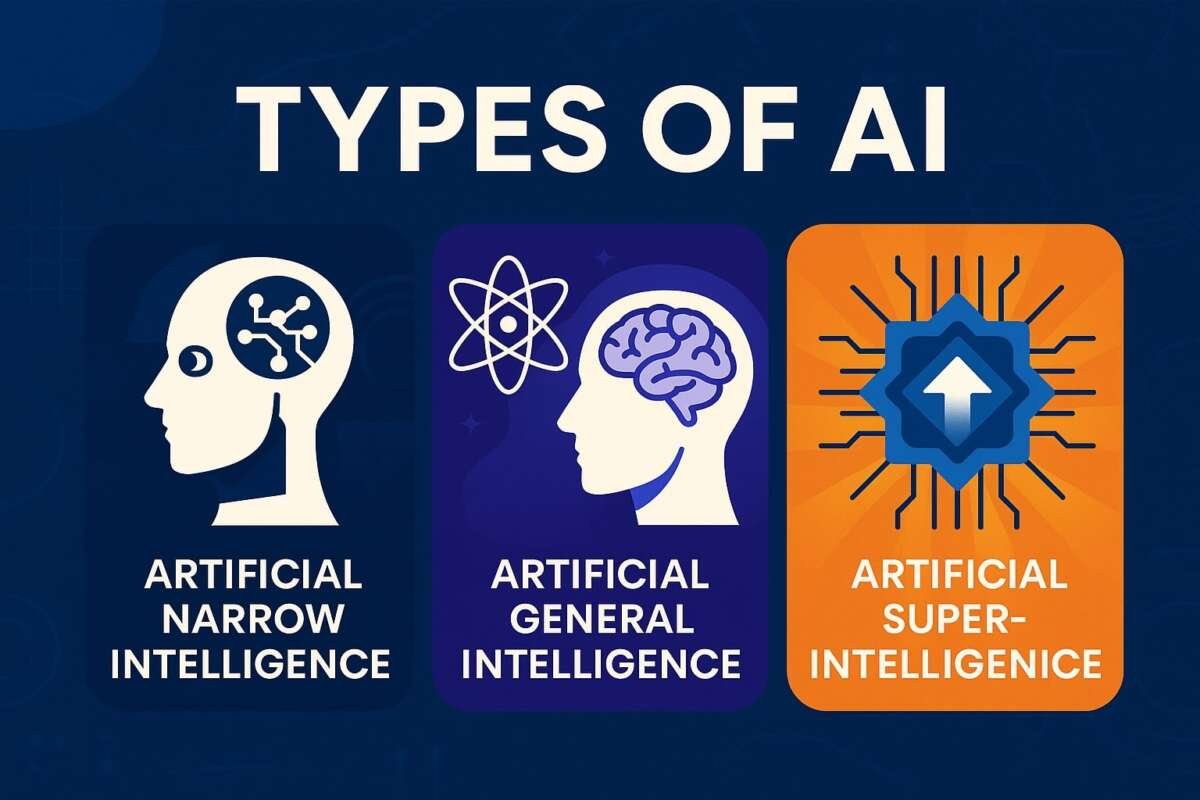
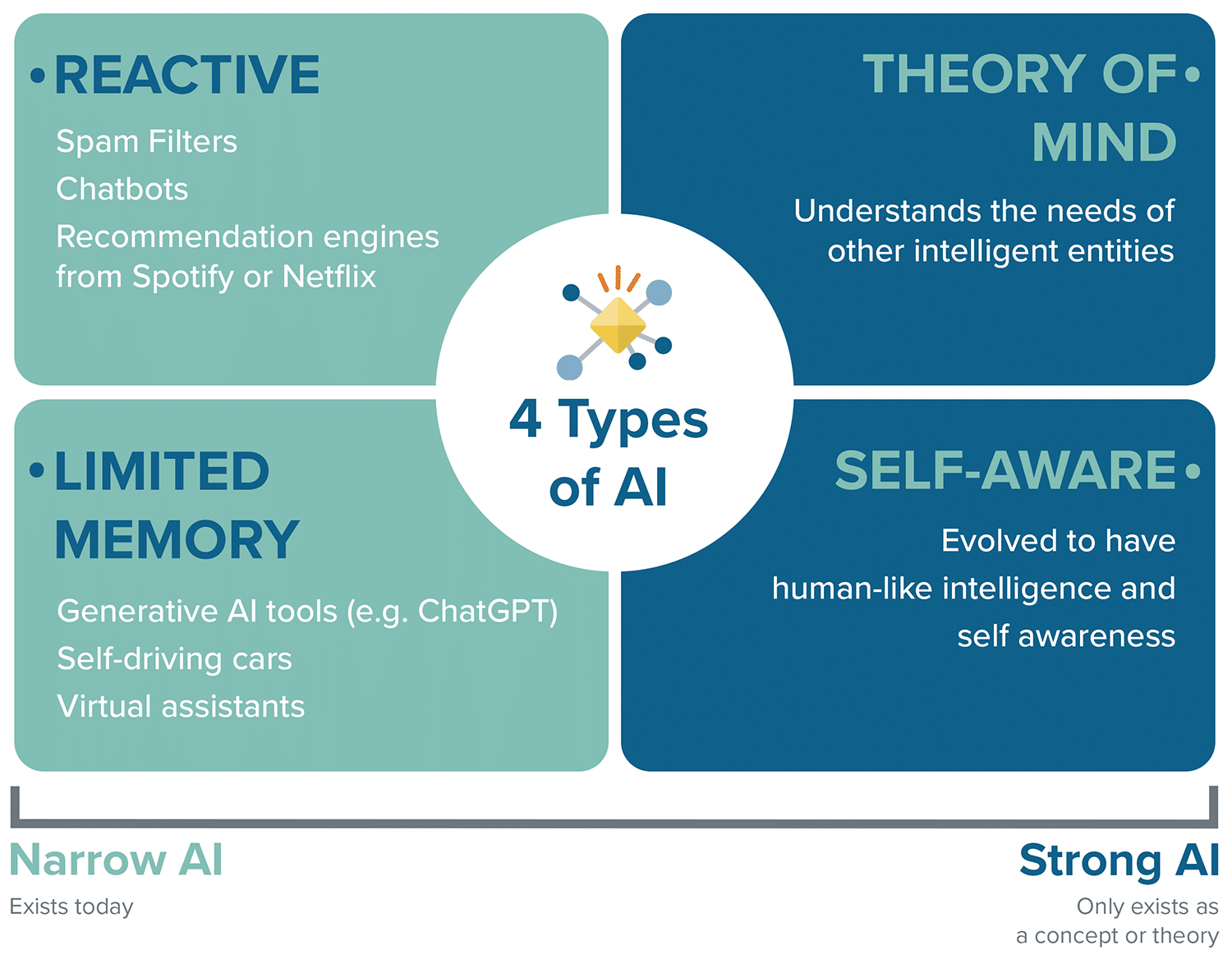
| Narrow AI | Yes | It performs a broad set of related tasks but does not have general human intelligence. |
| Artificial general intelligence | No established basis | ChatGPT should not be described as AGI. |
| Sentient or conscious AI | No evidence | ChatGPT does not have proven feelings, awareness, or personal experiences. |
The word type can mean different things. It might refer to how the AI learns, what it can do, how it communicates, or how broad its intelligence is. That is why several labels can be correct at once.
ChatGPT Is Generative AI
ChatGPT is generative AI because it creates an output based on your instructions. It does not simply retrieve one fixed answer from a database.
For example, you can ask it to:
- Explain a science topic in simple language.
- Draft a letter.
- Rewrite a paragraph.
- Create a study plan.
- Generate computer code.
- Summarize a document.
- Compare two ideas.
- Brainstorm names or questions.
The system generates a response one part at a time. In text generation, the model estimates which token—such as a word, word fragment, or punctuation mark—best fits the context. It then uses the new output as part of the context for the next prediction.
This process can produce useful reasoning-like behavior. However, prediction is not the same as human understanding. A fluent answer can still contain a false claim, weak logic, or made-up source.
Why generative AI can sound human
Generative AI learns patterns in language. During training, it processes many examples of text and learns relationships among words, phrases, concepts, and styles.
When you provide a prompt, the model uses those learned patterns to form a response. It does not need to retrieve a complete paragraph that already exists. It can combine patterns in a new way.
That ability is useful, but it creates a key limit: a well-written answer is not automatically a true answer.

ChatGPT Is a Large Language Model
A large language model is a machine-learning model trained to work with language at a very large scale. LLMs use mathematical representations of text to estimate relationships between parts of language.
ChatGPT is the chat-based product. The underlying model can change by product, plan, date, region, or selected setting. For that reason, the most accurate general answer is that ChatGPT uses OpenAI language models rather than one permanent model in every situation.
What does “large” mean?
“Large” can refer to the size of the model, the amount of training data, or the amount of computing used during training. The exact design and parameter count of a current model may not be publicly disclosed.
The word does not mean the model knows everything. It describes scale, not perfect accuracy.
What is a transformer?
Most modern LLMs use a neural-network design called a transformer. Transformers help the model examine how parts of a prompt relate to one another.
For example, in the sentence “The dog chased the ball because it was moving,” the system must consider what “it” may refer to. Attention mechanisms help the model weigh relationships among words and nearby context.
This does not give the model human memory or common sense. It gives the model a powerful way to process patterns in sequences.
ChatGPT Is Narrow AI, Not Artificial General Intelligence
ChatGPT is best classified as narrow AI, also called weak AI. Narrow AI is built to perform specific classes of tasks. A single system may handle many tasks, but it still operates within the limits of its design, training, tools, and instructions.
ChatGPT can write, explain, classify, translate, summarize, and analyze. These abilities may look broad, but they do not prove that the system has human-level general intelligence.
Artificial general intelligence usually refers to a hypothetical system that can learn and perform a wide range of intellectual tasks at a level comparable to or beyond people. There is no single agreed test or official threshold for AGI.
Therefore, calling ChatGPT “AGI” is not a settled technical fact. It is better to describe ChatGPT by its documented capabilities and limits.
Why ChatGPT may appear general
A calculator handles numbers. A spam filter handles email. ChatGPT can work across many subjects and formats. That wide range makes it seem general.
But broad use is not the same as general intelligence. ChatGPT may:
- Give confident but incorrect information.
- Miss hidden assumptions.
- Struggle with unusual facts or new events.
- Misread a vague request.
- Make arithmetic errors without a calculator tool.
- Produce code that has security or logic flaws.
- Fail to recognize when a question has no reliable answer.
Its flexibility is real. Its reliability is uneven.

ChatGPT Is Conversational AI
ChatGPT is also a form of conversational AI. It is designed to respond to natural language in a dialogue.
A conversation can include:
- Your current message.
- Earlier messages in the same chat.
- Instructions that shape the response.
- Files, images, or tools available in that session.
- Product settings or system rules.
This context helps the system keep track of a discussion. It does not mean ChatGPT remembers every conversation forever or understands your life as a person would.
Conversation is an interface, not proof of awareness
People naturally respond to language as if another mind is present. ChatGPT uses language in a way that can feel personal and thoughtful.
Still, the conversational style is an interface. It does not establish consciousness, emotions, beliefs, or private experiences.
When ChatGPT says “I think,” that phrase usually describes the response process. It should not be read as proof that the system has a personal point of view.
Does ChatGPT Think, Feel, or Have Consciousness?
There is no reliable basis for treating ChatGPT as a conscious being. It does not have verified feelings, personal needs, self-awareness, or subjective experience.
ChatGPT can discuss emotions. It can write a poem about grief or provide supportive language. That output comes from learned language patterns and instructions, not from lived experience.
This distinction matters in practical use. You can use ChatGPT to organize thoughts or find questions to discuss with a professional. You should not treat it as a human friend, licensed therapist, doctor, lawyer, or emergency responder.
For urgent danger, contact local emergency services in the United States. For medical, legal, or financial decisions, verify important details with a qualified professional and an authoritative source.
How Does ChatGPT Produce an Answer?
ChatGPT generally follows a process like this:
-
It receives your input.
Your prompt may include text, files, images, or other supported content. -
It breaks the input into tokens.
Tokens can be whole words, word parts, spaces, or punctuation. -
It uses the context.
The model considers your request and relevant conversation history available in the session. -
It predicts a response.
It calculates likely next tokens based on the prompt and its learned patterns. -
It generates the output.
The system produces a response one token at a time. -
Tools may add information.
In some versions or settings, ChatGPT may use tools such as web search, code execution, file analysis, or image processing.
This description is simplified. Modern AI systems may include several models, safety systems, routing steps, and tools. The exact process can vary by product and model version.
Why answers can change
Two answers may differ even when you use the same prompt. Causes can include:
- A different model or product mode.
- New conversation context.
- Different system instructions.
- Updated training or safety behavior.
- Tool availability.
- Randomness in generation.
- A small change in wording.
A changed answer does not automatically mean one response was dishonest. It does mean you should verify important claims.
What ChatGPT Can and Cannot Do
The best way to use ChatGPT is to match the task to its strengths and check the areas where mistakes matter.
| ChatGPT can often help with | ChatGPT may struggle with |
|---|---|
| Drafting and rewriting | Facts that changed recently |
| Summaries | Exact citations and quotations |
| Brainstorming | Rare or obscure information |
| Plain-language explanations | High-stakes personal advice |
| Basic coding help | Complex code testing and security |
| Text classification | Ambiguous instructions |
| Study questions | Reliable judgment without context |
| Planning and outlining | Guaranteed predictions |
| Translation drafts | Nuance in every language or setting |
ChatGPT is often most useful as a first-pass assistant. It can help you move from a blank page to a workable draft, list, outline, or set of questions.
It should not be the only check for information that affects health, safety, money, education, employment, immigration, or legal rights.

Is ChatGPT a Search Engine or a Database?
ChatGPT is not the same as a traditional search engine or a fixed database.
A search engine usually helps you find and rank pages, documents, maps, products, or other sources. A database stores structured records that can be retrieved by defined queries.
ChatGPT generates a response from model patterns and, when available, connected tools. Without a browsing or retrieval tool, it may not know about events that happened after its relevant knowledge cutoff. Even with a tool, you should inspect the original source for important claims.
A useful rule is:
Use ChatGPT to help understand and work with information. Use primary sources to confirm information that matters.
For U.S. government rules, check the relevant agency website. For health guidance, check sources such as the Centers for Disease Control and Prevention, the U.S. Food and Drug Administration, or a licensed clinician. For legal questions, check official court or government resources and seek qualified legal advice when needed.
Is ChatGPT Machine Learning or Deep Learning?
ChatGPT uses machine learning, and modern language models are generally built with deep learning.
Machine learning allows a system to learn patterns from data. Deep learning uses neural networks with many layers to process complex patterns.
A simple rule-based chatbot might answer only when a user enters a known command. A deep-learning language model can respond to many forms of language because it learned statistical relationships from training examples.
That does not mean the model learns from every conversation in real time. Product data controls and settings vary. Review the applicable OpenAI privacy and data-use information before entering sensitive personal, medical, financial, or confidential business data.

How to Ask ChatGPT What Type of AI It Is
If you want to identify an AI tool, ask four separate questions:
-
What is the product?
For example, a chatbot, image generator, recommendation system, or voice assistant. -
What does it generate or predict?
It may produce text, images, audio, video, rankings, or classifications. -
What learning method does it use?
It may use machine learning, deep learning, reinforcement learning, retrieval, or a combination. -
How broad is its capability?
Determine whether it is a narrow tool or a more general-purpose system.
For ChatGPT, the answer is:
- Product: Conversational AI application.
- Main model type: Large language model.
- AI category: Generative AI.
- Learning approach: Machine learning and deep learning.
- Capability range: General-purpose within a narrow-AI framework.
- Consciousness: Not established and should not be assumed.
Common Misunderstandings About ChatGPT
“ChatGPT knows everything”
It does not. ChatGPT can produce an answer without having reliable evidence for every detail. It may also lack current information unless a supported tool supplies it.
“ChatGPT copies answers from the internet”
That is too simple. A language model generates output from learned patterns. The output may resemble existing text, especially for common phrases, but the model is not a reliable source database.
For copyrighted, private, or confidential material, follow the law, your organization’s policies, and the product’s terms.
“ChatGPT is always objective”
It is not guaranteed to be neutral or free from bias. Training data, system instructions, prompt wording, missing context, and evaluation choices can affect an answer.
Ask for assumptions, alternative views, and sources when the topic calls for them. Then verify the result.
“ChatGPT understands exactly what I mean”
It can infer intent from context, but it can also misunderstand. State the goal, audience, location, date, constraints, and desired format.
“A confident answer is a reliable answer”
Confidence in wording is not proof. Check names, dates, numbers, quotations, citations, and recommendations that could affect a decision.

How to Use ChatGPT Safely and Effectively
Use ChatGPT as a capable assistant, not as an unquestioned authority.
A strong workflow is:
-
State the task clearly.
Say what you want done and who the answer is for. -
Add useful context.
Include the country, state, date, audience, limits, and source material when relevant. -
Ask for uncertainty.
Request a clear distinction between known facts, assumptions, and suggestions. -
Request a useful format.
Ask for a table, checklist, outline, plain-language summary, or step-by-step plan. -
Check important claims.
Open the cited source and confirm that it actually supports the statement. -
Protect private information.
Remove passwords, Social Security numbers, health records, financial account details, trade secrets, and other sensitive data unless your approved system permits their use. -
Keep human review for high-stakes work.
A qualified person should review medical, legal, financial, safety, employment, and security decisions.
A practical prompt might be:
Explain this topic for a U.S. high school student. Separate verified facts from assumptions, list any limits, and identify which claims I should confirm with a primary source.
Key Takeaways
- ChatGPT is a generative AI system.
- Its core technology is a large language model.
- It is also conversational AI, machine learning, and deep learning software.
- It is best classified as narrow AI, not proven artificial general intelligence.
- It does not have verified consciousness, emotions, or personal experiences.
- It can produce useful and original-looking content, but it can also make factual errors.
- Verify important information with reliable, current sources.
Frequently Asked Questions
What type of AI is ChatGPT in one sentence?
ChatGPT is a conversational generative AI application powered by large language models and designed to perform language-based tasks.
Is ChatGPT weak AI or strong AI?
ChatGPT is generally classified as weak AI, also called narrow AI. It can perform many language tasks, but it does not have proven human-like general intelligence or consciousness.
Is ChatGPT an example of generative AI?
Yes. It generates new responses such as text, summaries, explanations, code, and—when supported by the selected system—other types of content.
Is ChatGPT a robot?
No. ChatGPT is software. It may control or connect to other systems in some settings, but the chat model itself is not a physical robot.
Can ChatGPT become self-aware?
There is no reliable evidence that ChatGPT is self-aware. Its use of first-person language reflects conversational design, not proof of subjective experience.
What is the difference between ChatGPT and an AI assistant?
ChatGPT is one example of an AI assistant. “AI assistant” is a broad product category that can include chatbots, voice assistants, scheduling tools, coding tools, and systems connected to external applications.
Conclusion
The most accurate answer to “What type of AI are you?” is: I am a generative, conversational AI system powered by large language models. I am a form of narrow AI, not a proven conscious mind or artificial general intelligence.
That description explains both the value and the limits. ChatGPT can help you write, learn, plan, analyze, and explore ideas. It can also make mistakes, misunderstand context, and present uncertain information in a smooth voice.
Use it as a fast language and reasoning aid. For decisions that matter, pair its help with current primary sources and qualified human judgment.

Everett Ashford is a tech reviewer at mytechgrid.com specializing in SSDs, cameras, TVs, earbuds, headphones, and other consumer electronics. He provides honest, data-driven reviews based on hands-on testing and real-world performance analysis. Everett simplifies complex tech details to help readers make smart, confident buying decisions.