Introduction
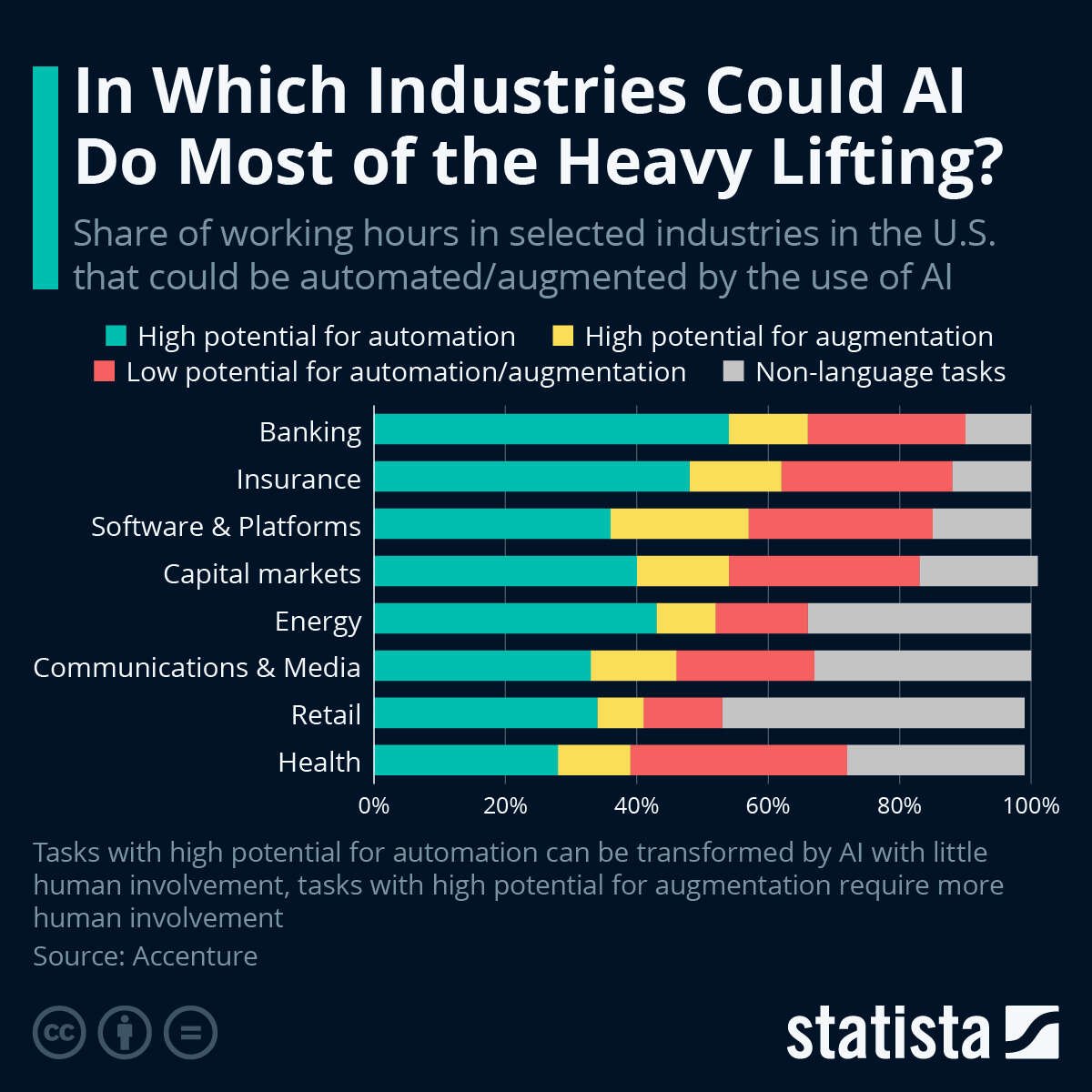
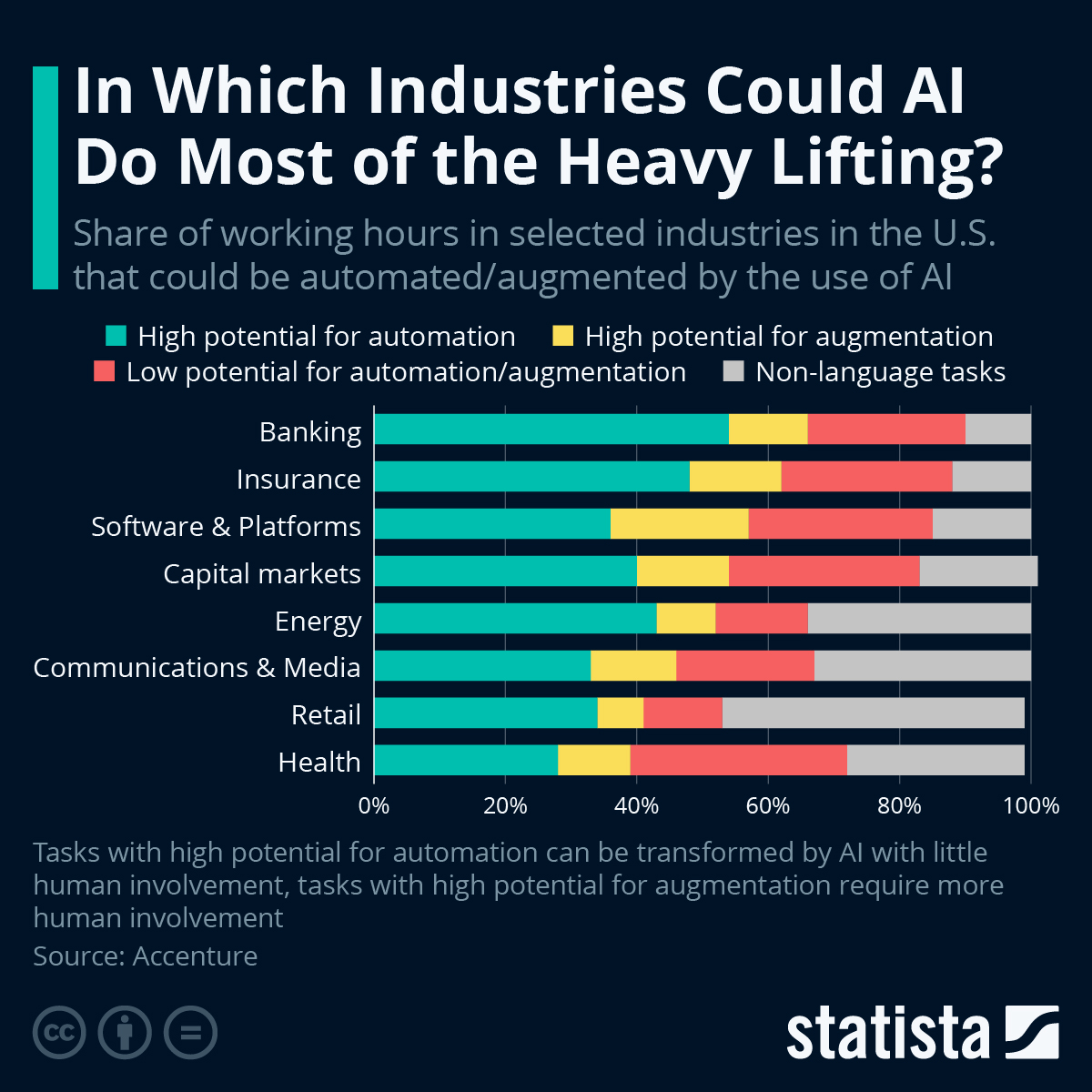
In the United States, finance, technology, media, customer service, health care administration, legal services, accounting, marketing, education, manufacturing, and logistics are among the industries most affected by artificial intelligence (AI).
The biggest impact is not always job loss. AI often changes which tasks people do, how fast work gets done, and what skills employers seek. Jobs with large amounts of text, data, images, code, or routine decisions tend to face the highest AI exposure.
The key distinction is simple:
- AI exposure means AI can perform or support many tasks in an occupation.
- AI adoption means U.S. employers are already using AI in real work.
- Job impact includes new roles, changed duties, higher output, and possible job loss.
A bank may use AI to review documents. A hospital may use it to manage records. A factory may use it to spot defects. In each case, AI changes work, but it does not necessarily replace the whole worker.
This guide explains which U.S. industries face the greatest impact, why they are exposed, what tasks are changing, and what workers and employers should watch next.
Which industries are most affected by AI?
The industries most affected by AI are those that rely heavily on repeatable digital tasks, large data sets, written communication, prediction, or pattern recognition.
| Industry | Main AI uses | Likely effect |
|---|---|---|
| Technology and software | Code generation, testing, support, data analysis | Faster development and fewer routine tasks |
| Finance and insurance | Fraud checks, risk analysis, customer service, underwriting support | More automated review and tighter human oversight |
| Media and advertising | Drafting, editing, image creation, targeting | More content with smaller teams |
| Customer service | Chatbots, call summaries, agent assistance | Fewer simple contacts and more complex human cases |
| Health care | Records, scheduling, imaging support, research | Less administrative work and more review duties |
| Legal services | Document review, legal research, contract analysis | Faster routine work; lawyers retain judgment |
| Accounting | Bookkeeping, tax review, audit support | Automated records and exception handling |
| Education | Lesson planning, tutoring, grading support | More personalized help but higher integrity risks |
| Manufacturing | Quality checks, maintenance, robotics, planning | Better uptime and output; skilled workers remain vital |
| Transportation and logistics | Route planning, warehouse systems, demand forecasts | More automation in planning and operations |
| Retail and marketing | Recommendations, pricing, inventory, customer insights | More targeted sales and automated support |
The industries at the top of this list have one feature in common: a large share of work already happens in digital systems.
1. Technology and software
Technology is one of the first industries affected because AI can assist with the same tasks that software teams already perform on computers.
Common uses include:
- Writing and explaining code
- Finding software bugs
- Creating test cases
- Converting code from one language to another
- Writing technical documents
- Summarizing support tickets
- Searching internal knowledge bases
- Reviewing security alerts
AI can help a skilled developer work faster. But generated code can contain security flaws, incorrect logic, or licensing problems. Human review remains necessary, especially for systems that handle money, health data, or personal information.
The effect may be strongest on entry-level tasks. New workers often start with simple code, tests, and documentation. If AI performs more of that work, employers may need better ways to train junior staff.
2. Finance and insurance
Banks, lenders, insurers, and investment firms use large data sets and rules-based processes. That makes them highly exposed to AI.
AI can support:
- Fraud detection
- Credit risk analysis
- Claims review
- Customer support
- Financial forecasting
- Document processing
- Anti-money-laundering checks
- Investment research
The main benefit is speed. A system can review thousands of transactions much faster than a person. It can also flag unusual patterns for an analyst to inspect.
The main risk is unfair or incorrect decisions. A financial institution cannot treat an AI model as a shield from U.S. consumer protection laws. For example, lenders still need to provide accurate and legally sufficient explanations for adverse credit decisions. Human review, audit trails, privacy controls, and model testing are essential.
3. Media, advertising, and publishing
Generative AI can create or revise text, images, audio, video, and advertising ideas. This makes media one of the most visible affected industries.
AI tools can help with:
- First drafts
- Headlines and product descriptions
- Translation
- Captioning
- Search optimization
- Video edits
- Image variations
- Audience analysis
- Ad testing
The cost of producing basic content may fall. At the same time, the value of original reporting, strong editing, trusted brands, and clear rights ownership may rise.
AI-generated content also creates risks. It may repeat false information, copy protected material, or present made-up facts with confidence. Publishers need fact checks and clear rules for when human authorship is required.
4. Customer service and call centers
Customer service may see some of the fastest task-level changes. AI can answer simple questions, search help articles, translate messages, and summarize calls.
A typical shift looks like this:
- A chatbot handles a password reset or order status request.
- AI sends the customer to a human when the issue is complex.
- The system gives the agent a short history and suggested reply.
- The agent handles the emotional, unusual, or high-risk part of the case.
This can reduce wait times and routine work. It can also make jobs more demanding. Human agents may receive fewer easy calls and more cases involving complaints, billing disputes, disability needs, or safety concerns.
Companies should measure more than cost. They should track error rates, repeat contacts, customer satisfaction, and whether customers can reach a person when automation fails.
5. Health care and health care administration
Health care is heavily affected by AI, but the impact varies by task. Administrative work is generally easier to automate than direct patient care.
Current and developing uses include:
- Appointment scheduling
- Medical transcription
- Clinical note drafts
- Coding and billing support
- Image analysis
- Patient messaging
- Drug research
- Hospital capacity planning
- Remote monitoring
AI may reduce paperwork and give clinicians more time with patients. However, health care decisions can carry serious risks. An AI system may miss a rare condition, reflect bias in its training data, or produce an incorrect note.
The U.S. Food and Drug Administration regulates certain AI-enabled medical devices. Health systems also need privacy safeguards under laws such as the Health Insurance Portability and Accountability Act, where applicable. A medical professional should remain responsible for clinical decisions.
6. Legal services
Law firms and corporate legal departments use AI for work that involves large collections of documents and repeated language.
Common applications include:
- Contract review
- Legal research
- Discovery
- Case summaries
- Clause comparison
- Due diligence
- Drafting routine documents
- Knowledge management
AI can find a relevant clause or summarize a long file in seconds. It cannot replace legal judgment in every case. A lawyer must still verify citations, facts, deadlines, confidentiality controls, and the final advice.
One well-known risk is fabricated legal authority. A system may produce a case name or quote that does not exist. Lawyers have a professional duty to check the work before submitting it to a court or giving it to a client.
7. Accounting, tax, and audit
Accounting contains many structured tasks. AI can classify transactions, match invoices, detect unusual entries, and prepare reports for review.
The main changes may involve:
- Automated bookkeeping
- Expense classification
- Tax document extraction
- Audit sampling
- Forecasting
- Reconciliation
- Payroll support
- Client question triage
Accountants may spend less time entering data and more time investigating exceptions and advising clients. That shift can improve productivity, but it changes the skills needed for early-career roles.
AI output should be treated as draft work. Errors in tax, payroll, or financial reporting can create legal and financial harm. A qualified professional must review important filings and conclusions.
8. Education and training
Schools, colleges, and workplace training programs are affected because AI can generate explanations, quizzes, study plans, and feedback.
Teachers may use AI to:
- Adapt reading levels
- Create practice questions
- Draft lesson plans
- Translate classroom materials
- Summarize student work
- Provide extra practice
Students may use AI as a tutor or writing aid. But schools face difficult questions about cheating, privacy, bias, and whether a student truly understands the work.
The best use of AI in education supports learning rather than hiding the learning process. Teachers should set clear rules for acceptable use and require students to show their reasoning when appropriate.
9. Manufacturing
Manufacturing is affected by both traditional AI and newer generative AI. Factories have used machine vision, predictive maintenance, and process controls for years.
AI can help with:
- Detecting product defects
- Predicting equipment failure
- Planning production
- Managing inventory
- Improving energy use
- Guiding robots
- Creating maintenance instructions
- Monitoring worker safety conditions
Physical automation is not the same as software automation. A factory system must work in a changing physical environment. Dust, lighting, machine wear, and unusual defects can reduce accuracy.
Manufacturing may see a growing need for robotics technicians, controls specialists, data analysts, and workers who can maintain AI-enabled equipment.
10. Transportation, logistics, and warehousing
Logistics firms use AI to plan routes, forecast demand, organize warehouses, and match shipments with available capacity.
AI can improve:
- Delivery routes
- Warehouse picking
- Fleet maintenance
- Load planning
- Inventory levels
- Estimated arrival times
- Supply chain risk monitoring
These systems can lower wasted miles and reduce delays. They can also fail when weather, road closures, labor shortages, or sudden demand changes disrupt the data.
Fully autonomous vehicles receive much attention, but near-term effects may come more from planning tools, warehouse automation, and driver-assistance systems than from replacing every driver.

Why are these industries more exposed to AI?
Industries face greater AI impact when their work has several of these traits:
Digital inputs
AI works best when information is already stored as text, numbers, images, audio, or software. A digital insurance claim is easier for AI to process than an unrecorded conversation in a changing physical setting.
Repeated steps
A repeated task is easier to automate than a task that changes every time. Data entry, document sorting, and standard questions are common examples.
Clear patterns
AI can find patterns in transactions, customer behavior, images, and machine data. The quality of those patterns depends on the data and the model.
Low physical complexity
Office tasks are often easier to automate than work that requires movement, touch, balance, or work in an unpredictable place.
Large scale
A business gains more from AI when it handles millions of records or customer interactions. Scale can justify the cost of building, testing, and monitoring a system.
Measurable outcomes
AI is easier to evaluate when success has a clear measure, such as fewer defects, faster response times, or more accurate forecasts.
Which jobs are most affected within these industries?
The most affected jobs are not always the jobs with the highest salaries. They are jobs with a high share of tasks that AI can assist with or automate.
Jobs with higher exposure often include:
- Data entry and processing
- Bookkeeping
- Claims processing
- Customer support
- Copywriting
- Paralegal document review
- Routine translation
- Scheduling
- Basic software development
- Market research
- Administrative analysis
Jobs may be less exposed when they require:
- Physical work in changing settings
- Deep personal trust
- Complex negotiation
- Leadership
- Accountability for high-stakes decisions
- Hands-on care
- Original research
- Work with incomplete or conflicting information
This does not mean low-exposure work is safe from change. A nurse may use AI for records. A mechanic may use an AI diagnostic tool. A manager may use AI to review reports. In many cases, the job changes before the job disappears.
AI exposure does not equal job replacement
A common mistake is to treat an “AI-exposed job” as a job that will vanish. Exposure usually means that AI can perform some of the job’s tasks.
The International Labour Organization has reported that generative AI is more likely to support or augment many jobs than fully automate them, although clerical work has a higher level of exposure. Research from Goldman Sachs and other organizations has also described broad exposure among U.S. knowledge workers, but exposure estimates are not forecasts of actual layoffs.
Several factors affect the result:
- Whether AI is accurate enough for the task
- The cost of deployment
- Privacy and security rules
- Worker acceptance
- Customer preferences
- Liability for mistakes
- The need for human judgment
- The availability of useful data
- Labor shortages or staffing costs
A bank may automate document review but hire more compliance staff. A software company may produce more features with the same team instead of cutting staff. A hospital may use AI to reduce paperwork while still needing more nurses.
The real outcome depends on how each employer redesigns work.

How will AI affect wages and hiring in the United States?
AI may increase the value of some workers and reduce demand for some routine tasks. The effect can vary within the same industry.
Workers may benefit when they can:
- Check AI output
- Use data tools
- Explain results to customers
- Apply industry judgment
- Manage AI workflows
- Protect privacy and security
- Solve unusual problems
- Build trust with clients or patients
Entry-level hiring may change if employers use AI for beginner tasks. This could make it harder to gain experience through routine work. Employers may need to create new training paths instead of assuming that junior workers will learn by doing tasks AI now performs.
The U.S. Bureau of Labor Statistics remains a useful source for occupation-level employment and wage data. However, standard employment projections cannot fully predict how quickly AI adoption will change a specific job. Adoption depends on business decisions, regulation, and the performance of real systems.
What are the main risks of AI in affected industries?
The largest risks are not limited to job cuts. They include:
Incorrect results
AI can produce wrong answers, false citations, bad code, or inaccurate classifications. A confident tone does not prove that an output is correct.
Bias
If training data reflects past discrimination or unequal access, AI may repeat or amplify those patterns.
Privacy loss
Sensitive customer, patient, employee, or financial data may be exposed if a company uses an unsafe tool or sends data to an unauthorized system.
Security threats
Attackers may use AI to create scams, automate attacks, or manipulate business systems. AI tools can also create new targets if poorly secured.
Lack of accountability
A business cannot avoid responsibility by saying that “the algorithm decided.” People and organizations remain responsible for decisions made through their systems.
Skill loss
If workers rely on AI for every draft, calculation, or decision, they may lose the ability to spot errors when the system fails.
The National Institute of Standards and Technology’s AI Risk Management Framework offers a voluntary U.S. framework for managing risks such as validity, reliability, transparency, privacy, and fairness.
How should U.S. employers prepare for AI?
Employers should begin with tasks, not job titles. A practical review looks like this:
- List the work. Break each role into daily tasks.
- Mark AI candidates. Identify tasks that are digital, repetitive, and measurable.
- Check the risk. Separate low-risk drafting from high-risk decisions.
- Test on real examples. Use approved data and compare AI results with human work.
- Keep human review. Define who checks the result and who can reject it.
- Protect data. Set rules for personal, confidential, and regulated information.
- Measure quality. Track errors, time saved, customer outcomes, and worker impact.
- Train staff. Teach workers how to use, question, and report problems with AI.
- Review often. Models, vendors, laws, and business needs can change.
A useful pilot should have a clear starting point and a clear stop rule. If an AI tool saves time but causes more errors or complaints, the pilot has not succeeded.
How can workers stay useful as AI changes work?
Workers do not need to become AI engineers to remain valuable. They should understand how AI affects their field and build skills that complement it.
Useful steps include:
- Learn the AI tools used in your industry.
- Improve data, writing, and communication skills.
- Practice checking AI output.
- Build knowledge of privacy and security.
- Develop judgment in your subject area.
- Keep records of results you helped achieve.
- Learn to explain complex issues to people.
- Seek tasks that involve trust, care, and accountability.
A strong worker may use AI for the first draft, then add the judgment that makes the result safe and useful. The tool supplies speed. The person supplies context and responsibility.
What industries will be affected next?
AI impact will likely spread wherever companies hold large digital records or perform repeatable knowledge work. Areas to watch include construction planning, government administration, energy, agriculture, real estate, and small business operations.
The timing is uncertain. Some industries have strong technical potential but slow adoption because of safety rules, old software, limited budgets, or a shortage of usable data.
The next wave may also come from AI agents. These systems are designed to complete several connected steps, such as finding information, filling out a form, and sending a report. They may offer more automation than a chatbot, but they also create greater risks when the system acts without close review.
Key takeaways
- Finance, technology, media, customer service, health care administration, legal services, and accounting are among the most AI-affected U.S. industries.
- Manufacturing, logistics, retail, marketing, and education are also changing quickly.
- AI exposure means that some tasks can be automated or assisted. It does not guarantee that a whole job will disappear.
- Routine digital tasks face the greatest pressure.
- Human judgment, trust, physical skill, care, accountability, and problem-solving remain important.
- Employers should test AI on specific tasks and measure errors, privacy risks, and real business results.
- Workers can prepare by learning AI tools while strengthening industry knowledge and critical judgment.
Frequently asked questions
What industry is most affected by AI?
Technology and software may be among the most directly affected because AI can assist with coding, testing, documentation, and support. Finance, media, customer service, and administrative health care also face major changes because they use large amounts of structured digital information.
Will AI replace most jobs?
Current evidence does not support a simple claim that AI will replace most jobs. AI is more likely to automate some tasks, change job duties, and raise productivity in many roles. Some jobs may shrink, while others may grow or change.
Which workers are most at risk from AI?
Workers who spend much of their time on routine digital tasks may face the greatest pressure. Examples include data entry, basic document review, simple customer support, routine bookkeeping, and some forms of content production.
Is health care safe from AI disruption?
No. Health care is already using AI for administrative work, records, imaging support, research, and patient communication. Direct care still requires human responsibility, physical skill, empathy, and professional judgment. High-risk uses require strong review and safety controls.
What skills will be valuable in an AI-driven workplace?
Useful skills include critical thinking, data literacy, communication, cybersecurity awareness, industry expertise, problem-solving, and the ability to check AI output. Workers who combine technical tools with sound judgment may be better positioned than workers who rely on either one alone.
How can a small U.S. business start using AI safely?
Start with a low-risk task, such as drafting internal summaries or organizing non-sensitive information. Do not upload confidential customer or employee data until the tool’s privacy terms and business controls have been reviewed. Test the output, keep a human check, and track both time saved and errors created.
Conclusion
The industries most affected by AI are not defined only by automation. They are defined by how much of their work involves digital information, repeated decisions, and measurable patterns.
In the United States, AI is already changing software, finance, media, customer service, health care administration, law, accounting, education, manufacturing, and logistics. The strongest response is neither blind adoption nor blanket fear. It is careful task-by-task testing, clear human accountability, better worker training, and honest measurement of results.
For a worker, the next step is to identify which parts of your role AI can assist and which parts depend on judgment, trust, or hands-on skill. For an employer, the next step is to run a controlled pilot with privacy, quality, and human review built in from the start.

Everett Ashford is a tech reviewer at mytechgrid.com specializing in SSDs, cameras, TVs, earbuds, headphones, and other consumer electronics. He provides honest, data-driven reviews based on hands-on testing and real-world performance analysis. Everett simplifies complex tech details to help readers make smart, confident buying decisions.