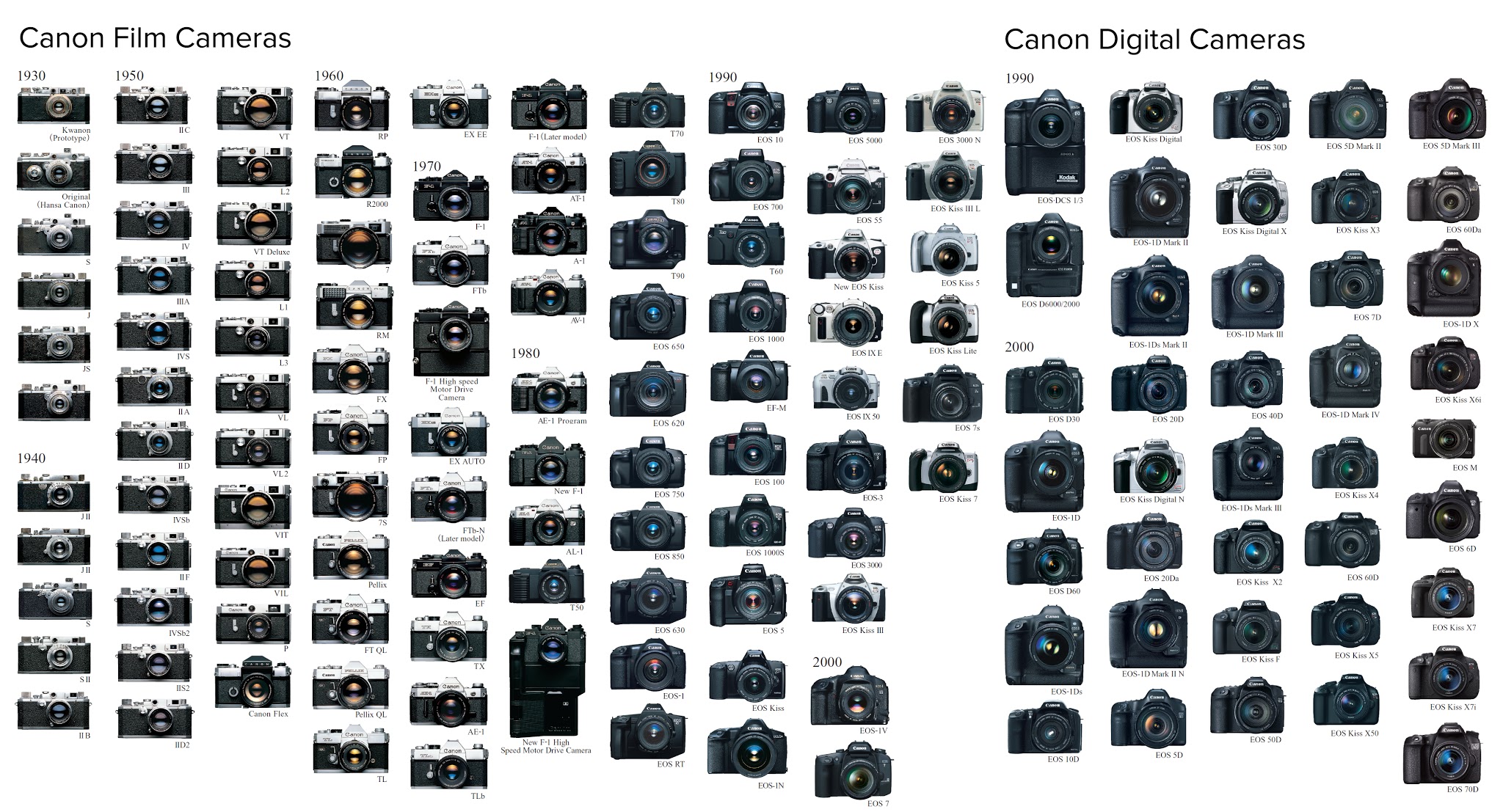
In the United States, Canon uses different naming systems for its DSLR, mirrorless, compact, and fixed-lens cameras. The name usually tells you the camera family, its market position, or its main feature—but Canon does not use one universal code for every product.
The quickest way to read a Canon camera name is to identify the product family first:
- EOS R means a Canon interchangeable-lens mirrorless camera.
- EOS DSLR names include models such as the EOS 5D, EOS 6D, and EOS Rebel series.
- PowerShot means a fixed-lens digital camera.
- PowerShot G usually identifies Canon’s more advanced compact cameras.
- PowerShot SX points to a compact camera with a long optical zoom.
- PowerShot ELPH identifies Canon’s small, pocket-style cameras.
After the family name, the number and letters usually show the camera’s class, generation, or special design. However, Canon naming is not perfectly consistent. A higher number does not always mean a newer or better camera.
The basic Canon camera naming system
Canon camera names usually contain three parts: the brand or system name, the model family, and the specific model number or suffix.
For example:
| Example | What it generally indicates |
|---|---|
| Canon EOS R5 | Full-frame mirrorless camera in the EOS R system |
| Canon EOS R50 | Entry-level APS-C mirrorless camera in the EOS R system |
| Canon EOS 90D | Advanced APS-C DSLR |
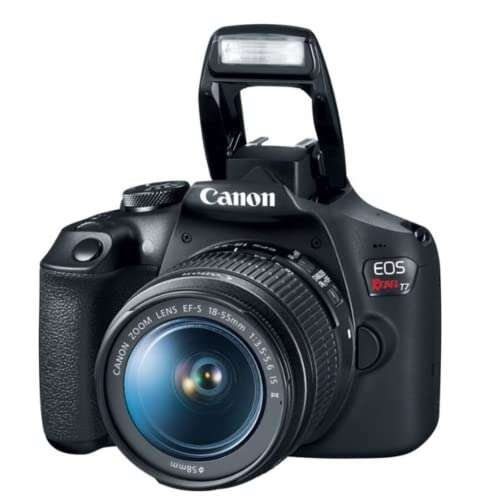
| Canon EOS Rebel T8i | Entry-level DSLR sold under the Rebel name in the United States |
| Canon PowerShot G7 X Mark III | Advanced compact camera |
| Canon PowerShot SX740 HS | Compact camera with a high optical zoom |
| Canon PowerShot ELPH 180 | Small point-and-shoot camera |
These names are useful, but they are not complete technical descriptions. For example, the “5” in EOS R5 does not mean it has five times the performance of an EOS R50. It identifies a position within Canon’s mirrorless lineup.
A camera name can tell you the family and approximate market tier. To know the sensor size, lens mount, autofocus features, video limits, or card type, you must check the official specifications.
What “EOS” means
EOS is Canon’s name for its interchangeable-lens camera system. Canon has used the EOS name for both film and digital cameras.
Today, the EOS label appears on two main types of Canon cameras:
- EOS R cameras: Mirrorless models that use the RF lens mount.
- EOS DSLR cameras: Digital single-lens reflex cameras that use the EF, EF-S, or EF-M mount, depending on the model.
The letters do not describe image quality by themselves. They identify the camera system.
What “PowerShot” means
PowerShot is Canon’s name for fixed-lens digital cameras. The lens cannot be removed, so the camera body and lens are designed as one unit.
PowerShot cameras range from simple pocket models to advanced compacts with larger sensors, bright lenses, manual controls, and RAW capture.
How Canon names EOS R mirrorless cameras
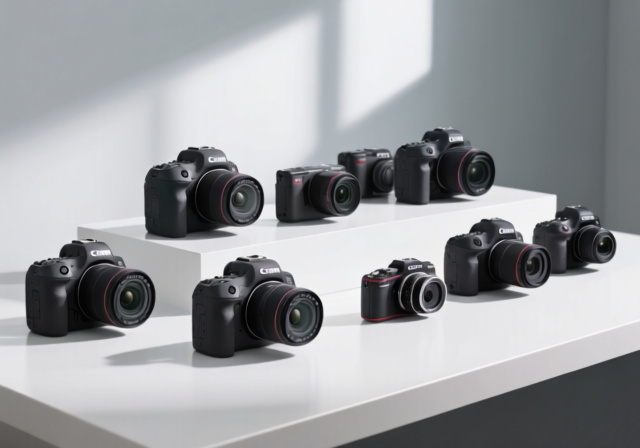
Canon’s EOS R naming system covers its current full-frame and APS-C mirrorless cameras. The most useful part of the name is the model number and any letter attached to it.
Examples include:
- EOS R1
- EOS R3
- EOS R5 Mark II
- EOS R6 Mark II
- EOS R8
- EOS R7
- EOS R10
- EOS R50
- EOS r100
the model number gives a broad idea of the camera’s position in the range. It does not act like a simple score.
What the number usually suggests
Canon’s EOS R range can be read roughly like this:
| Series | General position | Typical sensor format |
|---|---|---|
| EOS R1 | Professional flagship | Full frame |
| EOS R3 | High-end professional or action model | Full frame |
| EOS R5 | High-resolution enthusiast and professional model | Full frame |
| EOS R6 | General-purpose enthusiast and professional model | Full frame |
| EOS R8 | Smaller full-frame model | Full frame |
| EOS R7 | Advanced crop-sensor model | APS-C |
| EOS R10 | Midrange crop-sensor model | APS-C |
| EOS R50 | Entry-level crop-sensor model | APS-C |
| EOS R100 | Basic crop-sensor model | APS-C |
This table describes Canon’s broad product structure. It is not a fixed rule for every generation.
For example, the EOS R7 has a higher number than the full-frame EOS R8, but the R7 is not simply “better.” The R7 uses a smaller APS-C sensor and targets users who may value reach, speed, and a lighter system. The R8 uses a full-frame sensor and may better suit buyers who want full-frame image characteristics in a smaller body.
What the “C” suffix means
A C suffix usually identifies a cinema-focused version of an EOS R camera.
Examples include the EOS R5 C. This model combines a still-camera body with features aimed at video production, such as expanded video controls and cinema-oriented workflow options.
The letter does not mean that every C model is better for every video task. It signals a different balance between still photography, video, heat management, controls, and production needs.
What “Mark II” means
Mark II means that Canon has released a substantially updated version of an earlier model.
For example:
- EOS R6 → EOS R6 Mark II
- EOS R5 → EOS R5 Mark II
A Mark II camera may add a new sensor, faster processing, improved autofocus, stronger video features, or other changes. The exact upgrade depends on the model.
“Mark II” does not mean the camera is a completely different product family. It is a later generation of the same general model line.
Why EOS R numbers can confuse buyers
Canon uses model numbers across different sensor formats and price levels. That means a larger number does not always indicate a newer release or a more capable camera.
Compare these examples:
- EOS R5: Full-frame, high-resolution mirrorless camera.
- EOS R7: APS-C mirrorless camera with a different target user.
- EOS R50: Entry-level APS-C model.
- EOS R8: Compact full-frame model.
The safest method is to compare four things before choosing:
- Sensor format.
- Release generation.
- Main photo or video features.
- Lens and accessory compatibility.

How Canon names DSLR cameras
Canon DSLR names use several overlapping systems. The most familiar US names are the EOS Rebel, EOS xxD, EOS xD, and EOS 6D lines.
Canon EOS Rebel names
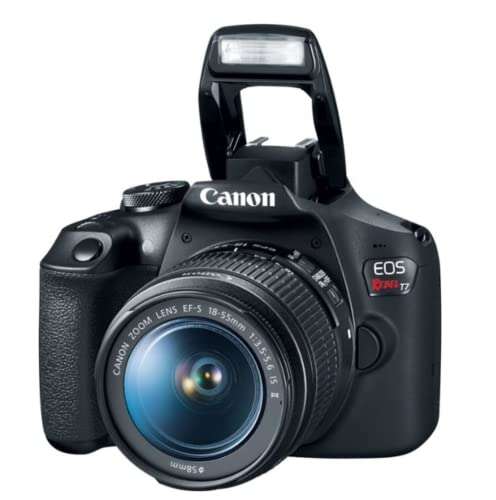
In the United States, Canon uses the Rebel name for many entry-level DSLRs.
Examples include:
- EOS Rebel T7
- EOS Rebel T8i
- EOS Rebel SL3
- EOS Rebel T7i
The letter T is part of the Rebel model name. The number identifies the specific model line, but it should not be read as a direct quality score.
A higher model number within the Rebel range may reflect a newer generation, but Canon has used different naming patterns over time. The Rebel T8i, for example, is not necessarily a direct replacement for every camera with a lower number.
The SL models, such as the Rebel SL3, emphasize a smaller and lighter DSLR body. A smaller body can be useful for travel, family photography, and casual use, but it may provide less room for controls and a smaller battery than a larger DSLR.
Canon EOS xxD cameras
Canon has used two-digit names for advanced APS-C DSLRs, including:
- EOS 70D
- EOS 80D
- EOS 90D
These models generally sit above the entry-level Rebel line. They often provide more direct controls, stronger build features, faster operation, and more advanced autofocus or video options.
The number is not a universal ranking across all Canon cameras. An EOS 90D is an APS-C DSLR, while an EOS 6D Mark II is a full-frame DSLR. The 6D Mark II has a lower number but a larger sensor.
Canon EOS xD cameras
Single-digit EOS DSLR names, such as the EOS 7D and EOS 5D, identify higher-end camera families.
Examples include:
- EOS 7D Mark II
- EOS 5D Mark IV
- EOS 1D X Mark III
Canon’s single-digit lines have served different groups:
- EOS 5D: Full-frame cameras known for high-resolution still photography and video features.
- EOS 7D: APS-C cameras designed around speed and action photography.
- EOS-1D X: Professional full-frame cameras designed for demanding sports, news, and wildlife work.
These are broad descriptions of the families. Always check the exact model because features can change sharply between generations.
What “Mark II,” “Mark III,” and “Mark IV” mean on DSLRs
The Roman numeral shows the generation of a camera family:
- Mark II = second major version.
- Mark III = third major version.
- Mark IV = fourth major version.
A later Mark model usually includes technical improvements, but it can also change the camera’s strengths. For example, a newer model may prioritize resolution or video instead of the speed or body design that some users prefer.
How Canon names PowerShot cameras
Canon PowerShot names are easier to understand when you separate the main families.
PowerShot G series
The PowerShot G line generally includes Canon’s more advanced compact cameras. These cameras have fixed lenses but often offer more control than basic point-and-shoot models.
Examples include:
- PowerShot G7 X
- PowerShot G5 X
- PowerShot G1 X
The number does not follow one simple ranking system across all G cameras. A G7 X and a G5 X can differ in lens design, viewfinder options, controls, and body shape.
The suffix often matters:
- X models commonly emphasize a bright lens and a compact design.
- G5 X models have traditionally emphasized a more camera-like body and electronic viewfinder.
- G1 X models have used a larger sensor than many other compact PowerShot cameras.
These patterns can change between generations, so the full specification sheet matters more than the number alone.
PowerShot SX series
The SX family generally identifies compact cameras with long zoom lenses.
For example, the PowerShot SX740 HS has a much longer zoom range than a small fixed-lens camera designed mainly for wide and normal views.
The SX name is useful if you want:
- Travel reach.
- Wildlife viewing in good light.
- A compact body with a built-in telephoto lens.
- One camera for many focal lengths.
Long zoom cameras involve a trade-off. The lens can reach distant subjects, but the small sensor and narrow aperture at the long end may limit image quality in low light. A long zoom number does not automatically mean better photos.
PowerShot ELPH series
The PowerShot ELPH line identifies small, simple compact cameras sold in the United States.
ELPH models are designed around portability and ease of use. Their small size can make them convenient for casual snapshots, but they usually offer less control and lower low-light performance than an interchangeable-lens camera or advanced compact model.
What “HS” means
Canon has used HS in several PowerShot names. It refers to Canon’s High Sensitivity system, which combines sensor and image-processing design intended to improve results in low light.
HS does not mean that a camera will produce noise-free images in dark conditions. It also does not replace a bright lens, a larger sensor, or a steady shooting technique.
What “IS” means
IS means Image Stabilizer. It refers to Canon’s optical image stabilization system in the lens or fixed-lens camera assembly.
Image stabilization can reduce blur caused by camera shake when the subject is still. It cannot fully stop blur caused by a moving person, animal, or vehicle.
How regional Canon names differ in the United States
Canon camera names can differ by market. A model sold in the United States may use a different name from a similar model sold in Japan, Europe, or another region.
The most familiar US example is the EOS Rebel label. Canon often uses the Rebel name in the United States for entry-level DSLR models. Other markets may use a different number-based name for a closely related camera.
This creates several common problems:
- A search result may show a model name that Canon does not use in the United States.
- A used-camera listing may combine a US name with an international name.
- A manual may cover more than one regional model.
- Accessories may have different package contents or warranty terms by region.
When buying in the US, check the exact model on the Canon USA website. Look for the full product name, not only the number.
A safe comparison process is:
- Search the complete model name.
- Confirm that the page is on Canon USA.
- Check the product support page.
- Compare the manual and specifications.
- Confirm the warranty and seller’s region.
This matters most with used cameras, imported models, and listings from large marketplaces.
How to tell whether a Canon camera is newer or better
The name alone cannot tell you which Canon camera is best. Use the name as a starting point, then compare the features that affect your work.
Check the generation
Words such as Mark II or Mark III usually show a newer generation within a camera family. A newer model may have better autofocus, processing, video, battery life, or connectivity.
Still, an older professional camera can remain more suitable for a specific task than a newer entry-level model.
Check the sensor format
Canon uses several sensor sizes:
- Full frame: Larger sensor used in many EOS 5, EOS 6, EOS R5, EOS R6, and professional models.
- APS-C: Smaller sensor used in many Rebel, xxD, EOS 7D, EOS R7, and EOS R10 models.
- Smaller compact-camera sensors: Used in many PowerShot models.
Sensor size affects more than image quality. It also affects lens size, field of view, body size, cost, and low-light performance.
Check the lens mount
Canon cameras do not all accept the same lenses.
| Canon system | Common lens mount |
|---|---|
| EOS R full-frame mirrorless | RF |
| EOS R APS-C mirrorless | RF, with RF-S lenses also available |
| Canon DSLR full frame | EF |
| Canon DSLR APS-C | EF and EF-S compatibility varies by body |
| EOS M mirrorless | EF-M |
| PowerShot | Fixed lens; no interchangeable mount |
A camera name can be correct while the lens is wrong for it. Confirm compatibility before buying.
Check the actual feature list
For a useful comparison, review:
- Sensor resolution.
- Autofocus system.
- Continuous shooting speed.
- Video resolution and frame rates.
- Viewfinder type.
- Screen movement.
- In-body image stabilization.
- Battery model.
- Memory card type.
- Wi-Fi and Bluetooth features.
- Weather-resistance details.
- Available lens adapters.
These details often matter more than the model number.
Common mistakes when reading Canon camera names
The most common mistake is treating Canon’s model numbers as a single ladder. They are not.
Mistake 1: Assuming a bigger number means a better camera
An EOS R50, EOS R7, and EOS R8 serve different purposes. The R8’s lower number does not make it inferior to the R7. It has a different sensor format and product role.
Mistake 2: Comparing DSLR and mirrorless numbers directly
An EOS 90D and an EOS R10 are not direct number equivalents. One is a DSLR and the other is a mirrorless camera. Their lenses, viewfinders, batteries, and shooting systems differ.
Mistake 3: Treating “Mark II” as the only important change
A Mark II label shows a later generation, but you still need to check what changed. Some updates improve autofocus or video while leaving other features similar.
Mistake 4: Confusing optical zoom with digital zoom
PowerShot SX cameras are known for optical zoom. Digital zoom enlarges the image through processing or cropping and usually gives less detail. Compare the optical zoom range first.
Mistake 5: Assuming every Canon camera accepts interchangeable lenses
PowerShot cameras have built-in lenses. EOS cameras use interchangeable lenses, but the mount determines which lenses fit.
Mistake 6: Ignoring the US regional name
A camera listed under an international name may be genuine but still have different support, warranty, menus, or accessories in the United States.
A simple way to decode any Canon camera name
Use this five-step method:
-
Find the main family.
Is it EOS R, EOS DSLR, EOS Rebel, PowerShot G, PowerShot SX, or PowerShot ELPH? -
Identify the camera type.
Determine whether it is mirrorless, DSLR, or fixed-lens compact. -
Read the number as a family marker.
Use it to locate the camera’s broad class, not as a universal score. -
Look for suffixes.
Mark II, C, HS, IS, and other letters may identify a generation or feature group. -
Confirm the specifications.
Check Canon USA for the sensor, mount, autofocus, video, battery, and card details.
For example, Canon EOS R7 means:
- Canon: the manufacturer.
- EOS: an interchangeable-lens camera system.
- R: the RF mirrorless system.
- 7: a specific camera family positioned toward advanced APS-C users.
It does not mean that the R7 is automatically better than every camera with a higher or lower number.
Key takeaways
- Canon uses separate naming families for EOS and PowerShot cameras.
- EOS R identifies Canon’s RF-mount mirrorless system.
- Rebel names usually identify entry-level Canon DSLRs in the United States.
- PowerShot cameras use fixed lenses.
- G generally identifies advanced compact cameras, while SX usually points to long-zoom models.
- Mark II, Mark III, and Mark IV identify later generations.
- A higher model number does not always mean a better camera.
- Sensor size, lens mount, generation, and features matter more than the name alone.
- US model names can differ from names used in other countries.
Frequently asked questions
Is Canon R5 better than R6?
Neither is simply better for everyone. The EOS R5 is aimed more at high-resolution photography and demanding video work, while the EOS R6 line generally balances resolution, speed, low-light use, and general-purpose shooting. Compare the exact generation and your main subject.
What does the “R” mean in Canon EOS R?
The R identifies Canon’s mirrorless camera system built around the RF lens mount. It is part of the EOS R system name, not a direct rating of image quality.
What does “Rebel” mean on a Canon camera?
Rebel is Canon’s US-market name for many entry-level EOS DSLRs. Similar cameras may use different names in other regions.
Are Canon EOS R and EOS M cameras the same?
No. EOS R cameras use the RF system, while EOS M cameras use the EF-M system. Their lenses and accessories are not automatically interchangeable.
Can I use an old Canon lens on a new Canon mirrorless camera?
Some Canon EF and EF-S DSLR lenses can be used on EOS R cameras with a suitable Canon mount adapter. Compatibility depends on the lens, camera body, and adapter. EF-M lenses are a separate system and are not generally interchangeable with EOS R lenses.
Does PowerShot mean the camera is basic?
No. PowerShot includes simple compact cameras and more advanced models. The G series, for example, has included compact cameras with manual controls and higher-end features.
Conclusion
Canon names its cameras by product family rather than one universal ranking system. Start with the name—EOS R, Rebel, PowerShot G, or PowerShot SX—then confirm the sensor, lens mount, generation, and features.
For a US buyer, the safest check is the official Canon USA product page and support manual. That extra step prevents the most common errors: comparing different camera systems by number, buying an incompatible lens, or mistaking an international model name for the US version.

Everett Ashford is a tech reviewer at mytechgrid.com specializing in SSDs, cameras, TVs, earbuds, headphones, and other consumer electronics. He provides honest, data-driven reviews based on hands-on testing and real-world performance analysis. Everett simplifies complex tech details to help readers make smart, confident buying decisions.