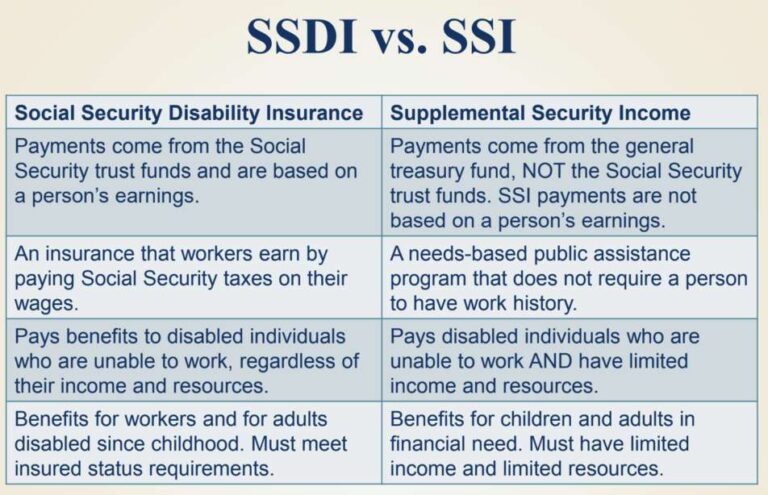
In the United States, SSDI means Social security Disability Insurance. SSI means Supplemental Security Income. People often say “SSD” as a short name for disability benefits, but SSD is not the formal name of a separate federal program.
The main difference is simple:
- SSDI is based on your work history and the Social Security taxes you paid.
- SSI is based on disability, low income, and limited resources.
- You may qualify for SSDI, SSI, or both.
The Social Security Administration (SSA) runs both programs. However, each program has different rules for eligibility, payments, health coverage, and family benefits.

SSD, SSI, and SSDI: What Do These Terms Mean?
SSDI provides monthly payments to people who have a qualifying disability and enough work credits. You earn work credits through jobs covered by Social Security.
SSI provides payments to disabled adults and children who have very low income and few resources. You do not need a work history to apply for SSI.
“SSD” is often used in everyday speech to mean disability benefits. It may refer to SSDI, SSI, or both. When you apply, identify the exact program because the rules are different.
The SSA defines disability in a strict way. Your condition generally must:
- Stop you from doing substantial work.
- Have lasted, or be expected to last, at least 12 months.
- Be expected to result in death or last for at least 12 months.
- Prevent you from adjusting to other work based on your age, education, and experience.
A short-term illness usually does not qualify for either federal program. Private disability insurance may use different rules.
SSDI vs. SSI: The Main Differences
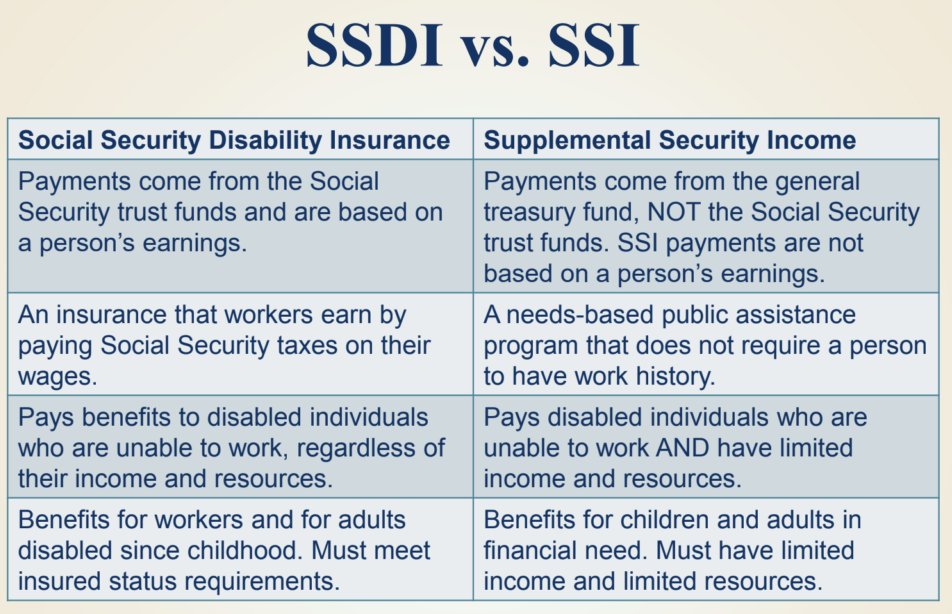
The table below shows the core differences between SSDI and SSI.
| Feature | SSDI | SSI |
|---|---|---|
| Full name | Social Security Disability Insurance | Supplemental Security Income |
| Main basis for eligibility | Disability and work history | Disability, blindness, age, income, and resources |
| Work credits required | Usually yes | No |
| Income limit | No general household asset test, but work rules apply | Strict income rules apply |
| Resource limit | No SSI-style resource limit | Generally $2,000 for one person and $3,000 for a couple, with some exclusions |
| Payment amount | Based mainly on your earnings record | Based on the federal benefit rate and countable income |
| Family benefits | May be available to certain dependents | Usually not based on a worker’s record |
| Medicare | Usually after a 24-month waiting period after entitlement | Not automatic through SSI alone |
| Medicaid | May be available under state rules | Often linked to SSI, but state rules vary |
| Funding source | Social Security payroll taxes | General federal tax revenue |
The resource limits above are long-standing federal SSI rules. Some assets do not count, such as one home you live in and, in many cases, one vehicle used for transportation. Always check current SSA rules because limits and exclusions can change.

How SSDI Works
SSDI is an insurance program for workers who become disabled. Your past work helps determine whether you have enough work credits.
You earn credits when you work and pay Social Security taxes. The number of credits needed depends mainly on your age when your disability began. Older workers usually need more credits than younger workers.
For example, a younger worker may qualify with fewer total credits if they worked recently before becoming disabled. A person who has been out of the workforce for many years may face a problem called lack of insured status.
The SSA also checks your recent work history. This is often called the recent work test. The exact rule depends on your age.
Your SSDI payment is based on your average covered earnings. It is not simply a flat disability payment. You can review an estimate through your my Social Security account.
SSDI has a five-month waiting period
SSDI usually has a five-full-month waiting period after the date the SSA finds that your disability began. Benefits normally begin in the sixth full month.
This rule can create confusion. The waiting period is based on the established onset date, not always the date you filed your application.
Some conditions have special rules. For example, people with amyotrophic lateral sclerosis (ALS) may receive faster processing and different timing under federal law.
SSDI may lead to Medicare
After you become entitled to SSDI, you usually become eligible for Medicare after a 24-month waiting period. The waiting period for Medicare is separate from the five-month SSDI waiting period.
Medicare eligibility can affect your health insurance choices. Review your notices carefully before dropping other coverage.
SSDI may provide family benefits
Some family members may qualify for benefits on your Social Security record. Possible beneficiaries can include:
- A spouse caring for your child.
- A spouse age 62 or older.
- A child under age 18.
- A child who became disabled before age 22.
- A dependent child in some cases.
Family benefits have their own rules and may be subject to a maximum family benefit.

How SSI Works
SSI is a needs-based program. It helps people who are disabled, blind, or age 65 or older and have limited income and resources.
You do not need to have worked or paid Social Security taxes to receive SSI. This makes SSI different from SSDI.
For disability-based SSI, the SSA first reviews your medical condition. It then reviews your income and resources. Both parts matter.
SSI counts more than wages
SSI may count several types of income, including:
- Wages.
- Self-employment income.
- Social Security benefits.
- Pensions.
- Unemployment benefits.
- Help with food, shelter, or living costs.
The SSA does not count every dollar in the same way. Some income exclusions apply. For example, certain portions of earned income may be excluded when SSI is calculated.
Because of these rules, earning money does not always end SSI at once. Report wages and other changes promptly to avoid an overpayment.
SSI has resource limits
A resource is something you own that could be used for support. Countable resources may include:
- Cash.
- Bank accounts.
- Stocks and bonds.
- Some property.
- Certain life insurance interests.
Common exclusions may include:
- The home where you live.
- One vehicle used for transportation.
- Some household goods and personal items.
- Certain burial funds.
The federal SSI resource limit is generally $2,000 for one person and $3,000 for a couple. Some states provide extra payments or apply different administrative rules.
SSI often connects to Medicaid
In many states, SSI eligibility also helps a person qualify for Medicaid. The process is not identical everywhere. Some states use SSI eligibility automatically, while others require a separate Medicaid application.
Contact your state Medicaid agency before assuming coverage starts on the same date as SSI.

Can You Receive SSI and SSDI at the Same Time?
Yes. A person may receive both programs. This is often called concurrent benefits.
Concurrent benefits may apply when your SSDI payment is low and you also meet SSI’s income and resource rules. SSI may help bring your income up to the applicable federal or state level.
For example, imagine a worker has enough credits for SSDI but has a low earnings record. The SSDI payment may be modest. If the person has little other income and few resources, they may also qualify for SSI.
However, SSDI usually counts as income for SSI. As a result, receiving SSDI can reduce the SSI payment. It may also make a person ineligible for SSI if total countable income becomes too high.
Receiving both programs does not mean you receive two full checks at the maximum rate.
Which Program Should You Apply For?
The right application depends on your work history, income, resources, age, and disability.
Use this basic guide:
- You worked and paid Social Security taxes: SSDI may be relevant.
- You have little income and few resources: SSI may be relevant.
- You have both a work record and financial need: You may be considered for both.
- You are 65 or older: SSI may be possible even without a disability, if financial rules are met.
- You are applying for a child: SSI is usually the main federal disability program to review.
You do not always need to choose only one program. When you contact the SSA, explain your full situation and ask which applications apply.
Check your work history
Create or review your Social Security Statement to see your reported earnings and benefit estimates. Errors in your earnings record can affect SSDI eligibility and payment estimates.
If your record is missing wages, gather documents such as:
- W-2 forms.
- Pay stubs.
- Tax returns.
- Employer records.
- Employment dates and job titles.
Gather medical evidence
Medical records should show how your condition affects your ability to work. Useful evidence may include:
- Diagnoses.
- Examination findings.
- Treatment history.
- Test results.
- Medication effects.
- Hospital records.
- Statements about work-related limits.
A diagnosis alone may not prove disability. The SSA also needs evidence about what you can and cannot do.
Apply through the SSA
You can start an SSDI or SSI application through the Social Security Administration. You may also contact the SSA by phone or visit an office.
Apply as soon as you believe you qualify. SSDI has strict timing rules, and SSI generally cannot pay benefits for periods before the application date.

How Much Do SSDI and SSI Pay?
SSDI payment amounts vary by work history. A person with higher average covered earnings may receive more than a person with lower earnings.
SSI payment amounts use a federal maximum, reduced by countable income. Some states add a supplement.
Do not rely on a random online calculator. The federal SSI rate can change each year, and your actual amount may depend on living arrangements and income.
For SSDI, your benefit estimate appears in your Social Security account. For SSI, the SSA must review your income, resources, and household situation.
Other benefits may also affect the result. For example, workers’ compensation and certain public disability payments can reduce SSDI under an offset rule. These rules are complex and depend on the type and timing of the payment.

What Happens If Your Application Is Denied?
A denial does not always end the process. Many applicants appeal.
The SSA appeal process generally includes:
- Reconsideration
- A hearing with an administrative law judge
- Review by the Appeals Council
- Federal court review
You usually have 60 days, plus mailing time, to request the next appeal after receiving a decision. Missing the deadline can create serious problems.
Read the denial notice closely. It may explain whether the issue involved:
- Medical evidence.
- Work activity.
- Insufficient work credits.
- Income.
- Resources.
- Failure to cooperate.
- A finding that you can perform other work.
A disability attorney or qualified representative may help, especially when your case involves complex medical evidence, work credits, or an appeal. You can also appeal without a representative.

Common Mistakes to Avoid
Treating SSDI and SSI as the same program
They use different financial and work rules. Applying the wrong label can lead to confusion about documents and deadlines.
Assuming a diagnosis guarantees approval
The SSA looks at functional limits, not only the name of a condition. Explain how symptoms affect sitting, standing, lifting, concentrating, attending work, and completing tasks.
Failing to report income or assets
SSI recipients must report changes such as wages, bank accounts, living arrangements, marriage, and household support. Late reporting can result in an overpayment.
Ignoring work activity rules
Working while receiving benefits may affect eligibility. SSDI has work incentives and trial work rules. SSI uses income calculations. Get advice before making major work changes.
Missing an appeal deadline
Keep the denial letter. Write down the date it arrived. If you cannot complete the appeal in time, contact the SSA at once.
Frequently Asked Questions
Is SSD the same as SSDI?
No. “SSD” is a common informal term for Social Security disability benefits. SSDI is the official name of one program. SSI is a separate program with different rules.
Can I get SSDI without a work history?
Usually not. SSDI normally requires enough recent work credits. If you lack the required work history, SSI may be the program to review.
Can I get SSI if I have never worked?
Yes. SSI does not require work credits. You must meet the disability, income, and resource rules, or be age 65 or older for age-based SSI.
Can I work while receiving SSDI or SSI?
Possibly. Both programs have work rules and incentives, but the effects differ. Report work and wages to the SSA. Do not assume that a small amount of work is automatically harmless.
Does SSI affect SSDI?
Yes. SSDI usually counts as income when the SSA decides whether you qualify for SSI and how much SSI you can receive.
Do SSDI and SSI provide health insurance?
SSDI may lead to Medicare after the required waiting period. SSI often connects with Medicaid, but state rules vary. Check with Medicare and your state Medicaid agency.

The Bottom Line
The difference between SSD and SSDI is mainly a naming issue. SSDI is a work-based disability insurance program. SSI is a needs-based benefit program.
SSDI depends on your work credits and earnings record. SSI depends on disability or age, low income, and limited resources. Some people qualify for both.
Review your Social Security work record, collect medical evidence, and contact the SSA to learn which applications fit your situation. For a denied claim, a late appeal, or a complex work and income issue, consider speaking with a qualified disability representative or attorney.

Everett Ashford is a tech reviewer at mytechgrid.com specializing in SSDs, cameras, TVs, earbuds, headphones, and other consumer electronics. He provides honest, data-driven reviews based on hands-on testing and real-world performance analysis. Everett simplifies complex tech details to help readers make smart, confident buying decisions.