
The best solar panel for Blink camera is a reliable, weatherproof charger with the right connector and enough daily sun.
A Blink camera can feel almost maintenance-free until its batteries die during a trip, storm, or busy week. A solar panel helps solve that problem by sending steady power to an outdoor camera, so you spend less time on a ladder. I reviewed the listed options for compatibility, cable reach, weather protection, mount design, power rating, and value. My goal is simple: help you find the best solar panel for Blink camera use in your yard, porch, driveway, or garden.
Rhorawill 4-Pack Solar Panels for Blink

The Rhorawill four-pack targets homes with several Blink cameras. Its listed compatibility includes Blink Outdoor 2K+, Outdoor 4, fourth-generation models, third-generation models, and XT3 cameras. That broad range makes it useful when a property has more than one camera generation. Instead of buying separate panels one at a time, you can plan a matching setup across the home.
A multi-pack also helps with camera placement. You can put one panel by the front door, one near the garage, one in the backyard, and keep an extra ready for a new camera. The panel still needs a clear view of the sky for good results. Before ordering, check the connector and camera model because Blink products do not all use the same power setup.
Pros:
- Four panels suit homes with several Blink cameras
- Broad compatibility across listed Blink Outdoor models
- Can create a more uniform camera installation
- Useful spare panel for future expansion
- May reduce repeated battery changes
- Good fit for larger homes and rental properties
Cons:
- More panels than a one-camera owner may need
- Performance depends on direct sunlight and panel angle
- Compatibility should be checked before installation
My Recommendation
I recommend this kit for homeowners who operate four compatible Blink cameras or plan to add more. It offers the best value when you need several charging points at once. The extra unit can also serve as a replacement if wind or an accidental impact damages a panel. For a single camera, however, a one-pack option may cost less and create less unused hardware.
| Best for | Why |
|---|---|
| Multi-camera homes | Four panels support several camera locations. |
| Future expansion | An extra panel stays ready for another Blink camera. |
| Matching installs | Each camera can use the same style of charger. |
4W Solar Panel for Blink Outdoor 4

This 4W solar panel is made for Blink Outdoor 4, according to its product listing. It includes a long 13.12-foot outdoor power cable, which gives you more freedom when the camera sits in shade but a nearby wall or roof gets sun. The adjustable mount helps you point the panel toward the brightest part of the sky. That detail matters because even a good panel struggles when it faces a wall or stays under thick leaves.
The IP65 rating suggests protection from dust and water jets, but it does not mean the panel should sit in standing water. The cable length can make installation easier on porches, sheds, and detached garages. I like this design for a simple, single-camera setup because it avoids the extra cost and clutter of a large multi-pack.
Pros:
- 4W output is suitable for a dedicated camera charger
- 13.12-foot cable supports flexible placement
- Adjustable mount helps improve sun exposure
- IP65 design suits normal outdoor conditions
- Simple choice for one Blink Outdoor 4 camera
- Long cable may keep the panel away from camera shade
Cons:
- Listed mainly for Blink Outdoor 4 compatibility
- Clouds and winter shade can reduce charging speed
- IP65 is not the same as full submersion protection
My Recommendation
This panel is a strong pick for someone seeking the best solar panel for Blink camera installations with one Blink Outdoor 4. The long cable is its most useful feature because the best mounting spot for a camera is often not the best spot for a solar panel. Choose it for a porch, side gate, or garage where you can place the panel several feet away. It offers a practical balance of output, reach, and easy positioning.
| Best for | Why |
|---|---|
| Single Outdoor 4 camera | The 4W design avoids buying unused panels. |
| Shaded camera locations | The 13.12-foot cable allows remote panel placement. |
| Basic outdoor installs | IP65 protection and an adjustable mount simplify setup. |
Rhorawill 5-Pack Solar Panels for Blink
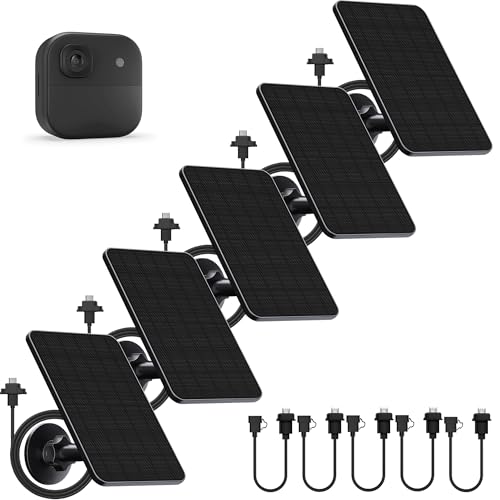
The Rhorawill five-pack is aimed at a full Blink camera network. Its listed support includes Blink Outdoor 2K+, Outdoor 4, fourth-generation, third-generation, and XT3 cameras. That range can help households with mixed camera models. A five-panel kit may also suit small businesses, farms, workshops, and large lots that need coverage at several entry points.
Buying in bulk can lower the hassle of matching different panels later. It also gives you a spare, which is helpful when a panel gets damaged or a new camera joins the system. Still, the value depends on your real needs. If you have one or two cameras, storing three unused panels may not be the most efficient choice.
Pros:
- Five-panel quantity supports large camera systems
- Works with several listed Blink Outdoor generations
- Useful for broad property coverage
- Includes spare capacity for future cameras
- Can simplify a uniform installation plan
- May reduce the cost per panel in a large setup
Cons:
- Overkill for a small one-camera system
- Requires several suitable sunny mounting spots
- Model and connector checks remain important
My Recommendation
I would choose this kit for a large property owner who wants one panel per camera. It is also a smart option for people building a five-camera Blink system over time. The broad listed compatibility adds flexibility, but I would confirm every camera model before checkout. As the best solar panel for Blink camera networks with many units, this pack stands out for quantity rather than compact design.
| Best for | Why |
|---|---|
| Large properties | Five units can cover many doors, paths, and gates. |
| New camera systems | Extra panels support future Blink purchases. |
| Mixed Blink models | The listing names several Outdoor generations. |
2-Pack Solar Panels for Blink Cameras

This two-pack is listed for Blink Outdoor 4, 2K+, third-generation, XT2, and XT cameras. That makes it one of the more flexible choices for a home with two cameras or mixed generations. Two panels can cover the front and rear of a house without leaving a large surplus. They can also work well for a driveway camera and a backyard camera.
A two-pack gives you a useful backup without forcing you to buy four or five units. It is a middle-ground option for buyers who want better value than a single panel. As with any solar charger, the panel needs a clear view of the sun, and the camera must use the correct port. Check the product details against your exact Blink model before mounting.
Pros:
- Two units suit common two-camera setups
- Listed compatibility covers several Blink models
- Provides one panel for each of two locations
- Includes a practical spare if only one camera is active
- Less waste than a large multi-pack
- Good fit for front-and-back home coverage
Cons:
- May not include enough units for a larger system
- Sun exposure controls real-world charging results
- Exact port compatibility should be confirmed
My Recommendation
This is one of the best solar panel for Blink camera options for a typical two-camera home. I like the balance between cost and coverage. It is especially useful if you have an older XT or XT2 camera beside a newer Outdoor model. Choose it when you want two matching chargers without committing to a five-pack.
| Best for | Why |
|---|---|
| Two-camera homes | One panel can serve each main camera location. |
| Mixed generations | The listing includes several Blink model families. |
| Value seekers | It offers more coverage than a single-panel kit. |
4W USB-C Solar Panel for Blink Outdoor 4

This 4W panel uses a USB-C port and includes a rubber plug, according to the listed specifications. USB-C can make the connection feel familiar to people who already use modern phones, tablets, and other devices. The included 13.12-foot cable offers useful reach around a porch or wall. Its IP65 weatherproof design is intended for normal outdoor exposure.
The rubber plug is a small but meaningful detail. A sealed connection can help keep dust and rain away from the port when installed correctly. The panel still needs careful cable routing so water does not run along the cable into the camera connection. I see this as a clean, focused option for Blink Outdoor 4 owners who prefer USB-C hardware.
Pros:
- USB-C port supports a modern connection style
- 4W rating suits a dedicated Blink camera panel
- 13.12-foot cable supports flexible mounting
- Rubber plug helps protect the connection
- IP65 design fits many exposed outdoor locations
- Good choice for a neat, simple installation
Cons:
- Designed mainly around Blink Outdoor 4
- USB-C does not guarantee universal Blink compatibility
- Panel output drops in shade or heavy cloud
My Recommendation
I recommend this model to Blink Outdoor 4 owners who want the best solar panel for Blink camera use with a USB-C connection. It is a good match for a modern camera setup and a clean cable run. The plug and weather rating add peace of mind, though correct installation still matters. Keep the connection sheltered when possible, and aim the panel toward open sky.
| Best for | Why |
|---|---|
| USB-C users | The panel uses a familiar modern port. |
| Outdoor 4 owners | The listing focuses on Blink Outdoor 4 compatibility. |
| Clean cable routing | The long cable and rubber plug support a tidy setup. |
iTODOS 7W Three-Pack Solar Panels

The iTODOS kit includes three 7W solar panels and 11.8-foot outdoor power cables. Its listed compatibility covers Blink Outdoor 4, third-generation models, XT3, 2K+, XT, and XT2 cameras. The higher stated wattage gives this kit a stronger power rating than the 4W options in this guide. That can be useful in locations with shorter useful sun periods, although no panel can make full power in deep shade.
Three panels fit a home with several key viewing zones. The adjustable mounts let you tune each panel instead of accepting one fixed angle. The cable is a little shorter than 13.12-foot designs, but 11.8 feet remains practical for most wall and porch installations. I would consider this kit when you want more output per panel and broad model coverage.
Pros:
- 7W rating provides a higher listed power level
- Three panels support multi-camera households
- Broad compatibility across older and newer Blink models
- Adjustable mounts help improve sun alignment
- 11.8-foot cables suit many standard installations
- Useful balance between single and large bulk packs
Cons:
- Higher output does not overcome heavy shade
- 11.8-foot cables may be short for distant roof mounts
- Three panels may exceed the needs of one camera
My Recommendation
The iTODOS kit is a strong candidate for the best solar panel for Blink camera systems with three active cameras. I would pick it for a home that needs broad compatibility and a higher listed wattage. It can also suit areas where the panel receives limited useful sun during part of the day. Confirm the connector and mounting location before purchase, then angle each panel toward the strongest open light.
| Best for | Why |
|---|---|
| Three-camera homes | The pack provides one charger per camera. |
| Higher output needs | Each panel carries a listed 7W rating. |
| Mixed Blink systems | The listing names many Blink generations. |
Uogw Solar Charging Mount for Blink

The Uogw product takes a different approach. It is a solar charging mount with a listed internal 3,300mAh battery, rather than only a basic panel. The listing says it is compatible with Blink Outdoor 4, XT3, XT2, and XT cameras. Its IP67 weatherproof rating suggests stronger protection against dust and water than IP65 products, provided the unit is installed as directed.
The internal battery may help bridge short periods of cloud or weak sun. That does not make the system immune to long dark winters, but it can add a useful buffer. The adjustable angle is another strong point because small changes can greatly affect daily light. This design may appeal to buyers who want a more integrated charging mount around a single camera.
Pros:
- Built-in 3,300mAh battery adds energy storage
- IP67 rating offers strong weather protection
- Adjustable angle helps tune the panel position
- Listed for several Blink Outdoor camera models
- Integrated mount may reduce installation clutter
- Useful for locations with brief cloudy periods
Cons:
- Battery capacity can decline over time
- Integrated designs may be harder to replace
- It may cost more than a basic panel
My Recommendation
I would choose the Uogw mount for people who want the best solar panel for Blink camera charging with extra storage and strong weather protection. It is a good fit for exposed walls, fences, and areas that see changing light. The internal battery is the main reason to consider it. Buyers who want the simplest and least expensive setup may prefer a standard 4W panel instead.
| Best for | Why |
|---|---|
| Cloud-prone locations | The internal battery can provide a useful short-term buffer. |
| Exposed mounting spots | IP67 protection offers added weather resistance. |
| Integrated setups | The mount and charging parts form one compact system. |
Two-Pack 4W Solar Panels for Blink Outdoor 4

This two-pack includes 4W panels, 13.12-foot outdoor cables, and 360-degree adjustable mounts. The listed compatibility focuses on Blink Outdoor 4. The full rotation range can help when the camera sits on one side of a building while the strongest sunlight comes from another. That flexibility is often more valuable than a small increase in panel size.
Two adjustable panels work well for front and side coverage. You can also use one as a spare while keeping the other active. The longer cable helps place each panel where it can see more sky. IP protection and correct cable sealing still matter, since outdoor charging hardware faces rain, dust, heat, and winter frost.
Pros:
- Two 4W panels cover two Outdoor 4 cameras
- 360-degree adjustment supports precise positioning
- 13.12-foot cables offer useful installation reach
- Spare panel adds convenience and backup value
- Good fit for front and side camera coverage
- Separate panel placement can reduce shade problems
Cons:
- Compatibility is focused on Blink Outdoor 4
- 4W output may need strong sun for best results
- Two panels require two suitable mounting locations
My Recommendation
This two-pack deserves attention from Outdoor 4 owners who need flexible mounting. The 360-degree adjustment makes it a strong choice when walls face awkward directions. I would call it the best solar panel for Blink camera buyers who value angle control over a higher watt rating. It gives you two charging points while keeping the setup fairly simple.
| Best for | Why |
|---|---|
| Two Outdoor 4 cameras | Each camera can receive its own 4W panel. |
| Awkward wall angles | 360-degree adjustment helps face the sun. |
| Backup planning | One panel can remain available as a spare. |
Three-Pack 4W Solar Panels for Blink Outdoor 4

This three-pack provides 4W solar panels for Blink Outdoor 4 cameras. Each unit includes a 13.12-foot cable and a 360-degree adjustable mount, based on the listed product details. Three panels can support a front door, driveway, and backyard camera setup. The matching design also keeps the property looking more consistent.
The long cable gives each panel room to move away from shade. The adjustable mount helps you adapt to seasonal sun changes, which is helpful because the sun sits lower in winter. A three-pack is more sensible than a two-pack when every main camera needs its own charger. Still, check whether your cameras truly match the listed model before buying.
Pros:
- Three panels suit a three-camera Outdoor 4 system
- 360-degree mounts allow detailed angle adjustment
- 13.12-foot cables offer broad placement options
- Matching panels create a neat whole-home setup
- Useful for front, driveway, and rear coverage
- Seasonal angle changes are easier to manage
Cons:
- Not ideal for a single-camera buyer
- Listed compatibility centers on Outdoor 4
- All three locations need reasonable sun exposure
My Recommendation
I recommend this kit for Outdoor 4 owners who want the best solar panel for Blink camera coverage across three outdoor zones. It offers the same useful angle control as the two-pack but adds one more charging point. This is a practical choice for a medium-size property. If your cameras use older Blink models, verify compatibility before ordering.
| Best for | Why |
|---|---|
| Three-camera coverage | Three panels match three active camera locations. |
| Seasonal sun changes | Adjustable mounts help follow the sun’s path. |
| Uniform installations | Matching panels create a clean visual layout. |
4W USB-C Solar Charger for Blink Outdoor 4

This compact 4W solar charger is listed for Blink Outdoor 4 and uses USB-C. It may suit buyers who want a focused solution without extra panels or a large accessory kit. A dedicated panel keeps the installation easy to understand. You mount it, aim it at open sun, and connect it to the compatible camera port.
USB-C is convenient, but the port alone does not prove compatibility with every Blink product. The safest method is to compare your camera model and connector with the listing before purchase. A 4W rating can work well in bright conditions, while shade, snow, dirt, and short winter days can reduce available power. Regularly wiping the panel can help preserve light intake.
Pros:
- Simple single-panel design
- USB-C connection suits newer setups
- 4W rating fits a dedicated Outdoor 4 camera
- Less hardware to mount and manage
- Good option for small homes and apartments
- Can reduce routine battery swaps
Cons:
- Limited listed compatibility
- No multi-pack flexibility for several cameras
- Cloud and shade can reduce charging performance
My Recommendation
This model is best for a buyer who needs one USB-C charger for a Blink Outdoor 4 camera. I would choose it when simplicity matters more than extra battery storage or higher output. It is a good candidate for the best solar panel for Blink camera use on a small porch or sunny wall. Keep the panel clear and confirm the port before installation.
| Best for | Why |
|---|---|
| Small homes | One compact panel supports one camera. |
| USB-C setups | The connector matches a modern charging style. |
| Simple installs | There are fewer parts to mount and route. |
How to Choose the Best Solar Panel for Blink Camera
Start with compatibility. Blink cameras can differ by generation, connector, and power needs. A panel listed for Outdoor 4 may not be the right choice for an older XT or XT2 camera. Read the complete listing, compare the model name printed on your camera, and check the plug before you buy.
Next, look at panel wattage. A 4W panel can be suitable for a basic camera charger in good sun. A 7W model may give you more power headroom, but its real output still depends on sunlight, temperature, dirt, and angle. More watts help, but placement often matters more than the number on the box.
Cable length also deserves close attention. A camera may sit under an eave while the roof edge gets direct sun. A 10- to 13-foot cable can let you move the panel into the light without moving the camera. Measure the path first, and leave a small amount of slack for clean routing.
Weather protection is another key factor. Outdoor panels face rain, dust, heat, snow, and ice. Ratings such as IP65 and IP67 describe protection against dust and water under test conditions. They do not excuse poor cable routing. Point connectors downward, use any supplied seals, and avoid low spots where water can collect.
Pay attention to the mount. A fixed mount can work on a south-facing wall with open light. An adjustable or 360-degree mount is better when trees, walls, or seasonal sun create a difficult angle. In the United States, the best direction varies by site, but direct midday light usually gives a panel its strongest daily chance.
Think about pack size. A one-pack works for one camera. A two-pack suits a front-and-back setup. Three-, four-, and five-packs make sense for larger properties or planned expansion. Buying too many panels can waste money, while buying too few can leave one camera dependent on batteries.
Installation Tips for Better Solar Charging
Choose the sunniest safe spot you can find. Look at the area in the morning, midday, and afternoon. A location that looks bright at 10 a.m. may sit in shade by lunch. Trees also change with the seasons, so leave room for branches and leaves that may block the panel later.
Keep the camera and panel close enough for a clean cable run, but do not sacrifice sunlight. Use outdoor-rated clips or ties to hold the cable against the wall. Avoid sharp bends and do not let the cable hang where wind can pull on the connector. A neat cable path is safer and easier to inspect.
Clean the panel from time to time. Dust, pollen, bird droppings, and leaves can block light. A soft damp cloth usually works for surface dirt. Do not use harsh chemicals or abrasive pads that could damage the panel face.
Give the system time to settle. Solar charging is not always instant, especially after several cloudy days. Check the Blink app and camera battery behavior over a full week. If the battery still drops, first inspect shade, angle, cable seating, and connector fit before assuming the panel has failed.
Do not treat a solar panel as a guarantee of unlimited operation. Long storms, snow cover, short winter days, and frequent camera activity can use more energy than the panel collects. A camera pointed at a busy street may wake far more often than one watching a quiet side yard. In demanding locations, a panel with a battery buffer may offer a better margin.
4W Versus 7W Solar Panels
Most shoppers ask whether they should choose a 4W or 7W panel. The simple answer is that both can work, but the best choice depends on sunlight and camera use. A 4W model is often smaller and easier to place. A 7W model provides a higher listed output and may offer more headroom in less-than-perfect conditions.
Do not assume that 7W means seven watts all day. Solar ratings describe output under test conditions, not guaranteed daily energy. A shaded 7W panel can perform worse than a clean, well-aimed 4W panel. I would choose the 7W iTODOS kit when the site has several cameras or shorter useful sun periods.
Are Solar Panels Safe for Blink Cameras?
A compatible solar panel can help maintain a Blink camera, but the connection must match the camera. Use a product made for the exact model or clearly listed model family. Do not force a plug into a port. If the connector feels loose, hot, or damaged, disconnect it and inspect the setup.
Keep water away from the connection. Even a weatherproof panel can have a vulnerable cable joint if it faces upward or sits in a puddle. Follow the maker’s instructions, protect the port, and check the cable after strong wind or heavy rain. These small steps protect both the camera and the charger.
FAQs Of best solar panel for blink camera
What is the best solar panel for Blink camera use?
The best option depends on your camera model and the number of cameras you own. For one Blink Outdoor 4, a 4W panel with a long cable is a practical choice. For several cameras, a multi-pack or the 7W iTODOS kit may offer better value.
Can a solar panel fully replace Blink batteries?
It can reduce or sometimes prevent battery changes when the panel receives strong, regular sunlight. Heavy shade, winter weather, snow, and frequent motion alerts can still drain the camera. Check battery status in the Blink app after installation.
Where should I mount a Blink solar panel?
Mount it where it receives open, direct light for much of the day. Keep it away from tree shade, roof shadows, and places where snow or leaves collect. Use an adjustable mount when the ideal angle is hard to reach.
Is a 4W panel enough for Blink Outdoor 4?
A 4W panel can be suitable for Blink Outdoor 4 when it receives good sunlight and uses the correct connector. Actual charging depends on weather, camera activity, angle, and cable condition. A 7W model gives more listed output but still needs clear sun.
Should I buy a one-pack or multi-pack?
Buy a one-pack for one camera, a two-pack for two cameras, and a larger pack for a full property system. A multi-pack can also provide a spare. Avoid buying more panels than you can place in sunny locations.
Final Verdict: Which Should You Buy?
For most homes, I would choose the 4W Blink Outdoor 4 panel with the 13.12-foot cable and adjustable mount. For several cameras, the iTODOS 7W three-pack offers stronger value and broad listed compatibility.
The best solar panel for Blink camera use is the one that matches your model and gets real sun. Confirm the connector, aim the panel well, and route the cable with care for dependable outdoor power.

Everett Ashford is a tech reviewer at mytechgrid.com specializing in SSDs, cameras, TVs, earbuds, headphones, and other consumer electronics. He provides honest, data-driven reviews based on hands-on testing and real-world performance analysis. Everett simplifies complex tech details to help readers make smart, confident buying decisions.